Open RAN is no longer a pilot. It is being deployed at commercial scale — and most engineering teams are not ready for it.
If you have been following the telecom industry in 2025 and 2026, you have probably seen two conflicting narratives. On one side: headlines about Open RAN struggles, delays, and missed targets. On the other: announcements of billion-dollar commitments and large-scale rollouts from the world’s biggest operators.
Both narratives are true. And the tension between them is exactly what this article is about.
The Real Open RAN Numbers in 2026
Let’s start with the facts — what is actually deployed, and what is planned.
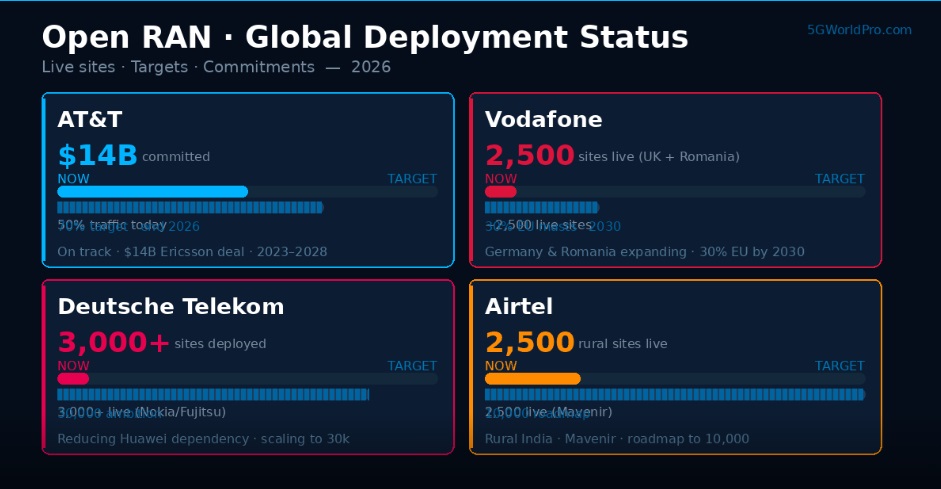
1- AT&T (USA) — $14 Billion Committed
In December 2023, AT&T signed a 5-year deal with Ericsson worth up to $14 billion — the largest Open RAN commitment by any operator in history. The target: move 70% of all wireless network traffic onto open-capable platforms by end of 2026. As of early 2026, AT&T is on track. Roughly 50% of its traffic already runs on open-capable hardware, Nokia equipment has been removed from large portions of the network, and the first Open RAN calls using third-party radios (1Finity/Fujitsu) have been completed successfully in live conditions.
2- Vodafone (Europe) — 2,500 Sites Live, 30% of European Masts by 2030
Vodafone is one of Europe’s most active Open RAN operators. Commercial deployments are live in the UK and Romania, with 2,500 sites targeted in the UK by 2027 using Samsung, Dell, Wind River, and NEC. In Germany, Vodafone has contracted Samsung for thousands of additional sites. The group’s overarching goal is to have 30% of all European masts running on Open RAN by 2030 — one of the most ambitious targets in the industry.
3- Deutsche Telekom (Germany) — 3,000+ Sites Deployed, Scaling to 30,000
Deutsche Telekom has deployed Open RAN across more than 3,000 sites in Germany, replacing Huawei equipment with Nokia and Fujitsu (1Finity) under an O-RAN Alliance-compliant architecture. This is not a full Huawei replacement across Germany — German law does not mandate a complete rip-and-replace — but it is a significant and growing Open RAN footprint. Deutsche Telekom’s ambition is to scale this to 30,000 sites, which would make it one of the largest Open RAN deployments in Europe.
4- Airtel (India) — 2,500 Live Rural Sites, Roadmap to 10,000
Bharti Airtel has deployed 2,500 Open RAN sites in rural India in partnership with Mavenir, focusing on areas where traditional macro deployments are cost-prohibitive. The contract includes an option to scale to 10,000 sites, making it a potential showcase for Open RAN in emerging markets. Airtel has also been an O-RAN Alliance board member since its founding and was the first Indian operator to validate Open RAN-based 5G in a live network.
So What Is Still the Problem?
The technology is maturing. The deployments are real. So why do operators still struggle after go-live?
The answer is not the hardware. It is not the multi-vendor interoperability. In most projects I support today, the integration works and the orchestration works.
What breaks is the human layer.
Open RAN is architecturally different from every RAN your engineers have ever operated. It is not a radio upgrade. It is a disaggregated, cloud-native system that runs on Linux containers, is managed through APIs, and is increasingly automated through AI via the RAN Intelligent Controller (RIC). Your best RF engineer from 2019 has deep knowledge of the radio layer — but Open RAN adds a cloud layer, a software layer, an API layer, and an AI layer on top of that. Those require a completely different skillset.
The team that has to troubleshoot at 2am when a container crashes, a fronthaul latency spike occurs, or a RIC feedback loop behaves unexpectedly — that team needs to be trained before the network goes live. Not after.
What Skills Does an Open RAN Engineer Need in 2026?
Based on current deployments and the O-RAN Alliance specifications, here is what a capable Open RAN operations engineer needs to master:
- Cloud-native infrastructure — Kubernetes, Docker, container lifecycle management
- O-RAN Alliance interfaces — E2, O1, A1, O2 and how they connect CU, DU, RU, RIC, and SMO
- RIC architecture — Near-RT RIC, Non-RT RIC, xApps and rApps
- 5G NR fundamentals — CU/DU/RU functional split, fronthaul (O-RAN 7.2x), timing
- Multi-vendor integration — working with hardware and software from different vendors simultaneously
- AI and automation — understanding AI-driven optimization, inference pipelines in the RAN
- Network security — zero-trust architecture applied to disaggregated RAN
- API debugging and observability — tracing issues across software-defined network layers
This is not one skill. It is a stack. And building that stack takes structured training — not on-the-job discovery during a production outage.
Three Things Operators Must Do Right Now
In every Open RAN project I have been involved with, the operators who deploy successfully share three common practices:
1. Accept the full skill requirement. Open RAN is not an incremental upgrade. Treating it as one is the most common reason teams struggle post-launch. Cloud, RF, AI, and security skills must coexist in the same team — or at minimum, in the same room.
2. Start upskilling before go-live. The best window for training is during network integration and acceptance testing. By the time the network is live and serving customers, every hour of downtime has a cost. Build the team’s readiness in parallel with the deployment, not after it.
3. Build internal expertise — do not outsource it permanently. System integrators and vendors will support your launch. But if your engineers cannot independently troubleshoot a multi-vendor Open RAN environment, you are permanently dependent. That is a strategic and financial vulnerability. The goal must be internal ownership of the knowledge.
The operators deploying successfully in 2026 did not just buy the right hardware. They built the right team first.
Where Open RAN Goes From Here
The direction is clear. The O-RAN Alliance has over 300 member companies. Ericsson and Nokia — who spent years resisting open interfaces — are now among its most active contributors. The multi-vendor RAN model is no longer a vision; it is a commercial architecture being installed in live networks today.
The next major inflection is AI-RAN — where AI inference runs natively on the baseband compute layer, enabling real-time radio optimization that was previously impossible. AT&T is already testing AI-native Link Adaptation with Ericsson. The RAN is becoming a software platform, and the engineers who operate it must think like software engineers as much as RF engineers.
For engineers and operators who invest in the right skills now, this transition is an enormous career and business opportunity. For those who wait, it is a window that is closing quickly.
Ready to Build Your Open RAN Skills?
At 5GWorldPro, we have built training programs specifically for engineers and operators working on 5G and Open RAN networks. Whether you are preparing for your first Open RAN deployment or upskilling an existing NOC team, our courses cover the full stack — from 5G NR fundamentals and O-RAN architecture to RIC, cloud-native RAN, and multi-vendor integration.
👉 Enroll in our 5G and Open RAN Training Courses and start building the expertise your network requires.
Benefit from Massive discount on our 5G Training with 5WorldPro.com
Start your 5G journey and obtain 5G certification
contact us: contact@5GWorldPro.com