Railway communications are undergoing a fundamental transformation. FRMCS (Future Railway Mobile Communication System) is the successor to GSM-R and is built on 4G LTE and 5G technologies defined by 3GPP. It is designed to support mission-critical railway operations for the next 30 years.
Unlike GSM-R (2G-based and mainly voice-centric), FRMCS enables IP-native, high-capacity, low-latency communications required for modern rail systems.
Why GSM-R Must Be Replaced
GSM-R was originally designed for:
-
ETCS signaling
-
Driver–dispatcher voice
-
Basic operational data
However, future railways require:
-
Real-time video surveillance
-
Predictive maintenance via IoT
-
Automatic Train Operation (ATO)
-
High-speed data exchange
-
Cross-border interoperability
2G technology cannot meet these performance and cybersecurity requirements.
5G FRMCS Architecture Overview
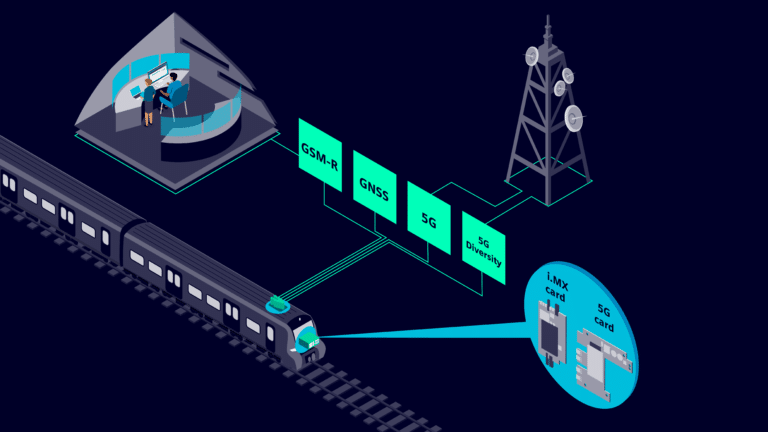
FRMCS is composed of:
1️⃣ Onboard Systems
-
5G modem
-
Multi-antenna system
-
ETCS interface
2️⃣ Trackside Network
3️⃣ 5G Core (Standalone)
A fully 5G Standalone (SA) architecture is required to enable low latency and service prioritization.
Key Technical Capabilities
Ultra-Reliable Low Latency Communication (URLLC)
-
End-to-end latency < 20 ms
-
High availability (>99.999%)
-
Required for ETCS and emergency braking
Network Slicing
Rail operators can create dedicated slices:
-
Signaling slice (highest priority)
-
MCPTT voice slice
-
Video surveillance slice
-
Passenger broadband slice
Each slice has independent QoS and isolation — a major improvement over GSM-R.
High-Speed Mobility
5G supports seamless handover at speeds above 500 km/h using:
-
Advanced mobility management
Spectrum Strategy
FRMCS may operate in:
Railways can deploy:
-
Private 5G networks
-
Shared infrastructure models
-
Hybrid public/private solutions
Migration from GSM-R
Migration will follow a phased approach:
-
Parallel GSM-R and FRMCS
-
Dual-stack operations
-
Full 5G FRMCS replacement
European transition is expected around 2030–2035.
Conclusion
5G FRMCS represents a paradigm shift from circuit-switched railway communications to a fully IP-native, mission-critical, software-defined railway network.
It enables:
-
Safer trains
-
Faster operations
-
Smarter infrastructure
-
Future-ready digital rail ecosystems
For railway operators, regulators, and system integrators, FRMCS is not optional — it is the communication layer of the next 30 years of rail transport.
Don’t miss our 5G FRMCS Training to learn more about this technology.
Benefit from Massive discount on our 5G Training with 5WorldPro.com
Start your 5G journey and obtain 5G certification
contact us: contact@5GWorldPro.com