What Is the Upper 6GHz Band and Why Does It Matter?
The U6GHz band spans 6425 to 7125 MHz, representing 700 MHz of contiguous mid-band spectrum. Industry stakeholders have long referred to it as the “golden spectrum” — and for good reason.
It sits at the sweet spot between:
- Sub-6 GHz coverage bands — wide area reach, but limited capacity
- mmWave bands — ultra-high capacity, but limited propagation range
The U6GHz band delivers both broad coverage and high throughput — precisely the combination needed to support the exploding demand from AI workloads, video streaming, industrial IoT, and immersive applications.
Under 5G-Advanced (3GPP Release 18/19), the U6GHz band is expected to support:
- Downlink speeds up to 10 Gbps
- Uplink speeds up to 1 Gbps
- Ultra-low latency for AI-driven, real-time applications
- A clear evolutionary pathway toward 6G architectures
The UAE’s U6GHz Roadmap: A Three-Year Sprint
The UAE didn’t wake up one morning and flip a switch. This commercial launch is the result of a deliberate, well-executed spectrum strategy:
| Year | Milestone |
|---|---|
| 2024 | TDRA allocates the U6GHz band (6425–7125 MHz) for mobile services |
| 2025 | Successful field trials achieve 10 Gbps speeds |
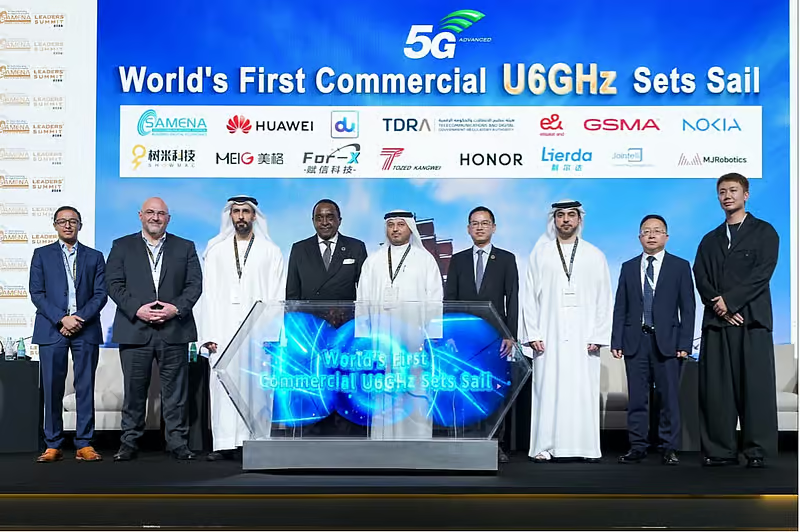
| 2026 | World’s first commercial rollout announced at SAMENA Summit |
This three-year arc from allocation → trial → commercial launch is a textbook example of how proactive spectrum governance accelerates network leadership.
Who’s Behind the Launch?
The commercial rollout was supported by a strong ecosystem of global vendors and operators:
- Huawei — RAN infrastructure and U6GHz radio units
- Nokia — network equipment and 5G-Advanced technology
- GSMA — industry body providing spectrum advocacy and standards alignment
- du — UAE operator
- e& (formerly Etisalat) — UAE operator
The involvement of both du and e& means the UAE’s U6GHz ecosystem will benefit from competitive operator deployment, accelerating real-world coverage expansion across the country.
Why U6GHz Is Critical for AI-Era Networks
The timing of this launch is not a coincidence. As AI applications migrate from the cloud to the edge, the demands on radio access networks are fundamentally changing.
Traditional 5G (sub-6 and mmWave) was designed for human-centric use cases — streaming, browsing, voice. AI-era use cases are different:
- Massive uplink requirements for real-time sensor data and video inference at the edge
- Burst throughput for AI model synchronization and distributed inference
- Sub-millisecond latency for autonomous systems and robotics
The U6GHz band addresses all three. Its combination of wide channels (up to 200 MHz per carrier in some configurations) and mid-band propagation makes it ideally suited for AI-native network architectures.
What This Means for the Region — and the World
The UAE’s move sets a powerful precedent for regulators and operators across the MENA region and beyond.
For regulators: The U6GHz allocation and commercial launch validate the WRC-23 decisions that identified the band for IMT (International Mobile Telecommunications) use. Countries that have not yet allocated this spectrum now have a clear commercial reference point to accelerate their own processes.
For operators: The 10 Gbps field trial results — now backed by commercial deployment — establish U6GHz as a credible capacity layer, not just a future roadmap item. Operators in Europe, Asia, and Africa should be revisiting their mid-band spectrum strategies right now.
For vendors: Huawei and Nokia’s co-presence at this launch signals that the U6GHz ecosystem is maturing rapidly. Expect U6GHz-capable radio units and core integrations to proliferate across RFP requirements in 2026–2027.
For 6G: Every commercial 5G-Advanced deployment on U6GHz is effectively a living testbed for 6G radio concepts — from AI-native air interfaces to spectrum co-existence studies. The UAE is building the experiential foundation that will inform 6G standardization in 3GPP Release 21 and beyond.
A Note on Spectrum Strategy
What makes the UAE case compelling from a spectrum management perspective is the speed of the value chain: from ITU/WRC alignment, to national allocation, to field validation, to commercial launch — all within roughly two years of WRC-23.
This is a model worth studying. Spectrum is only as valuable as the speed at which regulators, vendors, and operators collectively transform it into commercial services. The UAE just demonstrated that a two-year cycle from allocation to launch is achievable.
Want to Go Deeper?
Understanding the upper 6GHz band requires solid grounding in 5G NR spectrum management, 5G-Advanced features, and AI-RAN integration. At 5GWorldPro, our training courses cover exactly these topics — from spectrum fundamentals to advanced network architecture and deployment strategies.
👉 Explore our 5G training catalog at 5gworldpro.com
Benefit from Massive discount on our 5G Training with 5WorldPro.com
Start your 5G journey and obtain 5G certification
contact us: contact@5GWorldPro.com