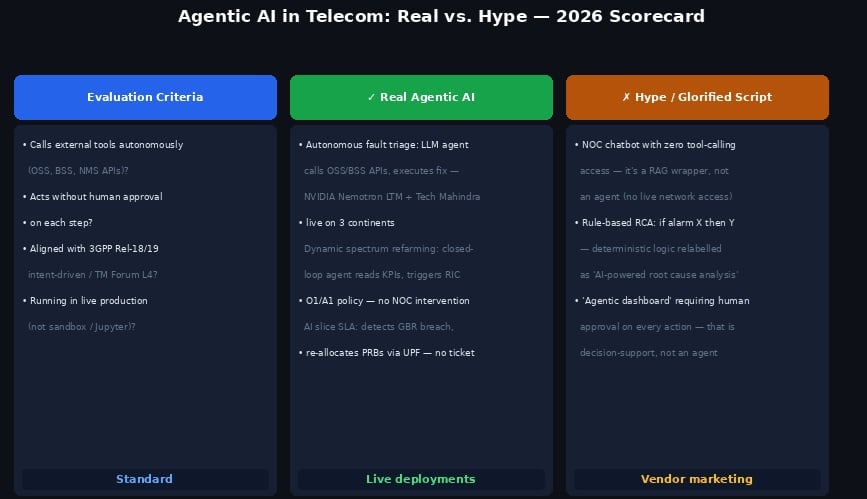
At MWC Barcelona 2026, one term dominated vendor presentations: agentic AI. Yet, beyond polished slides and controlled demos, very few implementations demonstrated true autonomy in live network environments.
This article provides a precise, engineering-level framework to distinguish real agentic AI systems from traditional automation scripts in telecom operations.
What Is an Agentic AI System?
An AI agent is not simply a script enhanced with a language model. It is a system capable of autonomous decision-making and execution within a dynamic environment.
A system qualifies as agentic only if it includes all four of the following properties:
1. Perception
The agent continuously ingests and interprets real-time network data:
- OSS alarms
- KPI streams (latency, throughput, PRB utilization)
- Topology and configuration states
2. Reasoning
The agent performs contextual analysis and decision-making:
- Correlates multiple data sources
- Handles uncertainty and incomplete inputs
- Generates action plans dynamically (not pre-coded)
3. Tool-Calling (Action Execution)
The agent can autonomously interact with external systems:
4. Feedback Loop
The agent validates outcomes and adapts:
- Measures post-action KPIs
- Confirms remediation success
- Iteratively refines decisions
If any of these four elements are missing, the system is not agentic—it is automation.
Industry Reference: NVIDIA’s Telco AI Framework
At MWC 2026, NVIDIA formalized this architecture with:
- Nemotron Large Telco Model (LTM) (~30B parameters)
- Blueprints for multi-agent NOC workflows
These systems target:
- Fault isolation
- Automated remediation
- Change validation
Deployments have already been reported in production environments such as:
- Cassava Technologies (multi-vendor networks in Africa)
- NTT Data (Tier-1 operator environments)
- Telenor Maritime
This marks a transition from assisted automation to closed-loop autonomous operations.
Three Real Agentic AI Use Cases in Telecom
1. Autonomous Fault Triage with Tool-Calling
- Detects alarm storms in OSS
- Queries BSS APIs to identify impacted subscribers
- Checks recent configuration changes via NMS
- Executes rollback automatically
Key differentiator: no human approval required per action; full closed-loop execution.
2. Dynamic Spectrum Refarming Agent
- Reads real-time PRB utilization via O-RAN O1 interface
- Combines traffic forecasts with live measurements
- Updates A1 policies to refarm spectrum (e.g., LTE → NR)
Impact: continuous, demand-driven spectrum optimization without manual planning cycles.
3. AI-Driven Slice SLA Enforcement
- Monitors QoS flows based on 3GPP TS 23.501
- Detects SLA degradation for GBR traffic
- Adjusts scheduler weights or reroutes traffic via UPF
Result: real-time SLA assurance aligned with network slicing requirements.
What Is Not Agentic AI
Despite marketing claims, many solutions fall short of true agency.
1. AI Chatbots Without Tool Access
- Use RAG over documentation
- Cannot execute actions on the network
Verdict: knowledge interface, not an agent.
2. Rule-Based RCA Disguised as AI
- Deterministic logic (IF X → THEN Y)
- LLM used only for formatting outputs
Vendors like Ericsson and Nokia do deliver real AI-RAN capabilities, but many third-party “AI NOC” tools remain rule engines with a conversational layer.
3. Traditional SON Rebranded as Agentic
- Offline optimization (e.g., overnight parameter tuning)
- No real-time interaction or iterative feedback
Examples include legacy SON frameworks such as:
- Huawei iSON
- Nokia SON
These are powerful—but they do not meet Level 4 autonomy as defined by TM Forum.
Agentic AI vs Python Script: The Core Difference
| Capability | Python Script | Agentic AI |
|---|---|---|
| Execution model | Predefined logic | Dynamic decision-making |
| Data handling | Static / batch | Real-time streaming |
| External interaction | Limited / manual triggers | Autonomous API/tool calling |
| Adaptation | None | Continuous feedback loop |
| Autonomy level | Task automation | Closed-loop autonomy |
A Practical Test for Engineers
To evaluate whether a solution is truly agentic, ask two questions:
- Does it call external tools or APIs autonomously?
- Can it act without step-by-step human approval?
If the answer to either is no, the system is not agentic—it is a script with advanced orchestration or AI-assisted logic.
Conclusion
The industry is at a critical inflection point. The shift from automation to autonomous networks is real—but still limited to a few advanced implementations.
Agentic AI is not defined by:
- The presence of an LLM
- A chatbot interface
- Or marketing terminology
It is defined by closed-loop, real-time, autonomous control of network operations.
Understanding this distinction is essential—not just to evaluate vendors, but to design the next generation of intelligent telecom systems.
Benefit from Massive discount on our 5G Training with 5WorldPro.com
Start your 5G journey and obtain 5G certification
contact us: contact@5GWorldPro.com