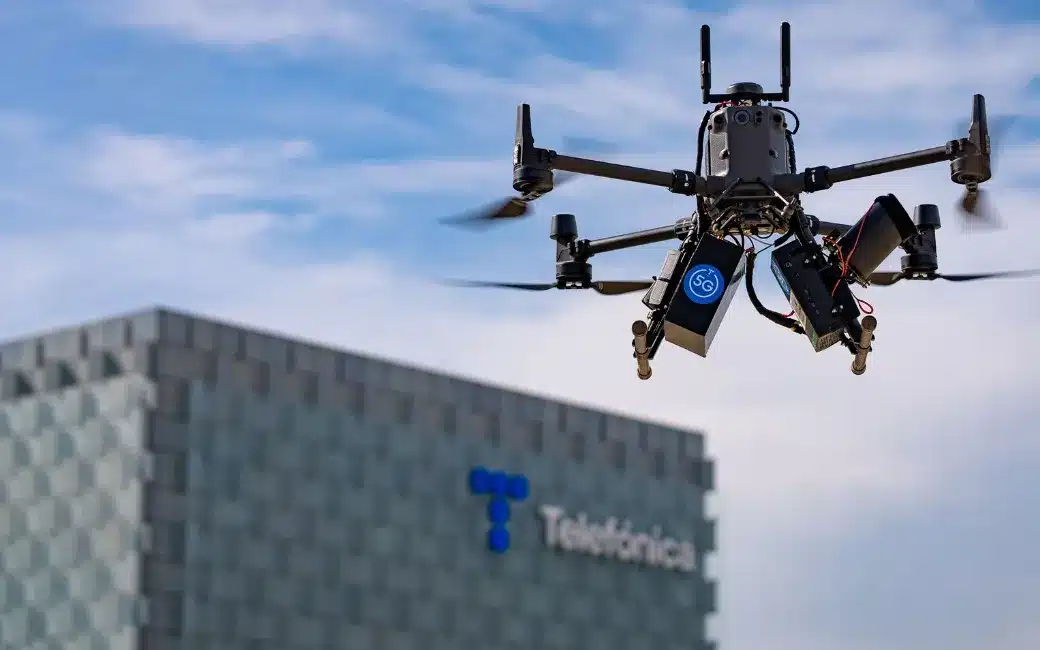
In April 2026, Telefónica launched T_Space, the first end-to-end drone-as-a-service in Spain fully operated by a telecom carrier. More than a connectivity play, it bundles 5G, multi-access edge computing (MEC), AI-driven video analytics, automated “drone-in-a-box” stations and regulated BVLOS piloting into a single commercial offer. For the wider industry, T_Space is less a product launch than a template for how 5G networks can be monetized in vertical B2B markets the use case telcos have been promising since 2019, finally productized.
What Is Telefónica T_Space?
T_Space is a managed drone service built on top of Telefónica’s 5G footprint. Instead of selling SIM cards and connectivity to drone operators, the Spanish incumbent is selling the full operational stack: aircraft, sensors, flight permits, remote pilots, real-time video, AI analytics and recharging infrastructure.
Flights are coordinated from Telefónica’s National Supervision and Operation Centre in Aravaca (Madrid) a facility in service since 1997 that has now been repurposed to command autonomous aircraft rather than switching nodes. Twelve certified remote pilots, each trained for close to a year, can each supervise up to two aircraft concurrently while receiving telemetry, HD/infrared video and meteorological feeds in real time.
This is a meaningful shift. For the first time, a tier-1 European operator is positioning itself not as a connectivity supplier to the drone economy, but as the prime contractor for it.
The Technology Stack Behind T_Space
Understanding why this matters for telcos requires unpacking how 5G, MEC and airspace regulation converge in the architecture.
1. Nationwide 5G Coverage and BVLOS Operations
T_Space relies on Telefónica’s 5G network, which the operator reports reaches roughly 95% of the Spanish population across more than 5,800 municipalities. That coverage density is what enables the most commercially valuable flight mode: BVLOS (Beyond Visual Line of Sight).
BVLOS flights are the holy grail of commercial drone operations. They remove the requirement for a pilot to physically see the aircraft, which in turn removes the economics of one-pilot-per-drone and unlocks remote, centralized operations at national scale. Telefónica claims a potential BVLOS range exceeding 500 kilometers per mission — a figure that is only defensible with continuous cellular coverage, low-latency handover and a regulator willing to certify the operational concept.
For 5G specifically, the relevant capabilities are:
- Uplink-heavy traffic profiles: drones push HD/IR video continuously. Mid-band 5G (C-band) and uplink-optimized carrier configurations matter more here than raw downlink headlines.
- Latency consistency: not peak latency, but bounded latency, so that the pilot’s control loop never stalls.
- Network slicing potential: a dedicated slice per flight mission is the natural next step, with guaranteed QoS independent of neighboring retail traffic.
2. Multi-Access Edge Computing (MEC)
Telefónica has deployed 17 proprietary edge nodes, and T_Space is one of the first retail-facing services to leverage them. Video analytics, object detection, fire signature recognition, QR inventory scanning, is latency-sensitive and bandwidth-heavy. Backhauling every frame to a central cloud would be both slow and expensive. Processing at the edge keeps round-trip times low and compresses the data that actually needs to reach the operations centre.
This is precisely the MEC monetization thesis that has struggled to find mainstream use cases in retail. Drones may be the first B2B vertical that genuinely needs it.
3. Drone-in-a-Box Infrastructure
On the ground, the physical anchor of T_Space is the drone-in-a-box (DiaB) concept. These are automated hangars distributed across Telefónica-owned sites. The aircraft docks, recharges wirelessly and waits for a mission order from Aravaca, at which point it takes off without any local human intervention.
The drones themselves are supplied by Nokia Drone Networks, a European-manufactured platform carrying HD and thermal imaging payloads, with a maximum take-off mass of around 20 kg, cruise speeds of 50–60 km/h and flight endurance near 30 minutes. The telco-vendor pairing is strategically interesting: Nokia provides the certified hardware; Telefónica provides the network, edge, pilots and commercial wrapper.
4. AI-Assisted Video Analytics
Every flight produces video, and video on its own is a cost, not a product. T_Space layers AI on top — fire detection in forest surveillance, defect recognition on power lines, object and QR tracking in warehouse inventories. This is where the service transitions from flying a camera to delivering an outcome, which is also where the billable enterprise value lives.
Two Commercial Models: FaaS and DaaS
Telefónica has packaged T_Space into two distinct offers, and the segmentation tells you how they are thinking about the market.
Flight-as-a-Service (FaaS) targets customers who already own aircraft. Telefónica provides the remote piloting, regulatory coverage and centralized operations. The customer keeps the hardware capex; Telefónica monetizes the operational layer.
Drone-as-a-Service (DaaS) is the fully managed version — hardware, sensors, analytics, flights, permits and maintenance bundled into a single subscription-style engagement. The customer pays for outcomes; Telefónica owns the full stack.
For a telco, DaaS is obviously the higher-margin, stickier model. FaaS is the foot in the door for industrial customers who have already invested in their own UAV programs and are not ready to rip them out.
Early Use Cases: Why Forests Before Pizza
The first operational deployment is in Cáceres, Extremadura, where the regional government is using T_Space drones to support emergency teams responding to forest fire alerts. Drones are dispatched to the reported coordinates and stream live 5G video to fire command centres, compressing the reconnaissance cycle from hours to minutes.
Telefónica’s broader target sectors are familiar: energy grid and pipeline inspection, industrial facility surveillance, logistics and warehouse inventory, critical infrastructure monitoring, and public administration. Notably absent: last-mile parcel delivery. That is deliberate. Anchoring the early narrative around public safety and industrial inspection rather than consumer delivery is a smart framing choice. It builds regulatory goodwill, avoids the crowded and unprofitable delivery-drone space, and positions T_Space as infrastructure rather than novelty.
Why This Launch Matters for the Wider Telco Industry
Strip away the aircraft and what Telefónica has really launched is a productized B2B vertical built on 5G + MEC + AI, sold as an outcome rather than a SIM.
That is a pattern worth studying for three reasons:
1. It monetizes 5G assets that are otherwise stranded.
Every major European operator has over-invested in 5G capacity relative to the retail ARPU uplift it has produced. Vertical services like T_Space are one of the few places where the technical uniqueness of 5G (coverage, uplink, latency, slicing) translates into a defensible margin structure.
2. It moves telcos up the value stack.
Connectivity is commodity; remote piloting, regulated airspace operations and AI analytics are not. By bundling them, Telefónica captures revenue that would otherwise flow to systems integrators, drone operators and SaaS vendors.
3. It is replicable across the continent.
Virtually every tier-1 European operator has flagged drones and UAV connectivity as strategic. Vodafone Germany, Deutsche Telekom, Orange, TIM and BT have all run BVLOS trials. What T_Space demonstrates is that the commercial packaging, not the underlying technology, is now the differentiator.
What 5G Professionals Should Watch Next
A few open questions will determine whether T_Space is a one-off showcase or a durable new telco business line:
- Regulatory scaling. BVLOS approvals are currently project-specific in most European jurisdictions. EASA’s evolving U-space framework will decide whether this model scales across borders.
- Network slicing productization. T_Space is a natural candidate for a dedicated 5G slice SLA, turning the drone service into an SLA-backed contract rather than a best-effort offer.
- 5G-Advanced and NTN integration. 5G-A features (improved uplink, positioning, reduced capability devices) directly map onto drone requirements. Longer term, non-terrestrial network (NTN) integration will be what extends services like T_Space into areas without terrestrial 5G coverage.
- AI-RAN crossover. Edge inference workloads from drone video analytics are an obvious co-tenant for AI-RAN infrastructure, a dual-use case that could improve the economics of both.
The Bottom Line
T_Space is more than a drone service. It is a commercial proof point that 5G, MEC, AI and regulated operations can be sold together, to enterprise customers, by a telco acting as the prime contractor, not just the pipe. For operators still searching for the 5G B2B use case that justifies a decade of infrastructure investment, this launch is worth studying closely.
The next question is which other European incumbent will copy the playbook first — and whether any of them can package it better than Telefónica has.
Learn with 5GWorldPro
Our live training catalog covers 5G NR, 5G SA, MEC, network slicing, NTN and AI-RAN — the exact technology stack behind services like T_Space.
👉 Browse our live 5G training programs.
Benefit from Massive discount on our 5G Training with 5WorldPro.com
Start your 5G journey and obtain 5G certification
contact us: contact@5GWorldPro.com