If you recently activated Voice over NR (VoNR) on your 5G Standalone core and noticed that call setup takes slightly longer than VoLTE did on 4G you are not alone. Many people wonder, "Why does VoNR call setup time appear longer than VoLTE?” This is one of the most reported surprises after 5G SA activation, and it is not a misconfiguration.
In this article we explain exactly why VoNR call setup involves more steps than VoLTE, what the extra signaling step is, and how operators can optimize it without compromising the richer policy control that 5G SA provides.
The Question We Get Most Often After VoNR Activation
Tech Expert: Hi Mohamed, I have a question for you.
Me: Go ahead.
Tech Expert: After activating VoNR on our 5G SA network, I noticed call setup is slightly longer than VoLTE was on 4G. Is this a misconfiguration?
Me: No — this is expected. VoNR involves more coordinated signaling steps than VoLTE. More steps, not a bug.
This exchange captures exactly what hundreds of operators experience in the field. The answer is always the same: the delay is by design. Let us explain why.
VoLTE vs VoNR — A Step-by-Step Comparison
VoLTE on 4G — the baseline
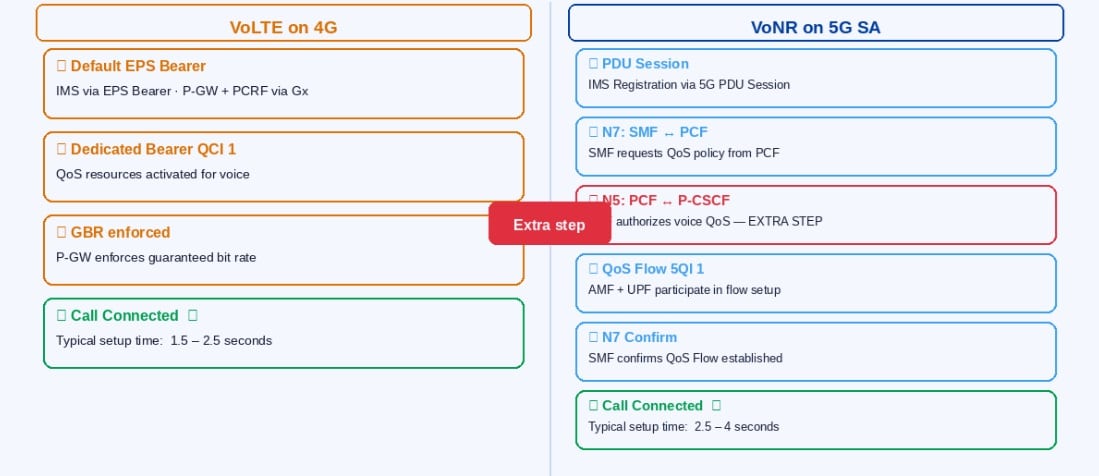
In a 4G network with IMS, the VoLTE call setup flow is well established and relies on the existing EPS bearer infrastructure:
- The UE is already registered to IMS via the default EPS bearer established at attach
- When a call is initiated, the P-CSCF requests a dedicated bearer (QCI 1) from the P-GW
- The PCRF and P-GW coordinate QoS via the Gx interface
- The dedicated bearer is established and the call connects
- ⏱ Typical call setup time: 1.5 – 2.5 seconds
VoNR on 5G SA — the additional coordination
In a 5G Standalone network, the architecture is fundamentally different. The session and policy functions are separated and this separation adds one critical signaling step:
- The UE is registered to IMS via a 5G PDU session (replacing the 4G default bearer)
- When a call is initiated, the P-CSCF signals the PCF via N5 to authorize voice QoS
- The PCF coordinates with the SMF via N7 to authorize a dedicated QoS Flow with 5QI 1
- The SMF instructs the UPF and the AMF participates in the QoS Flow modification
- Only after N5 authorization is complete can the QoS Flow be established
- ⏱ Typical call setup time: 2.5 – 4 seconds
Side-by-side comparison
| Parameter | VoLTE on 4G | VoNR on 5G SA |
|---|---|---|
| Policy interface | Gx (PCRF ↔ P-GW) | N5 (PCF ↔ P-CSCF) + N7 (PCF ↔ SMF) |
| Bearer / Flow type | Dedicated EPS bearer QCI 1 | Dedicated QoS Flow 5QI 1 |
| Functions involved | P-CSCF · PCRF · P-GW | P-CSCF · PCF · SMF · AMF · UPF |
| Extra authorization step | None | N5: PCF authorizes QoS before flow setup |
| Typical setup time | 1.5 – 2.5 seconds | 2.5 – 4 seconds |
Why Does This Extra Step Exist in 5G SA?
The N5 interface between the PCF and the P-CSCF is a deliberate architectural decision in 5G SA. In 4G, policy (PCRF) was tightly coupled with bearer management (P-GW via Gx). In 5G SA, the 3GPP architecture intentionally separates:
- Session management (SMF) from policy control (PCF)
- IMS application layer (P-CSCF) from the 5G core policy (PCF) via N5
- QoS flow authorization from QoS flow establishment
This separation gives operators much greater flexibility the PCF can enforce differentiated QoS policies per network slice, per subscriber and per application in real time. But it adds one coordination round-trip that 4G did not require.
The delay is not a performance issue. It is the price of architectural flexibility.
How to Optimize VoNR Call Setup Time
There are three proven approaches operators use to reduce VoNR call setup delay without compromising the policy control architecture:
1. Pre-establish the IMS PDU session at registration
When the UE attaches to the network, the SMF can pre-create the IMS PDU session and pre-allocate default QoS parameters. This eliminates the PDU session establishment delay from the call setup critical path entirely.
2. Pre-configure QoS policies at PCF level
Rather than triggering N5 authorization dynamically at each call, operators can pre-configure standing voice QoS policies in the PCF for IMS sessions. The PCF responds immediately on the N5 request without additional policy computation, significantly reducing the N5 round-trip.
3. Apply Reflective QoS (RQoS) for IMS sessions
Defined in 3GPP TS 23.501, Reflective QoS allows the UE to derive UL QoS parameters from DL packet marking reducing the explicit QoS Flow authorization exchange. This is particularly effective for operators with high N5/N7 signaling load.
Tech Expert: Can this be optimized?
Me: Yes. Pre-establish the IMS PDU session at registration. Pre-configure QoS at PCF level. The delay is not a bug — it is the cost of richer policy control in 5G SA.
Tech Expert: Thanks a lot.
Me: You are welcome. Please share — many teams see this behavior and assume it is a misconfiguration.
Key Takeaways
- VoNR call setup appearing slower than VoLTE is expected it is not a bug or misconfiguration
- The root cause is the N5 authorization step between PCF and P-CSCF unique to 5G SA
- The delay reflects the richer policy architecture of 5G SA compared to 4G EPC
- Optimization is achievable through pre-established IMS sessions, PCF pre-configuration and Reflective QoS
- Monitor N5 interface response times in your KPI dashboard this is where most of the delta lives
Benefit from Massive discount on our 5G Training with 5WorldPro.com
Start your 5G journey and obtain 5G certification
contact us: contact@5GWorldPro.com