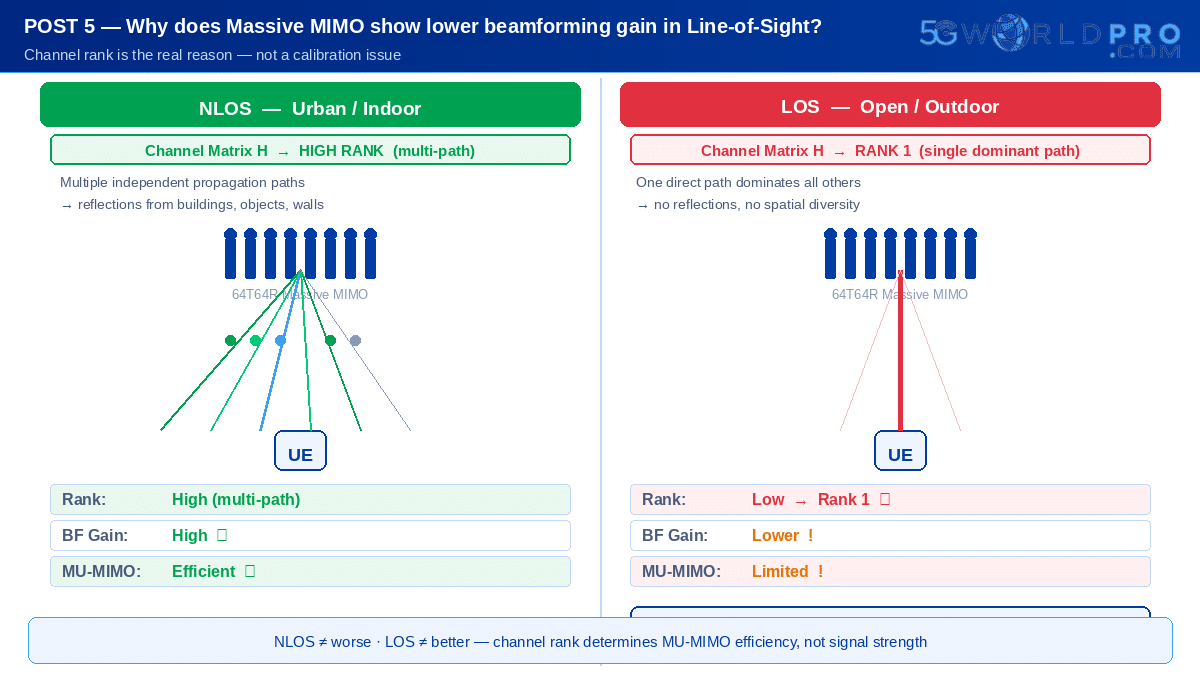
Tech Expert: Hi Mohamed, I have a question for you. Why does Massive MIMO show lower beamforming gain in line-of-sight conditions?
Me: Go ahead.
Tech Expert: Our outdoor LOS cells show lower beamforming gain than NLOS cells. Calibration issue?
Me: Not calibration. It is channel rank and it surprises most engineers. By the way, this is a classic case of why, in line-of-sight conditions, Massive MIMO often displays lower beamforming gain.
In NLOS environments:
▪️ Multiple reflections → rich channel → high rank matrix H
▪️ Beamformer focuses precisely → MU-MIMO works well ✅
In strong LOS environments:
▪️ One direct path dominates → rank 1 matrix H. That is one underlying reason why lower beamforming gain is seen for Massive MIMO in line-of-sight cases.
▪️ Spatial multiplexing collapses → single beam ⚠️
Tech Expert: So Massive MIMO is worse outdoors?
Me: Not worse, differently. Per-UE SINR is strong in LOS. But MU-MIMO efficiency drops because channels are too spatially correlated. To clarify, the lower beamforming gain with Massive MIMO you notice in LOS is precisely why this phenomenon occurs.
💡 Fix: increase minimum angular separation threshold for MU-MIMO pairing. Only pair UEs with sufficient spatial isolation.
Tech Expert: Thanks a lot.
Benefit from Massive discount on our 5G Training with 5WorldPro.com
Start your 5G journey and obtain 5G certification
contact us: contact@5GWorldPro.com