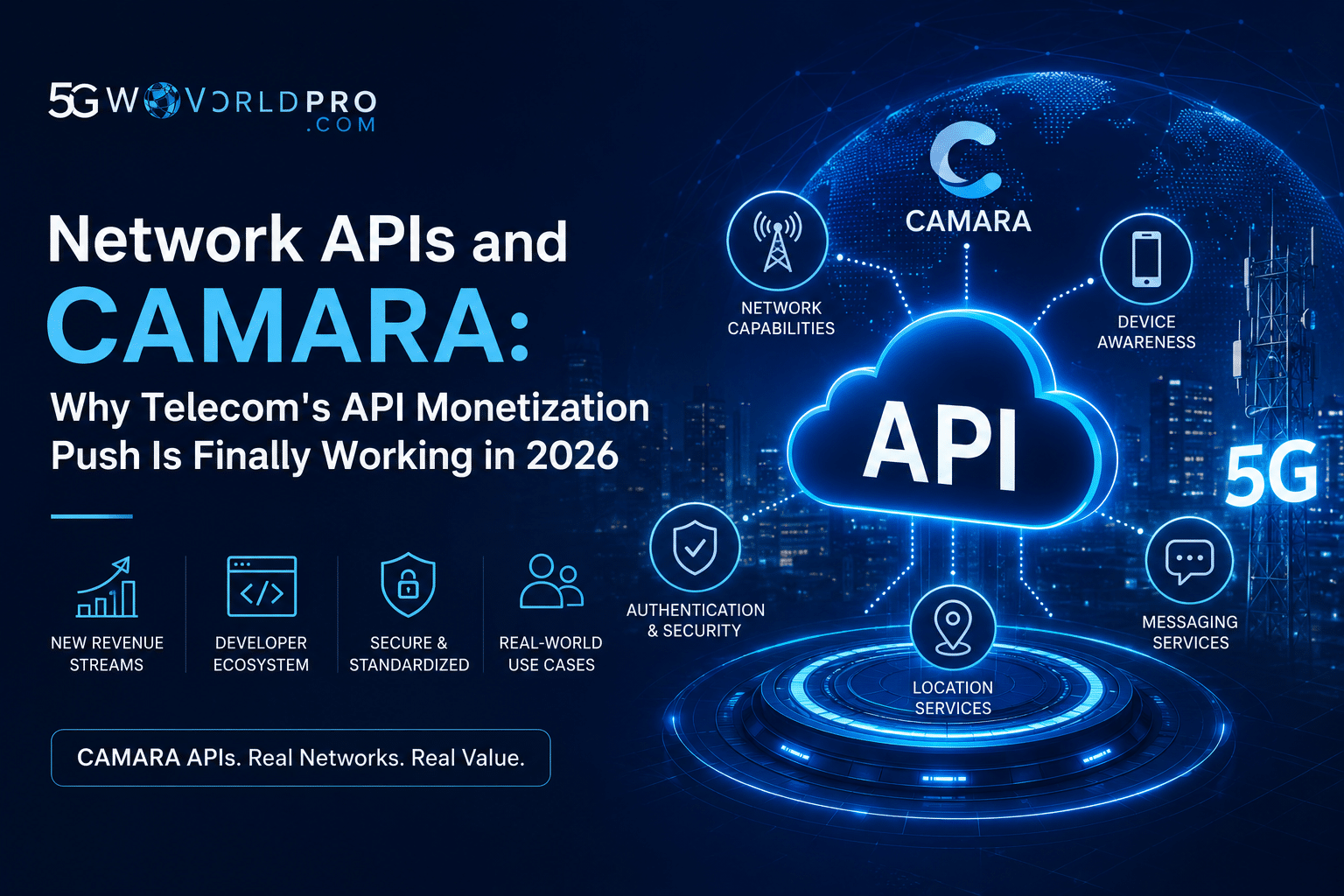
For years, “network API monetization” was one of those telecom phrases that sounded promising in a keynote and never quite showed up in a quarterly earnings call. That’s genuinely changed, and in 2026, Network APIs and CAMARA: Why Telecom’s API Monetization Push Is Finally Working in 2026 is at the forefront of industry discussions. If you want to understand Network APIs and CAMARA: Why Telecom’s API Monetization Push Is Finally Working in 2026, there are several factors driving this success. At MWC Barcelona 2026, the GSMA Open Gateway Summit opened with a blunt message from the stage the era of pilots and proof-of-concepts is over. Here’s what’s actually generating revenue, what still isn’t, and why the gap between the two matters.
From 8 APIs to a real commercial ecosystem
CAMARA the open-source project developed with the Linux Foundation that defines the actual API specifications behind GSMA’s Open Gateway initiative started in 2023 with 8 APIs. As of the most recent GSMA update, that’s grown into more than 300 instances of 20 different CAMARA APIs, commercially launched across 65 markets worldwide, from Canada to Chile and the US to New Zealand.
The Q1 2026 GSMA figures give a more granular picture: 33 certified, CAMARA-tagged released APIs (with another 40 in development), 81 operator groups and 61 channel partners representing 292 networks, covering 80% of global mobile connections. Of those, 140 API instances are commercially launched across 85 networks in 50 markets and 27 of those markets have already achieved 100% API alignment across their operators. Overall, more than 73 major mobile network operators have committed to Open Gateway, covering roughly 80% of the global mobile market.
What’s actually making money right now
This is the part that separates real traction from hype: identity verification and anti-fraud APIs are the clear commercial leaders today not the more ambitious “programmable network” APIs that get the most attention in vendor demos.
APIs like Number Verification, SIM Swap detection, Know Your Customer (identity, age, and tenure verification), and Silent Authentication are replacing older, weaker methods like SMS-based one-time passwords. The GSMA’s own Q1 2026 data shows this concretely: the industry is now close to protecting two-thirds of all mobile connections globally with commercial anti-fraud APIs. At the Open Gateway Summit, Twilio disclosed it’s processing 30.8 million API transactions per day a scale that makes clear this isn’t a pilot program anymore. In the Philippines, DITO Telecommunity, with 17 million subscribers, has highlighted the direct link between the country’s high mobile fraud rates and the need for better network-native authentication as a driver of its own adoption.
The reason this specific category took off first isn’t complicated: replacing insecure, annoying SMS one-time passwords with a carrier-verified silent authentication check is a straightforward value proposition that doesn’t require the requesting business to understand or trust anything about how the underlying network works. It’s the API equivalent of a quick win.
What’s still early: programmable network APIs
The more technically ambitious category APIs that let applications actively request network behavior changes, like Quality on Demand (QoD), Simple Edge Compute, and Device Density is real, but still in the pragmatic-early-rollout phase rather than broad commercial scale. MasOrange, for example, is launching an early access implementation of Quality on Demand in July 2026, focused specifically on one narrow, practical capability: traffic prioritization, rather than the full range of QoD’s theoretical use cases.
This split mirrors a familiar pattern in telecom technology rollouts: the simplest, most narrowly-scoped capability reaches commercial scale first, while the more architecturally demanding capabilities the ones that actually reshape how applications interact with the network in real time take meaningfully longer, even once the underlying standard exists. We saw the same pattern play out in our look at how NEF and CAMARA are reshaping 5G Standalone service exposure, which covers the architectural layer these APIs actually run on.
The honest caveat: this might not be enough on its own
Not every analysis of Open Gateway and CAMARA is purely celebratory, and it’s worth taking the more skeptical view seriously. Industry analysts have pointed out that while these APIs can help monetize network capabilities, they may not, by themselves, be enough to offset the broader ROI challenges telecom operators have faced from their 5G infrastructure investment. The frameworks and standardization are real progress, but success ultimately depends on sustained developer outreach, genuine co-creation of services with enterprise partners, and critically use cases compelling enough to resonate with end customers rather than just technically impressive demos.
That’s a meaningfully different message than “the era of pilots is over,” and both can be true simultaneously: identity and anti-fraud APIs have genuinely crossed into real commercial scale, while the broader promise of network monetization as a major new revenue pillar for operators is still being tested.
Where this connects to the AI-native network shift
Network APIs aren’t a standalone trend they’re increasingly framed as the execution layer for AI-enabled systems and contextual customer engagement, giving AI agents and applications a standardized way to actually act on network conditions rather than just observe them. That’s directly relevant to the broader AI-native network shift we’ve covered in our breakdown of AI for Network vs. Network for AI CAMARA and Open Gateway are, in effect, the standardized interface layer that lets AI-native applications actually request the network behavior they need.
What this means for telecom professionals
The clearest near-term opportunity is around identity, authentication, and anti-fraud API implementation and integration that’s where real commercial deployments and revenue already exist today, at genuine multi-market scale. The programmable network side (QoD, edge compute exposure) is where the more differentiated, harder-to-replace expertise will matter over the next few years, but it’s still early enough that deep specialization there is a bet on where the market is heading rather than where it already is.
Frequently asked questions
What is CAMARA, exactly? CAMARA is an open-source project, developed in collaboration with the Linux Foundation, that defines the actual technical specifications for the network APIs exposed through GSMA’s Open Gateway initiative things like Number Verification, Location Verification, SIM Swap, and Quality on Demand.
Which network APIs are actually generating revenue today? Identity verification and anti-fraud APIs Number Verification, SIM Swap detection, Know Your Customer checks, and Silent Authentication are the clear commercial leaders, with the industry approaching two-thirds of global mobile connections protected by commercial anti-fraud APIs.
Are programmable network APIs like Quality on Demand commercially available? They’re launching, but still in early, narrowly-scoped rollouts. MasOrange’s July 2026 Quality on Demand launch, focused specifically on traffic prioritization, is a representative example of this cautious, pragmatic early phase.
Will network APIs solve telecom’s 5G ROI problem? Not on their own, according to several industry analysts. They represent genuine new revenue potential, but success depends on sustained developer adoption and compelling end-customer use cases, not just the existence of standardized APIs.
Going deeper
If you want to understand the NEF, CAPIF, and network exposure architecture that CAMARA and Open Gateway APIs actually run on, our 5G Direct-to-Cell Training program covers exactly that.
Sources: GSMA Open Gateway (Q1 2026 update, MWC26 Open Gateway Summit coverage), Orange Developer, Amartus, IDC (“The Next Phase of Network API Monetization”), Shabodi. This article is part of our ongoing coverage of telecom monetization strategy, beyond the standards documents.
Benefit from Massive discount on our 5G Training with 5WorldPro.com
Start your 5G journey and obtain 5G certification
contact us: contact@5GWorldPro.com