The NEF, Network Exposure Function, appears in every 5G SA architecture diagram. Yet it is consistently the least explained network function in 5G SA training. Most engineers know AMF, SMF and UPF. Very few can clearly explain what the NEF does, why it matters, and what changes when CAMARA enters the picture.
This article explains exactly what the NEF does, what enterprises can request through it, and why CAMARA is the piece that transforms 5G from a faster data pipe into a programmable platform.
The Question That Comes Up on Every 5G SA Architecture Review
Tech Expert: Hi Mohamed, I have a question for you.
Me: Go ahead.
Tech Expert: The NEF is in every 5G SA diagram. But nobody explains what it actually does. Can you clarify?
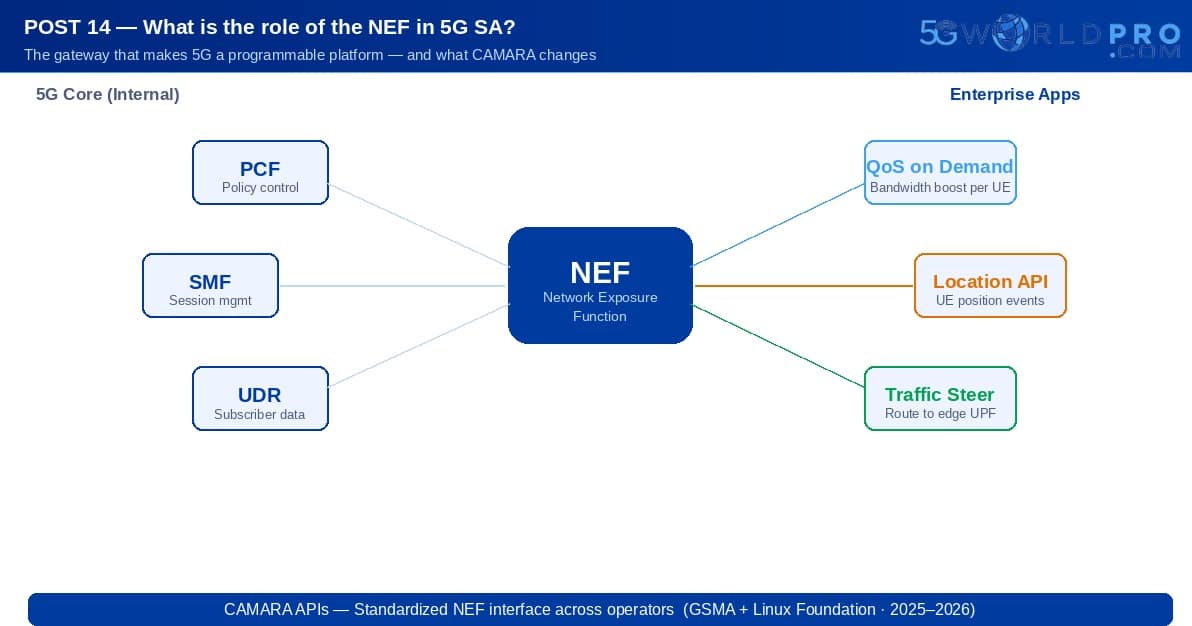
Me: The NEF — Network Exposure Function — is the gateway between the 5G core and the external world. It is what makes 5G programmable.
That last sentence is the key. The NEF is not just another internal network function. It is the interface between the telecom world and the enterprise/application world. Without the NEF, 5G SA is a closed system, powerful but inaccessible to the applications and industries it is supposed to serve.
What the NEF Actually Does
The NEF has three core functions, and understanding all three is essential:
1. Expose 5G core capabilities as APIs
The NEF takes internal 5G SA network capabilities QoS control, location, session management, slice selection and exposes them as standardized RESTful APIs (JSON over HTTP/2). External applications, enterprise systems and third-party developers can then consume these capabilities without any knowledge of the internal 3GPP architecture.
2. Translate external API calls into internal 5G core requests
When an enterprise application sends an API request — for example “boost the bandwidth for this UE”, the NEF translates that into the appropriate internal 5G SA signaling. It communicates with the PCF (via N30) to modify QoS policy, the SMF (via N29) for session parameters, or the UDR for subscriber data, all transparently from the application’s perspective.
3. Enforce security, authorization and rate limiting
The NEF is the security perimeter of the 5G core. Every external API call passes through the NEF, which verifies authorization (OAuth 2.0), enforces rate limits and validates that the requesting application has the permissions to access the requested network capability. No external entity accesses the 5G core directly, everything goes through the NEF.
NEF Interfaces in 5G SA
| Interface | Connected to | Purpose |
|---|---|---|
| N29 | SMF | Traffic influence, steer UE traffic to specific UPF or destination |
| N30 | PCF | Policy provisioning , deliver external policy to the core |
| N33 | AF (Application Function) | External app requests , QoS, location, monitoring events |
| N36 | UDR | Subscriber data provisioning from external systems |
What Enterprises Can Request via NEF APIs
The NEF exposes a growing catalog of network capabilities. Here are the most important ones for enterprise deployments in 2025–2026:
What it does: An enterprise application requests higher bandwidth or lower latency for a specific UE, in real time, without any operator intervention.
Real example: A factory automation system detects that a robotic arm is starting a precision operation. It calls the NEF API to request 5ms latency for the robot’s UE for the next 30 seconds. The NEF triggers the PCF to modify the QoS policy immediately.
What it does: An application subscribes to UE location events, entering or leaving a geographic zone, or requesting the current position of a specific UE.
Real example: A logistics company subscribes to location events for its delivery fleet UEs. When a vehicle enters a warehouse zone, the NEF sends a real-time notification — triggering automated dock door opening without any driver action.
What it does: An application requests that specific UE traffic is routed to a local edge server (edge UPF) instead of the central data center, reducing latency for latency-sensitive workloads.
Real example: A cloud gaming platform calls the NEF to request that a specific user’s traffic is steered to the nearest edge UPF. The NEF instructs the SMF via N29 to apply ULCL routing, the user’s round-trip latency drops from 40ms to 8ms instantly.
The CAMARA Problem and Why It Matters
Tech Expert: And what is CAMARA?
Me: CAMARA, GSMA + Linux Foundation, standardizes NEF APIs across operators.
▪️ Without CAMARA: each enterprise integrates differently with each operator — impossible at scale
▪️ With CAMARA (DT · Orange · Telefonica · 2025–2026): write once → works across all operators ✅
💡 This is what makes 5G a programmable platform — not just a faster data pipe.
Here is the problem CAMARA solves. Every operator has a NEF. But until CAMARA, every operator implemented their NEF APIs differently. An enterprise wanting to use QoS on Demand had to:
- Build a separate integration for each operator’s proprietary NEF API
- Maintain multiple SDKs, authentication schemes and data formats
- Re-certify and re-test with every operator and every API update
At the scale of a global enterprise — a manufacturer with factories in 12 countries, each served by a different operator — this is completely unworkable.
| Scenario | Without CAMARA | With CAMARA |
|---|---|---|
| Integration per operator | One per operator | One — works everywhere |
| API format | Proprietary per operator | Standardized — CAMARA spec |
| Authentication | Different per operator | Unified OAuth 2.0 |
| Time to integrate new operator | Weeks to months | Hours to days |
| Operators live (2025–2026) | — | Deutsche Telekom · Orange · Telefonica · Vodafone |
Why This Changes the 5G Business Model
The NEF + CAMARA combination is not just a technical detail. It fundamentally changes what operators can monetize. Without it, operators sell connectivity, a commodity where price competition is brutal. With it, operators sell programmable network capabilities, a differentiated service with API-based pricing models.
- New revenue streams: charge per API call, per QoS boost, per location event — not just per GB
- Enterprise stickiness: enterprises that integrate NEF APIs into their operations are much harder to churn than those buying raw connectivity
- Ecosystem positioning: operators become platforms — comparable to cloud providers — rather than pure transport providers
Key Takeaways
- The NEF is the gateway between the 5G core and the external world , every external API call passes through it
- It exposes, translates and secures, those are its three functions, and all three matter
- Key enterprise capabilities: QoS on demand · Location reporting · Traffic steering · Slice selection
- Without CAMARA, every enterprise needs a separate integration per operator, this kills adoption at scale
- With CAMARA, enterprises write once and run across all CAMARA-compliant operators
- NEF + CAMARA is what transforms 5G from faster connectivity into a programmable network platform
3GPP and CAMARA References
- 3GPP TS 23.501 System Architecture for the 5G System — NEF role and interfaces
- 3GPP TS 29.522 Network Exposure Function Northbound APIs
- 3GPP TS 26.531 Data Collection and Reporting — NEF event exposure
- CAMARA Project camaraproject.org — open-source API definitions (QoS, Location, Device Status)
- GSMA OPG Open Gateway initiative — operator deployment framework for CAMARA APIs
🎓 Want to master 5G SA Core architecture including NEF and CAMARA?
Our 5G SA Core Course on 5GWorldPro covers all 5G SA network functions in depth —
AMF · SMF · UPF · PCF · NEF · NSSF with real deployment scenarios and signaling diagrams.
Benefit from Massive discount on our 5G Training with 5WorldPro.com
Start your 5G journey and obtain 5G certification
contact us: contact@5GWorldPro.com