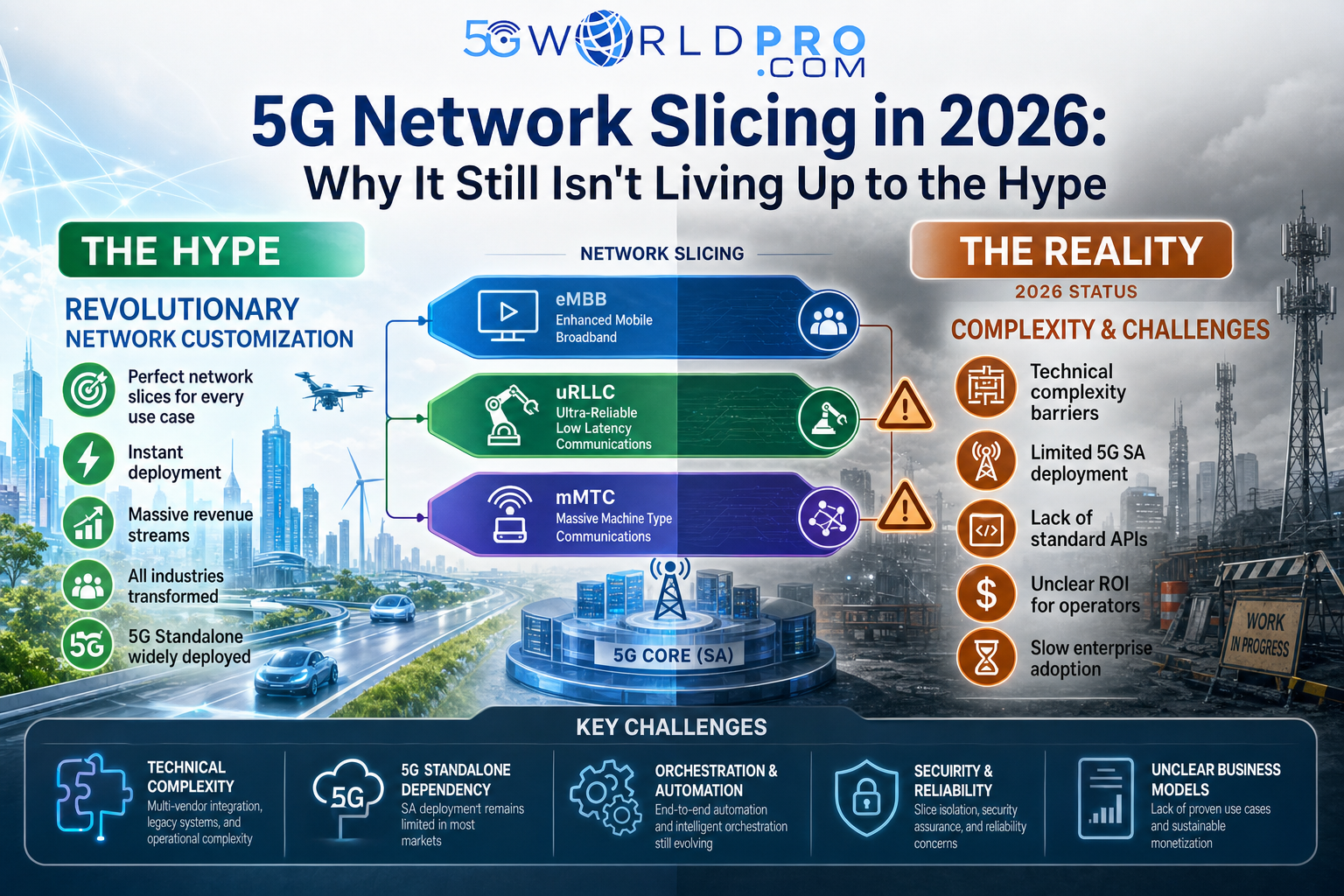
Network slicing has been one of 5G’s headline features since before commercial 5G even launched the promise that a single physical network could be carved into multiple virtual networks, each tuned for a different need: guaranteed low latency for a surgeon operating remotely, guaranteed bandwidth for a stadium full of phones, guaranteed reliability for a factory floor of robots, all running on the same infrastructure. Although 5G Network Slicing in 2026: Why It Still Isn’t Living Up to the Hype continues to be an industry topic, Android has supported app-level slicing access since 2021, iOS since 2023. And yet, as of 2026, consumer-facing network slicing remains, in the words of one industry analysis, “nearly nonexistent.” Here’s why the gap between the standard and the reality has stayed so wide, and where slicing is actually working today.
What slicing was supposed to deliver
Network slicing lets an operator carve its physical infrastructure into separate, logically isolated virtual networks each with its own performance characteristics using a combination of Software Defined Networking (SDN) and Network Function Virtualization (NFV). In principle, a single 5G network could simultaneously run a low-latency slice for autonomous vehicles, a high-bandwidth slice for video streaming, and a massive-connection-count slice for IoT sensors, all sharing the same physical radio and core infrastructure without interfering with each other.
3GPP designed the underlying standard to be vendor-agnostic meaning slicing should, in theory, work identically regardless of which vendors supply the radio access network and core. That’s the standard on paper. In practice, there’s meaningful room for vendor-specific implementation choices in the algorithms and techniques used to actually provision and manage a slice which is one of several reasons deployment has lagged the specification by years.
The market is growing fast just not where you’d expect
The global network slicing market is valued at roughly $3.96 billion in 2026, and projected to reach $223.33 billion by 2035 a 26% compound annual growth rate. That’s a real, substantial market. The catch is where that growth is actually concentrated.
| Metric | Figure |
|---|---|
| Operators reporting slicing improves bandwidth utilization by 40%+ | 65% |
| Enterprises citing integration complexity as an adoption barrier | 48% |
| New private 5G manufacturing deployments including a dedicated slice | 55%+ |
| Share of commercial SA deployments supporting slicing, by region | Asia-Pacific leads with ~42% |
| Slicing solutions provided by the top 5 telecom infrastructure vendors | ~60% |
| Market split: software vs. hardware vs. other | 62% / 28% / 10% |
The pattern is consistent across every one of these figures: slicing is working in private, enterprise, manufacturing-adjacent deployments not in consumer mobile plans. More than half of new private 5G deployments in manufacturing already include a dedicated slice. Meanwhile, the consumer use case most people associate with the technology a “VIP” streaming or gaming slice you’d request from your phone remains largely theoretical.
Why consumer slicing specifically hasn’t materialized
Device-side support isn’t the bottleneck anymore. The real gap is architectural and organizational, not technical capability alone.
End-to-end orchestration is still unsolved at scale. Delivering a slice with a guaranteed experience requires coordination across the network, the application layer, device OS, and management/orchestration systems simultaneously. Industry analysis puts genuine end-to-end architecture the kind needed for a true application-requested, on-demand slice still two to three years away, a timeline that has held roughly steady for several years running as each “two to three years” estimate gets revised forward.
Enterprises don’t trust shared public infrastructure yet. Manufacturers and other enterprise users remain cautious about network slicing specifically because it typically runs on public network infrastructure, and these customers prioritize security and reliability above the flexibility slicing offers. That caution is a major reason enterprise slicing adoption is expected to take longer to materialize than analysts originally modeled, despite enterprise being exactly the segment where slicing already works best in its simpler forms.
SLA and QoS guarantees are harder to operationalize than to specify. Implementing genuine Service Level Agreements and Quality of Service guarantees across a shared, virtualized infrastructure has proven considerably more complex in practice than the standard made it sound a recurring theme across 5G features generally, and one we’ve seen play out similarly in our honest look at where Open RAN’s promised cost savings actually stand.
Where slicing is quietly succeeding right now
The realistic near-term win isn’t the dynamic, application-requested slice most marketing materials describe it’s something considerably simpler: private 5G networks operating as a static slice of public infrastructure, provisioned at the SIM or eSIM profile level rather than negotiated per-application in real time. That’s a meaningfully lower bar technically, since it doesn’t require the full application-to-orchestration pipeline that consumer-facing dynamic slicing needs and it’s exactly the segment already showing real adoption in manufacturing.
This is also where the eSIM infrastructure we’ve covered separately becomes directly relevant: provisioning a static private slice at the SIM profile level depends on the same Remote SIM Provisioning infrastructure carriers are already building out for consumer eSIM and iSIM adoption. See our breakdown of what’s actually changing as carriers go eSIM-only for the infrastructure side of that connection it’s not a coincidence that both trends depend on the same underlying provisioning capability maturing at the same time.
What this means for telecom professionals
If you’re building expertise around network slicing, the practical opportunity right now is heavily weighted toward the private, static, enterprise-slice model not the consumer dynamic-slicing use cases most explainer content still leads with. Orchestration and lifecycle management skills matter more than ever, but the deployments actually paying for that expertise today are manufacturing and enterprise private networks, not consumer mobile plan tiers.
Frequently asked questions
Is 5G network slicing actually being used anywhere in 2026? Yes, but mostly in private enterprise and manufacturing deployments more than 55% of new private 5G manufacturing deployments include a dedicated slice. Consumer-facing dynamic slicing remains largely unrealized.
Why hasn’t consumer network slicing happened yet, if phones have supported it since 2021–2023? Device-side API support was never the bottleneck. The gap is end-to-end orchestration across network, application, device, and management layers simultaneously analysts have consistently estimated this is two to three years away, a timeline that keeps rolling forward.
Does network slicing require 5G Standalone (SA)? Effectively, yes, for the full capability. Meaningful slicing depends on the cloud-native, software-defined architecture that SA enables it doesn’t work the same way over NSA anchored to a 4G core.
What’s the easiest, most realistic form of network slicing to deploy today? A static private slice of public infrastructure, provisioned at the SIM/eSIM level, rather than a dynamic slice requested per-application in real time. This is considerably simpler than full orchestrated slicing and is already seeing real enterprise adoption.
Going deeper
If you want to understand the SA architecture, orchestration, and private network fundamentals that make real network slicing deployments work, our 5G Direct-to-Cell Training program covers exactly that.
Sources: ABI Research, Business Research Insights, Forrester (“The Future of 5G Network Slicing” and “Apple Brings 5G Network Slicing Closer to Reality”), IEEE Xplore, Cognixia. This article is part of our ongoing coverage of where 5G promises meet deployment reality.
Benefit from Massive discount on our 5G Training with 5WorldPro.com
Start your 5G journey and obtain 5G certification
contact us: contact@5GWorldPro.com