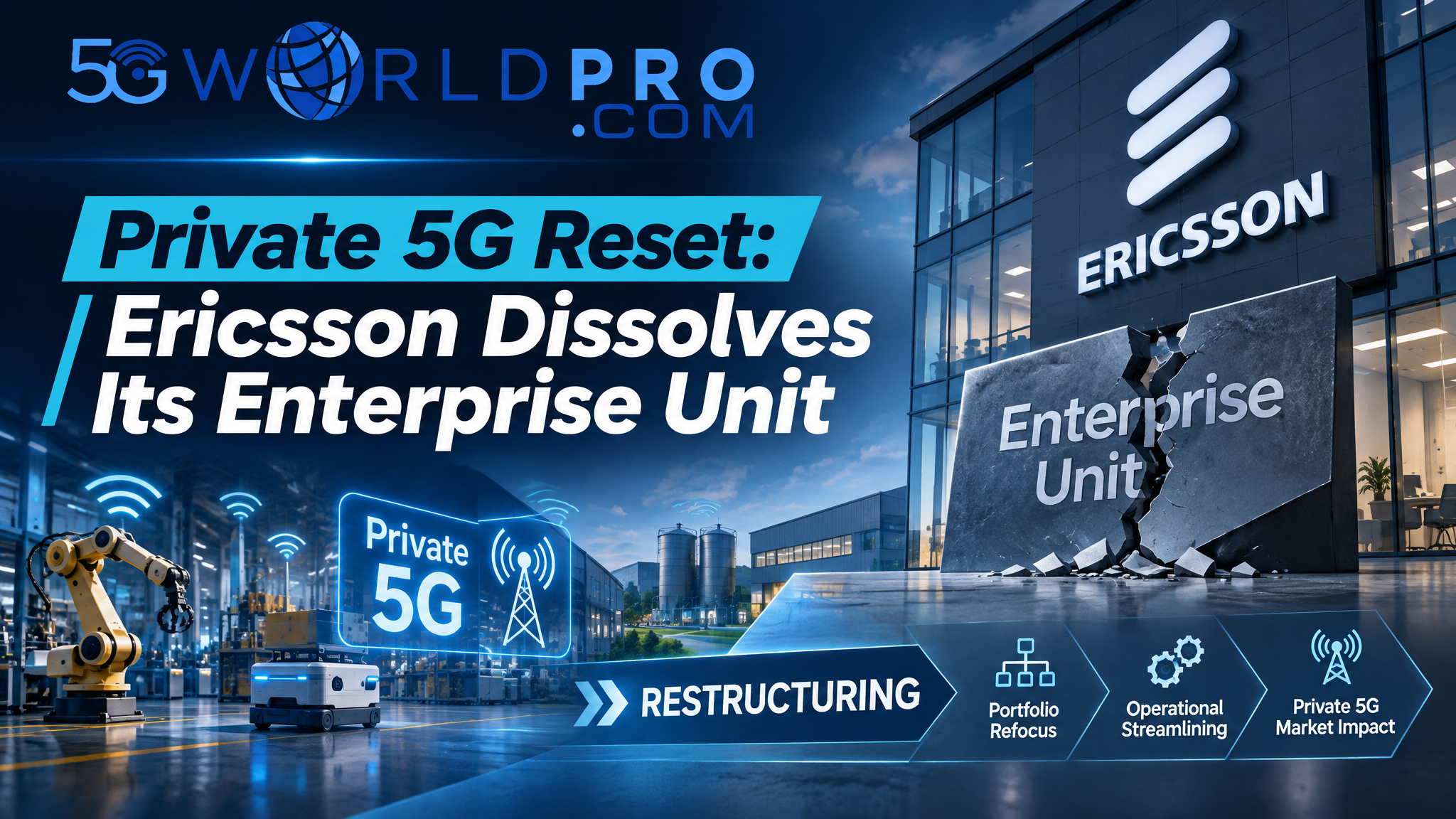
Private 5G is entering a more disciplined phase, and Ericsson’s latest reorganisation shows it. With its third-quarter results in mid-October 2026, Ericsson announced that it will dissolve its Business Area Enterprise Wireless Solutions as a standalone unit and redistribute the portfolio. Private 5G and neutral host solutions move into Business Area Networks, while the Wireless WAN activity stays separate. The company keeps the products, but removes the separate business structure around them.
What Ericsson Changed in Its Enterprise Wireless Business
The former unit combined the Cradlepoint wireless WAN business with Ericsson’s private 5G and neutral host offerings. According to ARC Advisory Group, the aim is to place those activities where they can scale, capture synergies and reuse R&D. Moving private 5G and neutral host into Networks also consolidates Ericsson’s indoor technology work.
Importantly, Ericsson frames the move as a way to accelerate the path to profitability. Commentary from the IEEE ComSoc technology blog reads that as an implicit admission that the standalone enterprise structure had not delivered the expected returns. Meanwhile, RCR Wireless notes the focus on indoor R&D, including indoor connectivity with satellite-style systems.

Private 5G Reset Key Facts
| Detail | Fact |
|---|---|
| Announcement | Mid-October 2026, with Ericsson’s Q3 results |
| Unit dissolved | Business Area Enterprise Wireless Solutions (BEWS) as a standalone unit |
| Private 5G | Moves to Business Area Networks |
| Neutral host | Moves to Business Area Networks, consolidating indoor technology |
| Wireless WAN | Remains a standalone activity |
| Stated goal | Accelerate the journey to profitability, with R&D and commercial scale |
| Precedent | Nokia sold its Enterprise Campus Edge business to AURELIUS |
| Market context | Private networks compete with mature, cheaper Wi-Fi (Dell’Oro) |
Why Private 5G Needed a Reset
Private cellular networks must compete with Wi-Fi solutions that are already mature, less expensive and sufficient for many enterprise needs. Analysts at Dell’Oro describe that pressure, and it explains why standalone private 5G units struggled to reach the growth once projected. Consequently, vendors are folding the technology back into their core network and indoor portfolios, where it can borrow scale from macro RAN.
Neutral host gains importance in this shift. Shared in-building coverage for several operators in venues, campuses and enterprise sites looks like a more scalable route than a one-off private network for each customer.
Operators Keep Building, Even as Vendors Reorganise
The vendor story is not the whole market. According to TelecomLead, Verizon Business completed a private 5G deployment across five Thames Freeport sites on 10 November for industrial AI and automation. In MENA, ADNOC and e& built a private network across about 11,000 square kilometres, and Inwi, China Mobile and Huawei announced Morocco’s first private industrial 5G network in April 2026.
These projects show demand where connectivity is critical and coverage is hard. However, GSMA Intelligence notes that most operators do not disclose private 5G revenue separately, so the commercial return remains difficult to verify. Our guide to the real ROI numbers for private 5G covers how to measure it.
What Buyers Should Check Now
Enterprises running or planning networks can use the reorganisation as a prompt for due diligence. Ask which product lines and releases are committed, who provides integration and support, and how upgrades to future 5G-Advanced features are handled. Compare the cost of a dedicated network with Wi-Fi and neutral host for the same coverage and reliability needs, and keep the decision tied to a measurable business outcome.
What This Means for the Industry
Private 5G is becoming an infrastructure feature rather than a standalone product line. When both Ericsson and Nokia restructure their enterprise offers within a few months, the signal is that the market rewards integration with the broader network, not a separate business.
Enterprise buyers should ask about roadmap and support continuity. Ericsson says the units keep full focus on customers and partners, but integration can reduce dedicated attention to niche requirements. Buyers with long-lived deployments should therefore confirm product commitments and upgrade paths in writing.
The next proof point is customer outcomes, not reorganisations. Deployments that show measurable productivity or safety gains will keep the category alive, while the rest will migrate to Wi-Fi or neutral host. Watch operator-led projects and disclosed returns over the coming quarters.
Going Deeper
Understanding when private 5G beats Wi-Fi, how neutral host works and how enterprise networks connect to the 5G core is exactly the kind of context covered in our 5G training courses and across the full 5G training catalog.
Benefit from Massive discount on our 5G Training with 5WorldPro.com
Start your 5G journey and obtain 5G certification
contact us: contact@5GWorldPro.com