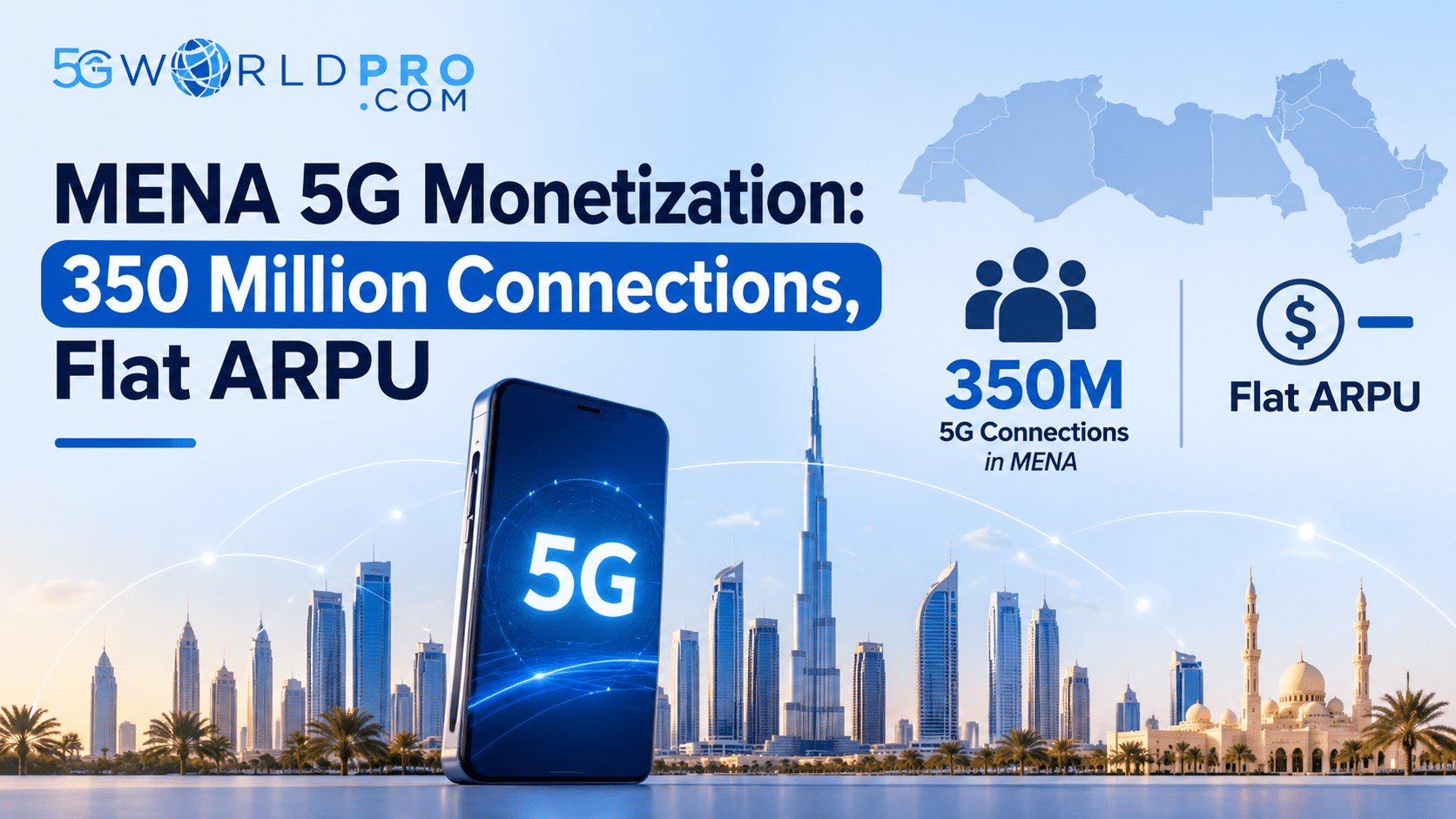
MENA 5G monetization is now the central question for operators in the Middle East and North Africa. According to a November 2026 report from GSMA Intelligence, 5G connections in the region are forecast to grow from 67 million in 2025 to nearly 350 million by 2030, while operators plan to invest $53 billion between 2026 and 2030 in coverage, standalone cores and 5G-Advanced. However, mobile ARPU across MENA has stayed broadly flat since the first commercial 5G launches in 2019. Growth in subscribers is therefore not the same thing as growth in revenue.
What the GSMA Intelligence Report Says About MENA 5G Monetization
The report, covered by TelecomLead, focuses on operators such as STC, e&, Du, Ooredoo, Zain and Turkcell. Its message is that years of spending on spectrum, coverage and network modernisation have not yet translated into higher average revenue per user.
Moreover, the investment programme follows several years of heavy spending. Türkiye’s 2025 spectrum auction alone raised more than $3 billion, and the next $53 billion must be financed while revenue growth remains subdued. The full analysis is available in the GSMA Intelligence report.
Why Flat ARPU Is the Core Problem for MENA 5G Monetization
Traditional data-volume pricing still dominates, and unlimited plans plus competitive tariffs limit how much operators can charge extra for 5G. Consumption is rising fast, with the GCC averaging 30 GB per active connection in 2025 compared with 13.5 GB globally, and a forecast of 54 GB by 2030. Heavier usage without higher prices raises costs faster than revenue.
Consequently, GSMA Intelligence points to alternatives to charging for 5G access alone: differentiated broadband, content bundles, guaranteed network performance and enterprise services. Operators are also testing speed-based tariffs, gaming packages and network slicing. The shift from non-standalone to standalone 5G is described as a major requirement for revenue from slicing, private wireless and managed enterprise services.
MENA 5G Monetization Key Facts
| Detail | Fact |
|---|---|
| 5G connections | 67 million in 2025 to nearly 350 million by 2030 (GSMA Intelligence) |
| Operator investment | $53 billion in 2026 to 2030 for coverage, standalone cores and 5G-Advanced |
| ARPU trend | Broadly flat since first 5G launches in 2019 |
| GCC adoption | 95% forecast by 2030, versus 56% global average |
| Standalone 5G | 11 operators across the six GCC markets offered commercial SA by September 2026 |
| Market availability | Commercial 5G in 17 of 24 MENA markets by September 2026 |
| FWA offered | 36 of 56 commercial 5G networks (64%) by September 2026 |
| Saudi Arabia FWA | About 20% of broadband connections |
| Du (UAE) FWA | 18% year-on-year growth, target of 40% of broadband market by 2027 |
| Private 5G disclosure | Most operators do not report private 5G revenue separately |
FWA and Private 5G: Where MENA 5G Monetization Could Come From
Fixed wireless access is described as one of the strongest MENA 5G monetization routes. It lets operators earn broadband revenue from existing 5G infrastructure, especially where fibre is expensive or unavailable. STC, for example, sells 5G home broadband packages with speeds of up to 1,000 Mbps.
Private 5G is the second route. In the UAE, ADNOC and e& built a network covering about 11,000 square kilometres to connect sensors across more than 12,000 wells and pipelines. In Morocco, Inwi, China Mobile and Huawei announced the country’s first private industrial 5G network in April 2026, covering a 52-hectare facility at the Nador West Med industrial hub. Nevertheless, the lack of revenue disclosure makes returns hard to measure, a point we explored in our analysis of private 5G ROI numbers for enterprises.
Morocco and North Africa: Earlier on the Curve
North African markets are generally at an earlier stage than the GCC. Maroc Telecom, Orange Maroc and Inwi launched 5G in Morocco in November 2025 after spectrum awards valued at about $213.9 million. Egypt’s four operators agreed to pay $3.5 billion for 410 MHz in February 2026, and Almadar Aljadid launched commercial 5G in Libya in January 2026.
Outside the GCC, operators are prioritising basic coverage, migration from 4G and handset affordability. At its launch, Türkiye’s Turkcell reported that only about 30% of devices on its network were 5G-compatible, which shows how much device availability limits the addressable base.
What This Means for the Industry
Subscriber growth is no longer the success metric for MENA 5G monetization. With connections set to multiply, the question is revenue per connection. Operators that rely on 5G access fees alone will struggle, while those that sell broadband replacement and enterprise services have a clearer path.
Standalone architecture is the enabler for premium services. Slicing, guaranteed performance and private networks all depend on a 5G core, which is why the migration to SA is as much a commercial decision as a technical one. Our article on cloud-native 5G SA core architecture explains the foundation.
North Africa’s MENA 5G monetization opportunity is different from the Gulf’s. Operators there must first build coverage and handset penetration, so monetization will come later and through simpler products such as FWA before advanced enterprise services.
Going Deeper
Understanding how 5G Standalone, network slicing, fixed wireless access and enterprise connectivity turn into revenue is exactly the kind of context covered in our 5G training courses and across the full 5G training catalog.
Benefit from Massive discount on our 5G Training with 5WorldPro.com
Start your 5G journey and obtain 5G certification
contact us: contact@5GWorldPro.com