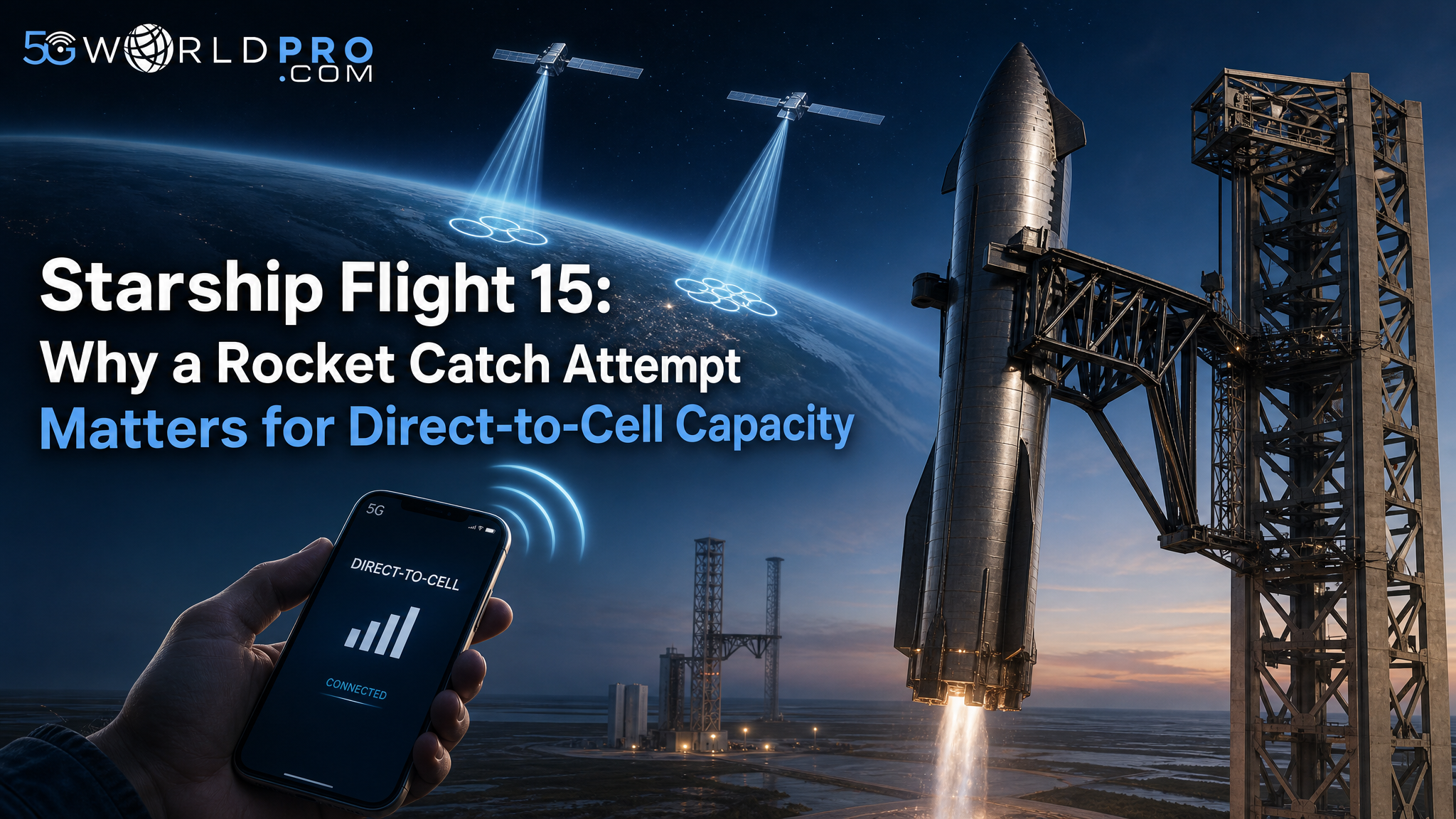
SpaceX is targeting November 2026 for Starship Flight 15, the 15th integrated flight test of its Starship rocket. This flight is aiming for a milestone the program hasn’t yet achieved: catching the upper stage at its launch tower after returning from space. In addition, it will attempt to recover the Super Heavy booster. No official launch date has been confirmed. However, on October 25 SpaceX completed a full-duration static-fire test of Super Heavy Booster 22. They ignited all 33 Raptor engines for roughly 15 seconds while the booster remained secured to the ground. This is a standard pre-flight validation step. For anyone tracking satellite-to-mobile connectivity, this test matters less for the rocket theatrics. More importantly, it matters for what it is expected to carry including the anticipated Starship Flight number 15 as a milestone for space innovation.

Why This Flight Matters Beyond the Rocket Milestone
SpaceX hasn’t officially confirmed Flight 15’s payload. However, industry speculation points toward another Starlink satellite deployment. This continues a pattern where Starship’s reusability milestones and satellite constellation buildout have advanced in parallel. Full and rapid reusability of both Starship stages is central to SpaceX’s broader cost-reduction strategy. Moreover, lower launch costs per kilogram translate directly into how quickly the company can deploy the next generation of satellites. These satellites make direct-to-cell connectivity viable at scale. For this reason, the significance of the fifteenth Starship Flight stretches beyond spaceflight itself.
That connection matters because SpaceX’s direct-to-device ambitions depend on sustained high-cadence satellite deployment. The company’s FCC approval for a 15,000-satellite direct-to-device constellation was covered in our earlier reporting. This approval only becomes commercially meaningful if SpaceX can actually launch and replace satellites fast enough to build out that capacity. Therefore, a successful tower-catch milestone on Flight 15 would be a meaningful proof point. It would show that the launch cadence needed to support that buildout is achievable, especially if the lessons learned from Starship 15 are applied to future missions.
The Broader November Launch Cadence
Starship Flight 15 isn’t SpaceX’s only near-term activity. The company has confirmed two Falcon 9 missions from Vandenberg Space Force Base in California for early November. The USSF-432 national security mission is targeted for November 2. Also, a Starlink deployment mission Starlink Group 15-21, carrying 27 satellites, is targeted for November 5. Both missions underscore that SpaceX’s Falcon 9 fleet continues shouldering the bulk of near-term Starlink deployment. Meanwhile, Starship’s reusability milestones are aimed at the next order-of-magnitude scale-up. Importantly, the progress and insights from Flight 15 are contributing to this momentum.
Starship Flight 15 and November Launch Activity Key Facts
| Detail | Fact |
|---|---|
| Flight 15 target window | November 2026 (no confirmed date) |
| Primary technical goal | First attempted tower catch of Starship’s upper stage, alongside Super Heavy booster recovery |
| Pre-flight validation | Full-duration static fire of Booster 22 (33 Raptor engines, ~15 seconds) October 25 |
| Speculated payload | Additional Starlink satellite deployment (unconfirmed) |
| Falcon 9: USSF-432 | Targeted November 2, Vandenberg SFB |
| Falcon 9: Starlink Group 15-21 | Targeted November 5, 27 satellites |
| Strategic context | Builds toward FCC-approved 15,000-satellite direct-to-device constellation |
| Broader program relevance | Reusability milestones directly affect launch cadence needed for satellite-to-mobile scale-up |
Why Reusability Is the Real Story for Telecom Watchers
A tower-catch of Starship’s upper stage would mark a genuine technical first for the program, extending the booster-catch capability SpaceX has already demonstrated on earlier flights to the much larger and more complex upper stage. The commercial logic is straightforward: every reusable stage recovered rather than discarded lowers the marginal cost of the next launch, and lower marginal launch costs are what let a satellite operator deploy and replace a constellation of thousands of direct-to-device satellites on a sustainable economic basis, rather than a one-time deployment that becomes prohibitively expensive to maintain and upgrade over time. Notably, the challenge and achievement of a Starship Flight like the 15th mission provide new opportunities for cost reduction and reliability tracking.
This is also relevant to the broader question of how fast next-generation Starlink V3 satellites can realistically reach orbit. These satellites are expected to carry meaningfully more direct-to-cell capacity than the current generation. A higher-cadence, lower-cost launch system is a prerequisite for that rollout timeline holding up. This holds true independent of how quickly the satellites themselves are manufactured, and developments such as Flight 15’s engineering outcomes have a direct impact on these timelines.
What This Means for the Industry
Launch cadence is now a telecom infrastructure variable, not just a space industry one. As satellite-to-mobile connectivity becomes a genuine competitive factor for carriers and a regulatory priority for the FCC, the pace at which SpaceX can reliably launch and recover Starship directly affects how quickly direct-to-cell capacity scales. This is a dependency telecom planners haven’t historically had to track. Furthermore, the upcoming Starship Flight 15 is poised to influence future telecom rollout scenarios.
Milestone testing, not commercial service, is still the operative phase. Flight 15’s tower-catch attempt is a technical validation step, not a signal that the 15,000-satellite constellation is close to complete. Operators and enterprises evaluating satellite-to-mobile partnerships should continue distinguishing between program milestones and deployed commercial capacity. Many are closely monitoring the status and outcomes of Starship Flight 15, as it represents a major progress marker for reusable space systems.
Falcon 9 remains the workhorse while Starship matures. With two more Falcon 9 missions confirmed for early November, including another Starlink deployment, the existing fleet continues doing the heavy lifting of constellation maintenance and growth. At the same time, Starship’s reusability program works toward the scale that could eventually replace it. Advances made via Starship missions—especially flight number 15—will be essential to making this transition possible in the coming years.
Going Deeper
Understanding how satellite launch economics, direct-to-device regulatory approval, and terrestrial network integration fit together is exactly the kind of forward-looking context covered in our 5G Direct-to-Cell (D2C) Training, which covers regulation, 3GPP NTN architecture, and a full Starlink capacity analysis across six modules, alongside our full 5G training catalog. Additionally, you can learn more about Starship Flight 15 and its potential industry significance in these resources.
Benefit from Massive discount on our 5G Training with 5WorldPro.com
Start your 5G journey and obtain 5G certification
contact us: contact@5GWorldPro.com