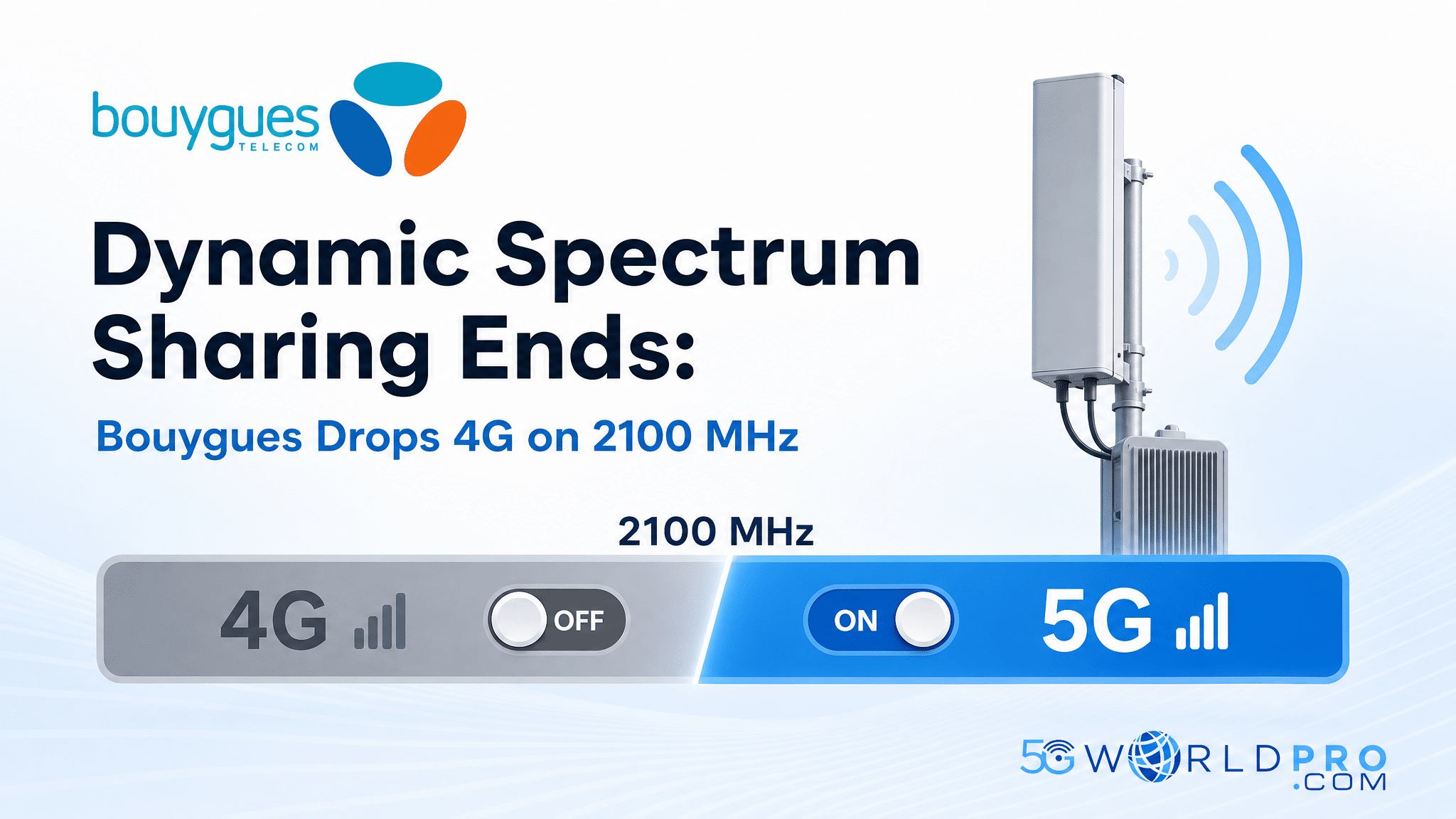
Dynamic spectrum sharing helped operators put the 5G logo on phones quickly, and now one French operator is moving away from it. According to data from France’s spectrum agency ANFR, as reported by Linformatique.org, Bouygues Telecom removed 4G from 5,883 sites on the 2100 MHz band within four weeks. Importantly, the towers stay in service. What changes is the software configuration of the radio equipment, which is reassigned to 5G.
What the ANFR Data Shows About Dynamic Spectrum Sharing
The move accelerates a shift that began over the summer. In early July, Bouygues Telecom had 19,718 sites running 4G on 2100 MHz, a record after years of densification. Today it has 10,271, a reduction of about 48%, and close to 9,500 antennas in total have been relieved of that frequency in a few months.
Moreover, the strategy sets the operator apart. According to analysis by DegroupTest, Orange, SFR and Free kept or extended their 4G installations on the same band during the period. The figures come from Linformatique.org and UniversFreebox.
Why Dynamic Spectrum Sharing Is Losing Its Role
Dynamic spectrum sharing lets 4G and 5G use the same carrier at the same time, with the network dividing radio resources between the two technologies down to the millisecond. It allowed operators to launch 5G without new spectrum, and that speed was its whole value.
The trade-off is overhead. The reporting cites a throughput cost of roughly 15 to 20% from the extra signaling. Treat that figure as an estimate from the source, because the real impact depends on the network, the load and the devices. Nevertheless, once a dedicated carrier is possible, the sharing arrangement becomes a compromise rather than a benefit.

Bouygues Telecom 2100 MHz Key Facts
| Detail | Fact |
|---|---|
| 4G removed in four weeks | 5,883 sites on 2100 MHz (ANFR data) |
| Total since the summer | Close to 9,500 sites |
| 4G sites on 2100 MHz | From 19,718 in early July to 10,271, about 48% fewer |
| Competitors | Orange, SFR and Free kept or extended 4G on the same band (DegroupTest) |
| Physical change | None: towers stay, radio equipment reconfigured by software |
| Band | 2100 MHz (n1), reported as a 15 to 20 MHz duplex band |
| Estimated DSS overhead | Roughly 15 to 20% throughput cost (estimate from the source) |
What Changes for Users and for 5G Standalone
For users, the impact is limited. Phones that only support 4G should notice nothing, because they shift automatically to the 1800, 800 and 700 MHz bands. Meanwhile, 5G phones get a cleaner carrier without 4G scheduling interference, which helps mostly in sustained downloads and uploads. Results will still vary by site and by load.
For the network, a dedicated 5G carrier prepares the ground for wider 5G Standalone (SA). SA decouples 5G from the 4G core and enables lower latency and quality control per service. Our article on cloud-native 5G SA core architecture explains why the core matters as much as the radio in this transition.
What This Means for the Industry
Dynamic spectrum sharing is turning from a launch tool into a transition tool. Every operator that started 5G on shared carriers now faces the same question: keep sharing the band, or give it to 5G. The French data shows one operator choosing the second path at scale, while its rivals have not yet followed.
Software reconfiguration makes this reversible and fast. Because the change does not touch the towers, it can be rolled out site by site and rolled back if results disappoint. Therefore, thousands of sites can move in weeks, which is a useful reference for planning teams elsewhere.
The next monthly reports will be the real test. One operator’s strategy is a snapshot, not yet a trend. Operators and analysts should watch whether Orange, SFR and Free change course, and whether the promised 5G Standalone gains appear in measured results.
Going Deeper
Understanding how spectrum refarming, dynamic spectrum sharing and 5G Standalone fit together is exactly the kind of context covered in our 5G training courses, alongside our full 5G training catalog.
Benefit from Massive discount on our 5G Training with 5WorldPro.com
Start your 5G journey and obtain 5G certification
contact us: contact@5GWorldPro.com