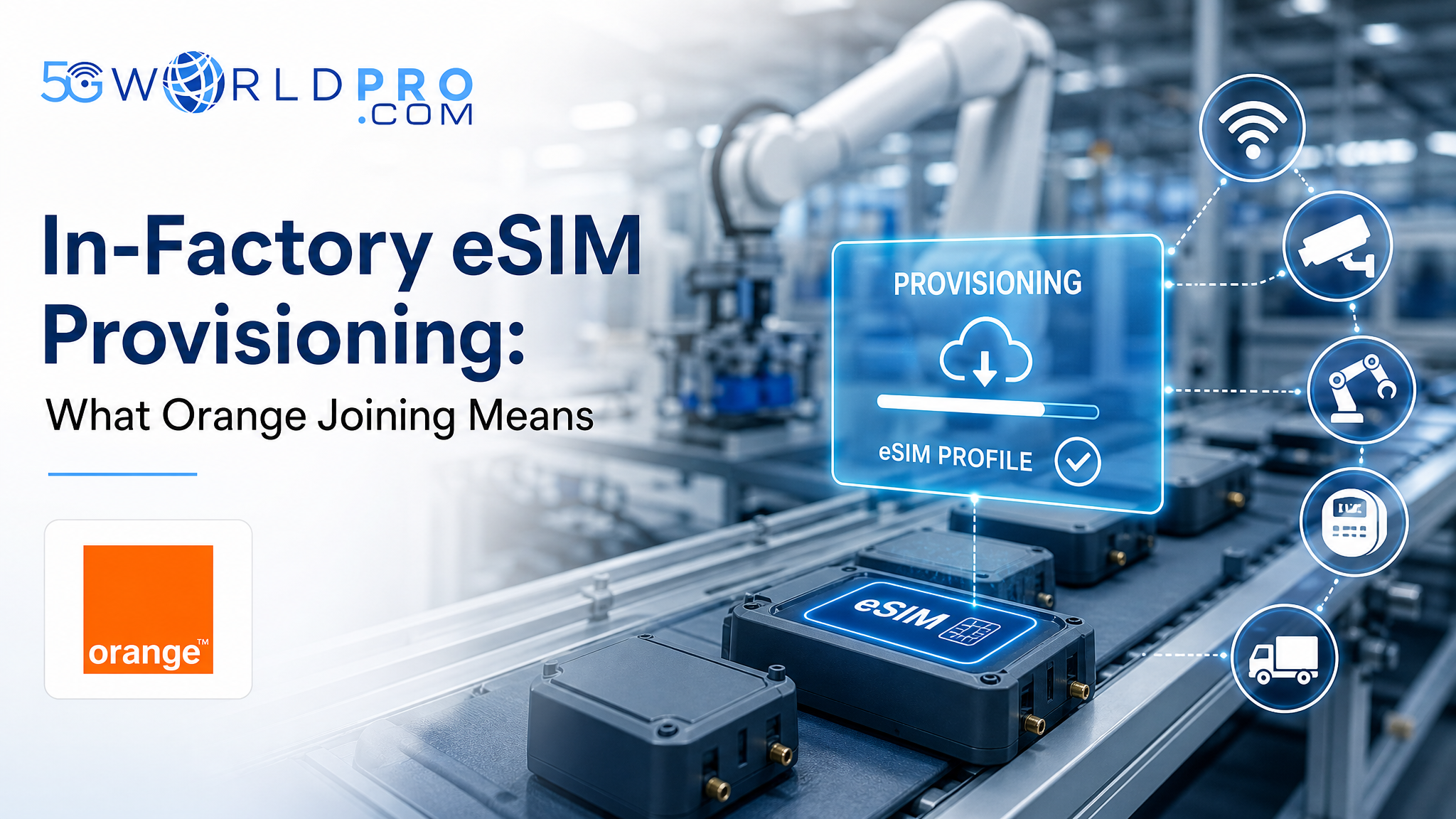
In-factory eSIM provisioning moved a step closer to mainstream IoT on 4 November 2026, when Orange joined the In-Factory Profile Provisioning (IFPP) program that Acceleronix and IDEMIA Secure Transactions launched at MWC Barcelona in February. The program lets device makers load an operator profile onto an eSIM at the end of their own production line, so every device leaves the factory tested, provisioned and ready to connect. For manufacturers that ship the same product to many regions, this changes a decision that has always been made too early: which SIM goes in which box.
In-Factory eSIM Provisioning: Why Connectivity Is Locked In Too Early
Today, connectivity is decided at the design stage and locked in through SIM variants, regional SKUs and separate stock. Consequently, a manufacturer that sells in several markets may carry several versions of the same hardware, only because the SIM differs. That ties up stock in regional variants, makes forecasting errors expensive and slows entry into new markets.
In-factory eSIM provisioning moves that decision to the very end of production. The manufacturer builds one hardware platform and assigns the operator profile on the line, order by order. Moreover, it works in air-gapped factories, which matters for plants that keep production networks isolated for security reasons.

How IFPP Works and Why Orange Joining Matters
Each partner covers one layer. Acceleronix provides the loader and factory orchestration tools that plug into existing production lines, with full traceability per device, and manages connectivity once devices are in the field. IDEMIA provides an IFPP-ready eSIM with quantum-safe profile binding. Orange supplies the operator profiles and managed IoT connectivity through its own network and roaming partners, so devices join the network from first power-on.
Importantly, the program follows the GSMA SGP.41 framework and runs on existing eSIM IoT (SGP.32) infrastructure. Therefore, manufacturers can deploy now and upgrade to SGP.42 once its detailed specification is published. Our guide on eSIM vs physical SIM in 2026 explains why this shift away from physical SIM is already underway.
In-Factory eSIM Provisioning Key Facts
| Detail | Fact |
|---|---|
| Program | In-Factory Profile Provisioning (IFPP), launched by Acceleronix and IDEMIA Secure Transactions at MWC Barcelona, February 2026 |
| New member | Orange, announced 4 November 2026 |
| Standard | GSMA SGP.41 framework |
| Infrastructure | Existing eSIM IoT (SGP.32), with upgrade path to SGP.42 once the specification is published |
| Security | Quantum-safe profile binding protects operator credentials during production |
| Form factors | All eSIM form factors, with MFF4 highlighted |
| MFF4 size | 2 x 2 mm, around 87% smaller than MFF2 |
| Availability | IFPP trial kits for OEMs |
| First live demo | electronica 2026, Messe München, Hall C2, Stand 601, 10 to 13 November |
The details come from the Business Wire announcement and reporting by The Quantum Insider.
Why Quantum-Safe Binding and MFF4 Belong in the Same Story
Most connected devices share the same weak spot: provisioning and testing on the production line. Operator credentials must be handled outside the operator’s own secure environment, yet they have to stay protected for the whole life of the device. Quantum-safe binding is meant to protect them during production. The reasoning is practical: devices shipped now may stay in the field for a decade or more, so the protection has to outlast that window.
MFF4 raises the stakes. At 2 x 2 mm it is the smallest standardised eSIM, and the smallest devices such as trackers, sensors and wearables have the least room for error. Notably, a soldered chip leaves no second chance to correct a wrong SIM choice, so loading the profile late in production is especially valuable here. This segment overlaps with the RedCap IoT wave we covered earlier this year.
What This Means for the Industry
Connectivity is becoming a production setting, not a design decision. If manufacturers can assign the operator profile on the line, fewer SIM SKUs and less regional stock follow, and market entry becomes faster. For IoT makers with global ambitions, in-factory eSIM provisioning turns a supply chain problem into a configuration step.
Operators gain a new place to compete through in-factory eSIM provisioning. Winning IoT connectivity at the factory, before the device ships, is a stronger position than chasing customers afterwards. Consequently, more operators are likely to follow Orange if early trials show demand, and device makers selling worldwide will want several operators on the platform.
Early access is still not volume production. Trial kits and a trade-show demo are useful validation steps, but pricing, profile fees, the SGP.42 timeline and real production volumes remain open. Manufacturers evaluating in-factory eSIM provisioning should therefore separate program announcements from deployed capability.
Going Deeper
Understanding how eSIM, IoT connectivity and 5G device ecosystems fit together is the kind of context covered in our 5G training courses and across the full 5G training catalog.
Benefit from Massive discount on our 5G Training with 5WorldPro.com
Start your 5G journey and obtain 5G certification
contact us: contact@5GWorldPro.com