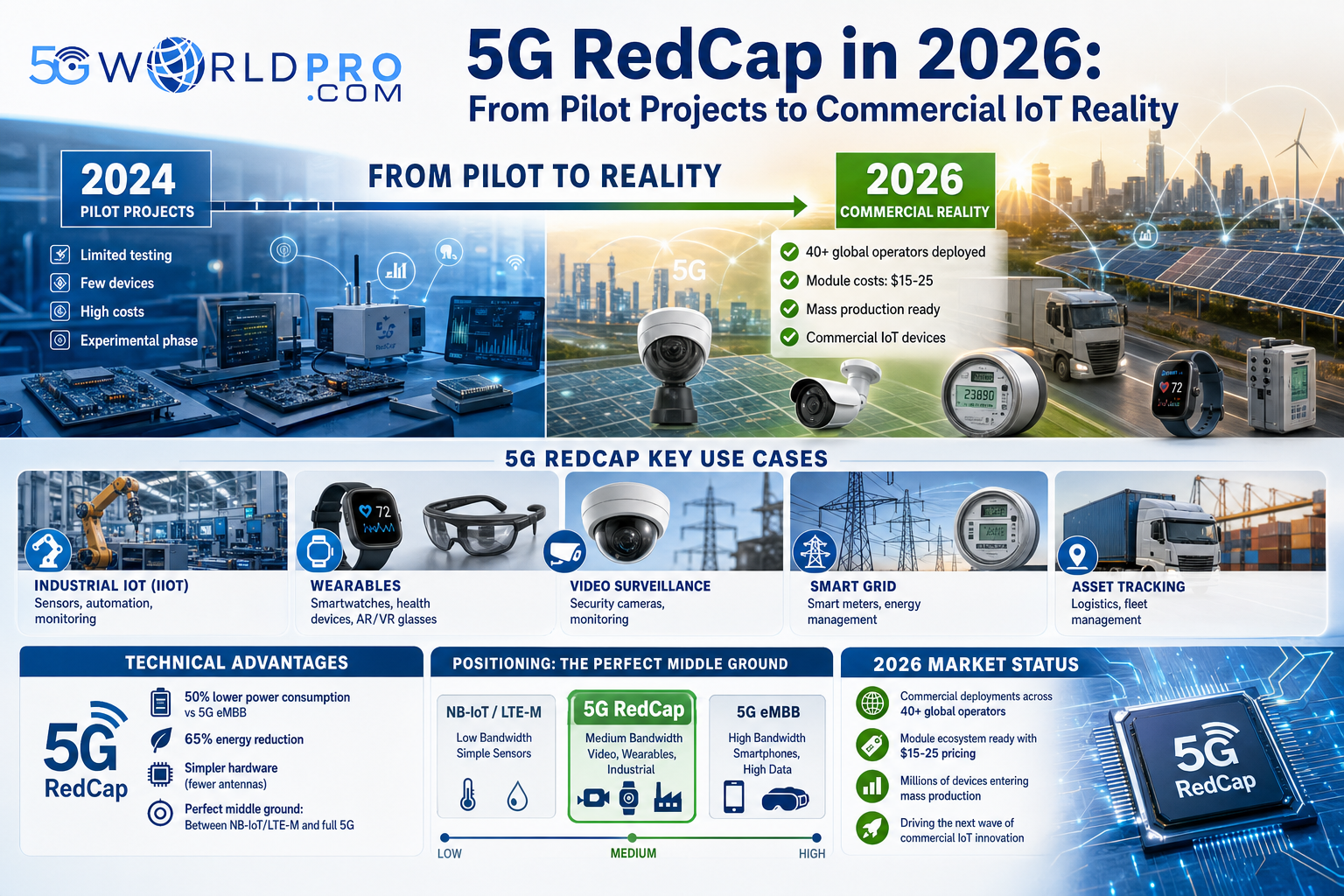
For years, 5G RedCap (Reduced Capability) sat in the same bucket as network slicing: a promising 3GPP feature that analysts kept describing as “coming soon.” That changed in 2026. 5G RedCap in 2026: From Pilot Projects to Commercial IoT Reality is not just a headline, but the current state of the industry. RedCap has quietly crossed from trial deployments into commercial service across dozens of markets, and the technology is now shaping how carriers plan to retire aging LTE Cat-1 IoT fleets. Here’s where RedCap actually stands today, who is deploying it, and what it means for anyone building a career or a network strategy around 5G.
What RedCap actually solves
Standard 5G NR was built for two extremes: blazing-fast mobile broadband and ultra-reliable low-latency communication. Neither extreme fits the majority of IoT use cases a smart meter, a wearable, or an industrial sensor doesn’t need gigabit speeds, but it does need better performance and battery life than legacy LTE. RedCap, introduced in 3GPP Release 17, closes that middle gap by stripping down antenna count, bandwidth, and modem complexity while keeping devices on native 5G infrastructure. The result is hardware that costs less than a full 5G modem, lasts years longer on a single battery, and still benefits from the 5G core.
Release 18 pushes this further with eRedCap, which caps peak downlink speeds around 10 Mbps specifically to compete with and eventually replace the LTE Cat-1 and Cat-1bis categories that still run the bulk of the world’s point-of-sale terminals, fleet trackers, and utility meters.
The market moved faster than most predicted
As of mid-2026, over 40 mobile operators across more than 25 countries are actively investing in RedCap, with commercial services already live in the United States, Germany, Japan, Singapore, Spain, and the UAE. The table below summarizes where the technology stands right now.
| Metric | Figure |
|---|---|
| Operators actively investing in RedCap (2026) | 40+ across 25+ countries |
| Commercial RedCap launches live today | US, Germany, Japan, Singapore, Spain, UAE |
| Power efficiency gain vs. LTE Cat-M1 | 3–5x |
| Projected RedCap share of global IoT connections by 2030 | ~40% |
| eRedCap peak downlink (Release 18) | ~10 Mbps |
| Prerequisite network architecture | 5G Standalone (SA) core |
The pattern worth noting: RedCap adoption is tracking almost exactly with 5G SA rollout. Every commercial RedCap deployment depends on a Standalone core, which is why coverage today is concentrated in major cities and business districts rather than nationwide.
Why utilities and industry got there first
Battery life is the killer feature, not speed. A smart grid sensor that used to need replacing every 2–3 years on LTE Cat-M1 can now stretch past 10 years on RedCap, depending on reporting frequency. For utility operators managing hundreds of thousands of endpoints, that difference alone justifies the hardware refresh.
SA coverage gates everything. RedCap cannot run on NSA anchored to a 4G core it requires a genuine 5G Standalone deployment. That’s exactly why early commercial launches cluster in dense urban markets: it’s where operators finished SA buildout first, not because consumer or rural demand is lower.
LTE fallback keeps the transition low-risk. Most RedCap modems ship with LTE fallback built in, which means fleets can be deployed today even where RedCap coverage is patchy, and gradually inherit the performance gains as SA coverage expands around them.
Where RedCap is heading next
The near-term opportunity isn’t the consumer smartphone chip market it’s the enormous installed base of legacy LTE Cat-1 devices that eRedCap is positioned to replace outright. Point-of-sale terminals, fleet telemetry units, and utility meters represent millions of connections that will refresh onto eRedCap as their existing hardware reaches end of life, not because operators are marketing a new consumer feature, but because the total cost of ownership math favors it.
This mirrors a pattern we’ve tracked elsewhere in the 5G rollout: infrastructure-dependent features move fastest in the segments where the business case is unambiguous enterprise, industrial, and utility well ahead of any consumer-facing use case built on the same underlying architecture.
What this means for telecom professionals
If you’re building expertise in IoT connectivity, RedCap and eRedCap should be on your radar as a near-term, revenue-generating skill set not a future one. The operators paying for RedCap expertise today are doing so to solve a concrete replacement problem: retiring LTE Cat-1 fleets before support costs spike. Understanding 5G SA core architecture, RedCap’s power and bandwidth trade-offs, and eSIM-based fleet provisioning is quickly becoming as relevant to IoT engineering roles as RAN planning is to radio engineers.
Frequently asked questions
Is 5G RedCap commercially available in 2026? Yes. More than 40 operators across 25+ countries are investing in RedCap, with live commercial services in markets including the US, Germany, Japan, Singapore, Spain, and the UAE.
Does RedCap work without 5G Standalone (SA)? No. RedCap requires an SA core; it does not function the same way over NSA anchored to a 4G core, which is why coverage today tracks SA rollout closely.
What’s the difference between RedCap and eRedCap? RedCap (Release 17) targets wearables, sensors, and mid-tier IoT. eRedCap (Release 18) goes further, capping peak downlink around 10 Mbps to directly replace the LTE Cat-1 and Cat-1bis categories used in point-of-sale, telemetry, and metering.
Why are utilities and industry adopting RedCap before consumers? Because the business case is immediate: 3–5x better power efficiency than LTE Cat-M1 can stretch device battery life from 2–3 years to 10+ years, which materially cuts fleet maintenance costs at scale.
Going deeper
If you want to understand the SA architecture, orchestration, and private network fundamentals that make real network slicing deployments work, our 5G Direct-to-Cell Training program covers exactly that.
Sources: GSA (Global mobile Suppliers Association), 3GPP Release 17/18 documentation, operator public disclosures (T-Mobile, Deutsche Telekom, EE, Vodafone, MasOrange, Etisalat), industry analysis from GSMA. This article is part of our ongoing coverage of where 5G promises meet deployment reality.
Benefit from Massive discount on our 5G Training with 5WorldPro.com
Start your 5G journey and obtain 5G certification
contact us: contact@5GWorldPro.com