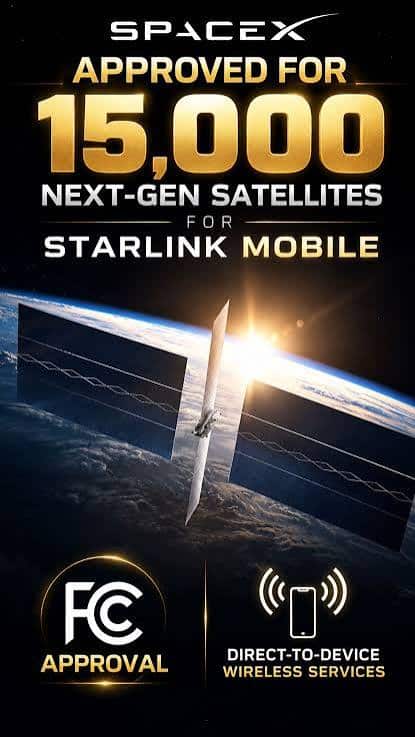
The FCC has cleared SpaceX to fly 15,000 phone-ready satellites by 2035. The marketing promises 150 Mbps to your pocket. The physics says: read the fine print.
The order (DA 26-1078, 6 October 2026) puts the fleet at 326–335 km, with 7,500 satellites due by 2032. It also waives the usual leasing requirement: SpaceX holds the ex-EchoStar licences itself, so it can sell mobile service in the US without an operator partner. That is the real news. Now, five claims tested against engineering reality.
SpaceX’s own figures are bold: about 20 times the throughput per satellite versus Gen-1, over 100 times total network capacity, first launches in 2027 and Gen-2 service in the first half of 2028. The fleet grows from roughly 650 D2D satellites today. Reaching even the 7,500 milestone implies around 190 Starship launches at 40 satellites each.
Claim vs reality
| The claim | The engineering reality |
| “150 Mbps to a smartphone” | About 25 MHz of downlink means 6 bps/Hz, roughly 18 dB SNR. Handset links run 0–10 dB. Expect tens of Mbps per beam, shared by every user under it. |
| “15,000 satellites = 15,000 times more speed” | More satellites add beams, not spectrum. Capacity grows per km², not per user. Dense cities still need towers. |
| “Lower orbit, better link” | True: ~4 dB less path loss than at 550 km. But drag shortens life. At an assumed five-year lifetime, that is ~3,000 replacements and ~75 Starship launches a year just to stand still. |
| “Works with ordinary phones” | Gen-2 runs 3GPP NTN in AWS-4, H-Block and AWS-3. Chipset band support and a three-year handset cycle set the real launch date, not rockets. |
| “FCC approval = a global network” | US only. Abroad, every beam needs a national licence. WRC-27 agenda item 1.13 will set the rules for satellite-to-handset in mobile bands. |
| “SpaceX will replace mobile operators” | Even SpaceX plans femtocells for suburbs and cities. Satellites cannot serve dense traffic or deep indoor users, where building loss reaches 10–20 dB. Competing on the ground means billions in sites and spectrum. |
None of this makes the project less significant. It makes it a different kind of network: one that wins on geography, loses on density, and depends on regulators more than on rockets.
What it means for operators
D2D will redefine coverage, not capacity. Every operator holds what satellite players need: terrestrial spectrum, national licences and customers. How to use that leverage depends on the market.
| Operator profile | What to do now |
| Tier-1 operators in competitive markets (US, Canada, Australia) | Treat SpaceX as partner and rival at once. Lock in partnership terms on pricing, branding and customer ownership before it can sell direct. Budget for higher spectrum prices at auctions and renewals, and coordinate with peers as the US joint venture does. |
| European operators | Weigh in on the 2 GHz MSS renewal and on WRC-27 positions. Use Europe’s push for sovereign capacity to keep several D2D suppliers in play rather than one. |
| Operators in emerging markets (MEA, South Asia, Latin America) | D2D closes real coverage gaps. Sell it as a coverage layer for rural, maritime and emergency use under your own brand, and work with regulators on clear D2D authorisation and lawful-intercept rules. |
| All operators | Never open your bands to satellite use without commercial terms. Build NTN skills into RAN teams now: link budgets, Doppler and timing, beam planning and coexistence are core engineering, not niche satellite topics. |
Go deeper: our 5G Direct to Cell Training covers regulation, 3GPP NTN, architectures and a full Starlink capacity analysis in six modules.
Benefit from Massive discount on our 5G Training with 5WorldPro.com
Start your 5G journey and obtain 5G certification
contact us: contact@5GWorldPro.com