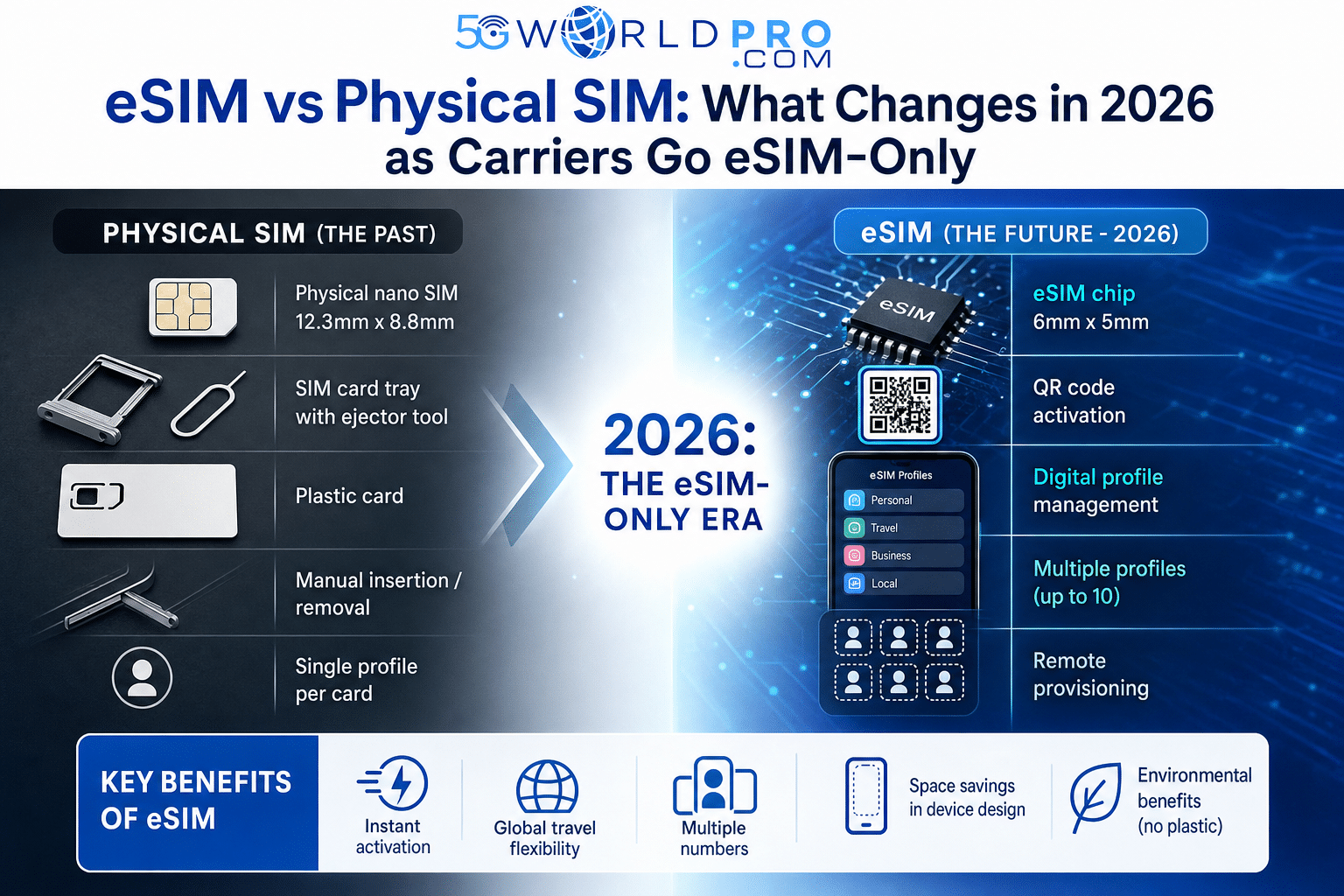
For three decades, the tiny plastic SIM card was one of the few constants in mobile technology phones got smarter, screens got bigger, headphone jacks vanished, but that little card slot stayed. In 2026, it’s finally disappearing too, and not gradually. Here’s what’s actually changing, for users and for the carriers who have to support the transition.
Where things stand right now
Apple has the most mature eSIM rollout of any manufacturer: every iPhone since the XS (2018) has supported eSIM, and US-market iPhone 14 and newer ship with no physical SIM tray at all eSIM-only, since 2022. The iPhone 17 Air went further, becoming Apple’s first phone that’s eSIM-only worldwide, not just in the US. Google followed with the Pixel 10 in the US market, and Samsung is moving select markets of the Galaxy S26 toward eSIM-only as well.
That said, this is still a US-and-flagship-led shift, not a universal one. International variants of most flagships including iPhones sold outside the US still carry a physical SIM tray alongside eSIM support. And plenty of budget and older phones remain physical-SIM-only. As of 2026, more than 1,000 smartphone models across Apple, Samsung, Google, and other brands are eSIM-capable, and the GSMA’s tracker counts more than 100 countries with active eSIM-capable networks but “eSIM-capable” and “eSIM-only” are very different milestones, and most of the world is still further along on the first than the second.
What actually changes for users
The practical difference is smaller than the “end of an era” framing suggests. Switching to an eSIM-only device isn’t a dramatic change: your carrier transfers your existing number and plan to an eSIM profile, a process most carriers now support fully online. From there, eSIM genuinely simplifies specific situations travel being the clearest one. Instead of hunting for a local SIM card or paying steep roaming rates, you install a travel eSIM profile and get connected the moment you land, without ever touching a paperclip.
The tradeoffs are narrower than they used to be, but they still exist. Some phones support only one active eSIM at a time; others including recent iPhones support two simultaneously. Carrier locking still works differently with eSIM than physical SIM: a locked phone will only accept eSIM profiles from the locking carrier, and switching networks requires an unlock the same way it always did. And there remains a shrinking but real list of countries and smaller carriers, concentrated in parts of Africa and Southeast Asia, where eSIM network support simply isn’t there yet.
The part most consumer coverage skips: what this means for carriers
For operators, eSIM isn’t just a hardware change on the device side it changes SIM provisioning from a physical logistics problem into a digital infrastructure one. Historically, issuing a new SIM meant manufacturing a physical card, shipping it to a store or customer, and activating it on arrival. eSIM provisioning, standardized through the GSMA’s Remote SIM Provisioning (RSP) architecture, turns that into a remote software operation a shift that reduces physical inventory and logistics costs, but requires operators to build and maintain the provisioning infrastructure and security model that process depends on.
That’s part of why carrier eSIM rollout has been uneven globally: in the US, major operators have already scaled back in-store physical SIM inventory and now actively encourage digital activation, while some international carriers are still building out that provisioning capability. Some carriers have gone further, introducing eSIM-only plans or prioritizing eSIM-compatible devices in promotions a sign operators see genuine cost and operational upside in pushing the transition, not just following manufacturer hardware decisions.
What comes after eSIM: iSIM
eSIM itself is a transitional technology, not the final form. The next step already in motion is iSIM (integrated SIM) where the SIM function is built directly into the phone’s main processor rather than existing as a separate embedded chip at all. iSIM removes even the small amount of dedicated hardware eSIM still requires, further simplifying device design and freeing up internal space relevant as manufacturers keep pushing for thinner devices and larger batteries within the same footprint. For operators, iSIM continues the same provisioning and security model eSIM established, meaning the infrastructure investment carriers make for eSIM now carries forward rather than needing to be rebuilt again.
What this means if you work in telecom
The eSIM-to-iSIM transition is a useful case study in how a seemingly consumer-facing hardware change actually depends entirely on carrier-side infrastructure most users never think about GSMA RSP compliance, provisioning security, and profile management systems that have to work flawlessly across every device a carrier supports. It’s a good reminder that “the phone supports it” and “the network is ready for it” are two different milestones, a pattern that shows up constantly in 5G feature rollouts too, from Standalone architecture to network slicing.
Frequently asked questions
Do all 2026 phones support eSIM? No most flagship and recent mid-range phones do, but many budget phones and older models remain physical-SIM-only. Check your specific model and regional variant before assuming eSIM support.
Which phones are eSIM-only, with no physical SIM tray at all? US-market iPhone 14 and newer, the iPhone 17 Air worldwide, US-market Google Pixel 10, and select-market Samsung Galaxy S26 models are eSIM-only as of 2026. International variants of most of these still include a physical SIM tray.
Can I use eSIM and a physical SIM at the same time? On many phones, yes most non-eSIM-only devices support a physical SIM plus one active eSIM simultaneously, and some recent iPhones support two active eSIM profiles at once with no physical SIM at all.
What’s the difference between eSIM and iSIM? eSIM is a small embedded chip separate from the phone’s main processor. iSIM integrates that same function directly into the processor itself, removing the need for dedicated SIM hardware entirely the next step in the same direction eSIM already started.
Going deeper
If you’re on the professional side of this shift evaluating how SIM provisioning, GSMA RSP infrastructure, and device-side changes actually connect to carrier network operations our 5G Direct-to-Cell Training program goes into exactly that level of detail.
Sources: GSMA eSIM adoption tracker, Simology, EasySIM, UnlockBase, eSimphony, CheapereSIM. This article is part of our ongoing series on 5G device and network fundamentals.
Benefit from Massive discount on our 5G Training with 5WorldPro.com
Start your 5G journey and obtain 5G certification
contact us: contact@5GWorldPro.com