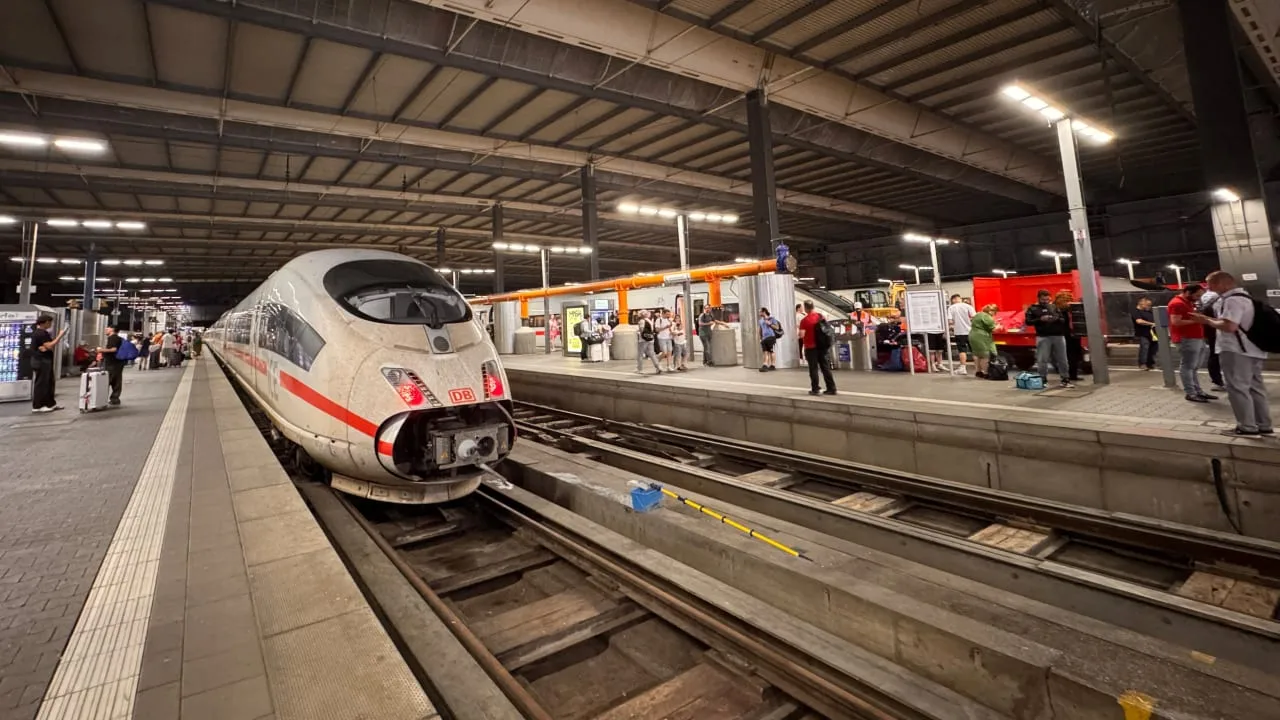
On 23 June 2026, around 21:59 local time, Deutsche Bahn did what it had never done for a technical reason: it stopped every train in the country. Long-distance, regional, S-Bahn, all of it. Thousands of passengers were stranded at Berlin, Frankfurt, Munich, Hamburg and Cologne, where 200 people ended up with hotel vouchers. This unprecedented disruption was later identified as a GSM-R Outage. Service came back step by step from about 00:30. The official cause was described only as a “technical fault” on the GSM-R radio network. A possible DDoS attack was mentioned in one report, but it remains unconfirmed.
After thirty years in radio networks, it is not the cause that worries me. It is that one radio failure was enough to paralyse the rail network of a G7 country. That is the real story.
Why one radio failure stops a whole railway
GSM-R is not a convenience layer. It is the safety bearer that lets drivers talk to control centres and, more importantly, carries ETCS signalling at the heart of ERTMS. No radio, no movement authority. No authority, no train. By design, a fail-safe railway stops rather than runs degraded.
The technology underneath is old. GSM-R is circuit-switched GSM, standardised through EIRENE/MORANE in the late 1990s, running in the dedicated 900 MHz railway band. Germany operates roughly 3,000 to 4,000 base stations on it. There is site-level redundancy, but everything funnels through centralised core elements and the IT systems around them. Redundant radio sites save nothing if a core component or a software change fails. On 23 June, the network found one of those single points of failure.
FRMCS is the answer the industry already chose
The successor exists, it is standardised, and migration is already underway. FRMCS (Future Railway Mobile Communication System), led by the UIC, is built on 5G. Three strengths map directly onto what failed in Germany:
- Bearer-independent. It runs on 3GPP mission-critical services (MCPTT, MCData, MCVideo) and decouples the railway application from the transport. The same session can run over a dedicated railway network, a public operator, a private 5G network, or a satellite link. The opposite of GSM-R’s single-bearer dependency.
- Built for 5G SA. The 1900–1910 MHz band plus the adapted 900 MHz railway band (3GPP band n100), with network slicing, far more capacity for ETCS, and the kind of core redundancy GSM-R never had.
- On a deadline. GSM-R support is guaranteed only to around 2030. This is no longer research — it is a deployment programme to budget now.
The real gap: skills
The standards are ready and the spectrum is allocated. What is scarce are the people who understand both worlds: railway signalling and operational safety on one side, 5G SA, mission-critical services, slicing and NTN on the other. Migration projects do not fail on the standard. They fail in that gap. Every incident like this one shortens the runway to close it.
The 5G FRMCS Training from 5GWorldPro.com is built to bridge exactly that: from the GSM-R your teams know to the FRMCS architecture they will deploy — migration path, 3GPP mission-critical services, spectrum and 5G SA, network slicing, ETCS over 5G, and resilient design to avoid the single point of failure that stopped Germany.
Benefit from Massive discount on our 5G Training with 5WorldPro.com
Start your 5G journey and obtain 5G certification
contact us: contact@5GWorldPro.com