Telecom operators have spent the past several years hearing the same uncomfortable truth: core connectivity revenue is flat in most mature markets, competition keeps compressing margins, and network upgrade costs keep climbing regardless. Drones commercial, industrial, and increasingly autonomous have quietly become one of the few adjacent markets where operators hold a genuine structural advantage rather than starting from zero. Here’s what’s actually happening in 2026, not just the pitch-deck version.
Why telecom operators specifically are positioned for this
Drone-as-a-Service (DaaS) isn’t an obvious fit for a phone company at first glance but look closer at what large-scale drone operations actually require, and the overlap with what operators already own becomes clear: nationwide connectivity, cloud infrastructure, big data and analytics capability, and critically for Beyond Visual Line of Sight (BVLOS) missions deep knowledge of how their own networks perform above ground level, across flight corridors, industrial sites, and rural routes. Traditional 4G and 5G networks were designed and optimized for people, vehicles, and ground-based devices, not aerial applications which means operators who understand that gap have a real head start over pure-play drone companies trying to build connectivity from scratch.
The market opportunity backing this up is substantial and growing. The global commercial drone market reached $38 billion in 2025 and is projected to exceed $55 billion by 2030 with some longer-range forecasts putting the broader drone market as high as $190 billion by 2034. The drone delivery segment alone is expected to reach $6.8 billion by 2026, driven by BVLOS expansion and urban logistics demand.
What operators are actually building right now
This isn’t a future-tense story several major operators already have live or near-live commercial drone services running on their 5G networks:
Telefónica launched T-Space in April 2026, described as a pioneering commercial service for remotely piloted drones one of the clearest examples yet of an operator moving from pilot project to genuine commercial B2B offering. We covered this launch in detail in our dedicated breakdown of Telefónica’s T-Space drone-as-a-service blueprint, which remains one of our most-read articles on the broader satellite-and-drone connectivity theme.
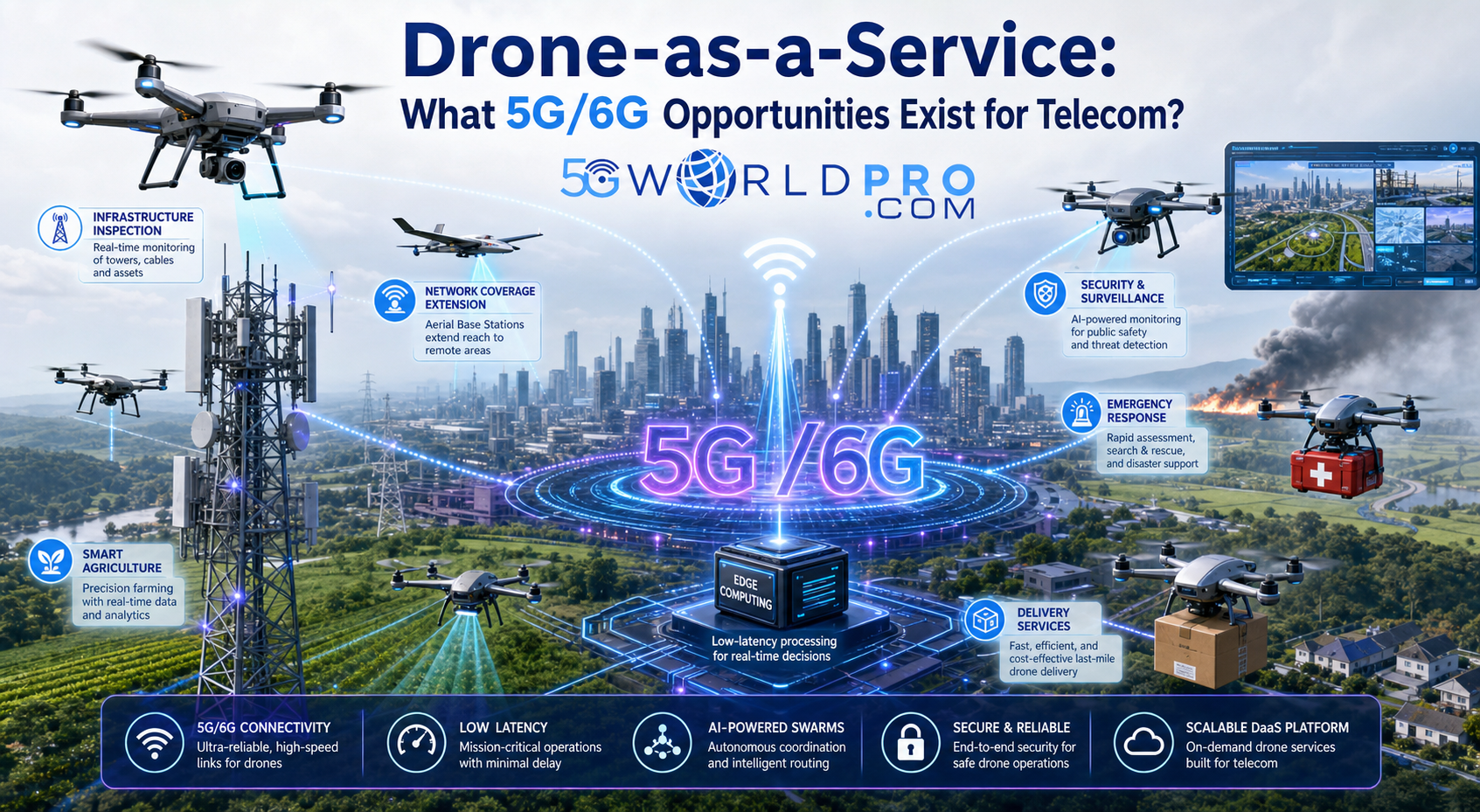
Vodafone has been positioning itself around Drone Traffic Control Centres (DTCC), working directly with airspace regulators in multiple countries, alongside use cases spanning temporary connectivity in disaster zones, real-time digital twins of network sites, precision farming, and delivery logistics.
Telia and AirborneRF have partnered specifically to unlock what the companies describe as the next generation of aerial digital infrastructure a signal that Nordic operators are pursuing the same opportunity through a slightly different partnership model than Telefónica’s more vertically integrated approach.
Orange used MWC 2026 to showcase multiple live drone use cases through its Orange 5G Lab network of 22 sites: a next-generation airport security alert chain combining drones, AI, and network APIs on an open platform, and a live antenna inspection demo flown remotely from Barcelona to a mobile base station near Paris a concrete example of drones replacing manual infrastructure inspection with 5G-connected automation.
Two distinct business models, not one
Coverage of this space often treats “drone services” as a single opportunity, but operators are actually pursuing two genuinely different models:
| Model | What it involves | Example |
|---|---|---|
| Unmanned Traffic Management (UTM) | Operator provides the connectivity and airspace coordination layer other drone operators rely on | Vodafone’s Drone Traffic Control Centre work |
| Direct Drone-as-a-Service | Operator offers the full service drone procurement, data processing, and data delivery directly to enterprise customers | Telefónica’s T-Space |
| Network augmentation | Drones carry temporary cell coverage to restore or extend connectivity during emergencies or events | Emergency network restoration use cases |
| Infrastructure inspection | Drones inspect operators’ own physical network assets (towers, antennas), replacing manual climbs | Orange’s Drone Inspection demo at MWC 2026 |
Some operators are pursuing more than one of these simultaneously Orange’s MWC 2026 showcase alone spanned both infrastructure inspection and third-party security applications, suggesting the more successful operators won’t pick a single lane.
The technical problem nobody’s fully solved yet
Before this becomes as routine as mobile broadband, there’s a real engineering gap between how cellular networks were built and what aerial connectivity actually needs. Cellular antennas are physically optimized to broadcast outward and slightly downward, toward ground-level devices not upward, toward drones flying at altitude. That limits effective coverage for aerial applications unless addressed with more advanced beamforming techniques specifically tuned for airborne connections.
There’s a second, less obvious problem: at altitude, a drone has line of sight to far more base stations than a ground-level device would including cells that aren’t actually serving the one the drone is currently connected to. That creates interference and handover complexity that terrestrial network planning wasn’t originally designed to handle. Solving this properly is less about deploying more towers and more about rethinking RAN configuration and interference management specifically for the airspace layer which is exactly the kind of problem AI-native RAN optimization is increasingly being applied to.
Regulation is catching up, unevenly
Drone integration into commercial airspace remains a genuine bottleneck, not just a technical one. In the US, the FAA continues working to integrate drones into the National Airspace System, including Remote ID requirements for drone identification and tracking. European regulators are moving on a broadly similar timeline. The operators furthest ahead commercially Telefónica, Vodafone, Orange are also the ones most actively engaging directly with regulators rather than waiting for rules to settle, which looks increasingly like a deliberate first-mover strategy rather than a coincidence.
What this means for telecom professionals
Drone-as-a-Service sits at a genuinely interesting intersection: RAN engineering (aerial coverage and interference management), network APIs and edge compute (real-time data processing for time-sensitive drone missions), and increasingly AI-native network operations (managing the added complexity of airborne connections dynamically rather than through static configuration). Professionals who understand more than one of these layers not just classic ground-based RAN are positioned well for where operators are actually investing next, based on what Telefónica, Vodafone, Orange, and Telia are already building rather than what’s still theoretical.
Frequently asked questions
Is Drone-as-a-Service already generating real revenue for telecom operators? Yes, though still early-stage. Telefónica’s T-Space launched as a commercial service in April 2026, and Orange, Vodafone, and Telia all have active commercial or near-commercial initiatives, rather than purely experimental pilots.
Why are telecom operators specifically well-positioned for drone services, rather than pure drone companies? Operators already own the nationwide connectivity, cloud infrastructure, and data analytics capability that large-scale drone operations require particularly for BVLOS missions, which depend heavily on understanding how existing networks actually perform above ground level.
What’s the biggest technical obstacle to drone connectivity on cellular networks? Cellular antennas are built to broadcast toward ground-level devices, not upward toward aerial ones, limiting effective coverage without advanced beamforming. Drones at altitude also have line of sight to far more base stations than ground devices, creating interference and handover complexity terrestrial networks weren’t originally designed to manage.
How big is the actual market opportunity? The global commercial drone market reached $38 billion in 2025, projected to exceed $55 billion by 2030. The drone delivery segment specifically is expected to reach $6.8 billion by 2026.
Going deeper
If you want to understand the RAN, edge compute, and AI-native network fundamentals that Drone-as-a-Service and similar emerging use cases are actually built on, our 5G Direct-to-Cell Training program covers exactly that.
Benefit from Massive discount on our 5G Training with 5WorldPro.com
Start your 5G journey and obtain 5G certification
contact us: contact@5GWorldPro.com