“Private 5G” spent years as a technology enterprises evaluated in theory more than deployed in practice. That’s shifted. Private LTE/5G deployments reached roughly 6,500 globally in 2025, increasingly driven by organic enterprise demand rather than vendor pilots and the ROI data behind that growth is concrete enough to actually run the numbers yourself, rather than take a vendor’s word for it.
The headline number, and what it actually means
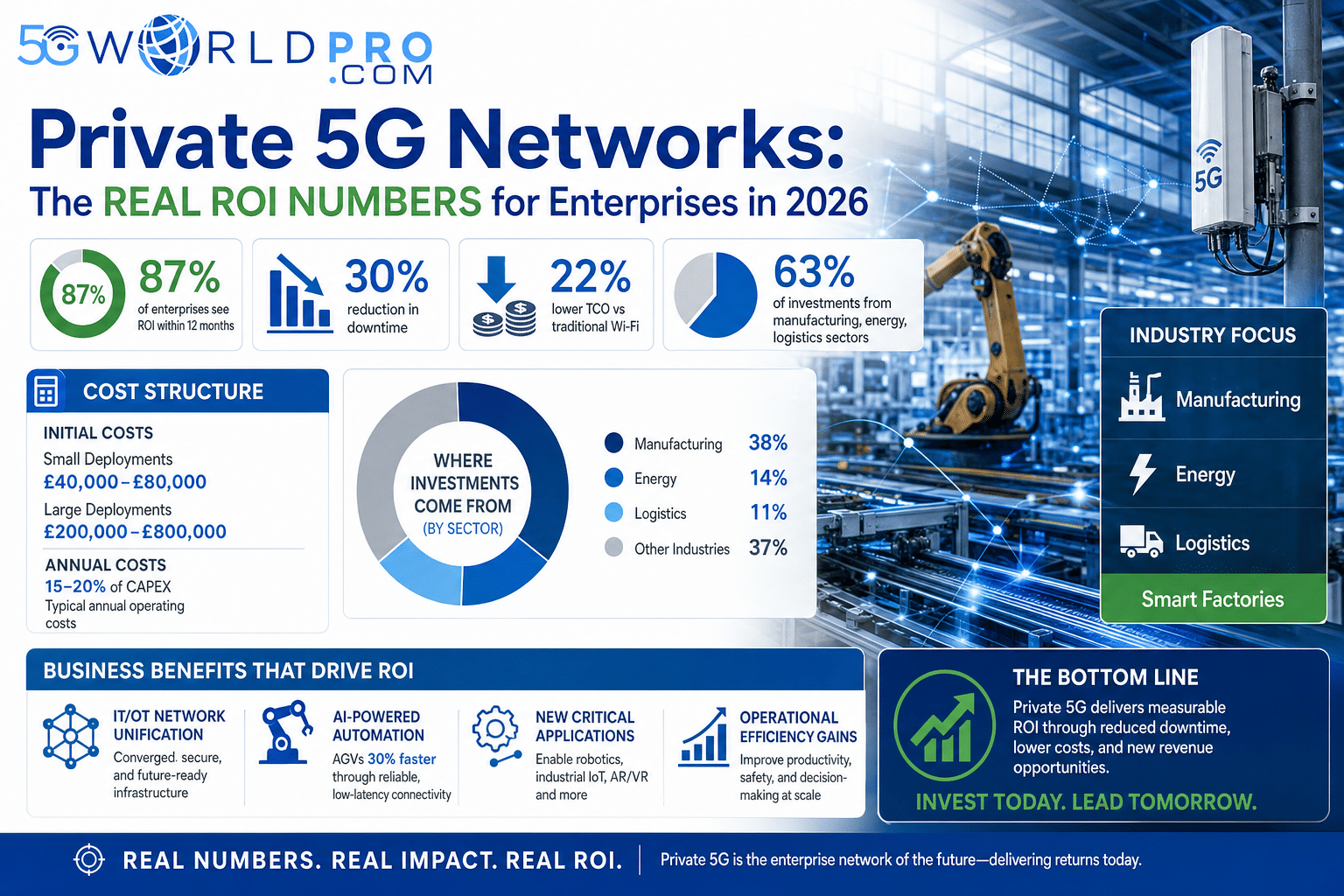
Across current industry data, 87% of enterprises report achieving ROI within 12 months of deploying private 5G. That’s a genuinely strong figure but “ROI within 12 months” depends entirely on what an enterprise is measuring, and the underlying cost and benefit ranges are wide enough that the same headline stat can describe very different actual outcomes.
What it actually costs
Initial deployment investment for private 5G typically ranges from roughly £40,000 to £800,000, depending on facility size and deployment complexity a wide enough range that it spans everything from a single-building pilot to a full industrial campus rollout. On top of that upfront cost, ongoing operational expenses typically run 15–20% of the initial capital expenditure annually, covering maintenance, spectrum costs where applicable, and network management.
A simple ROI formula commonly used across this data: (Total Benefits − Total Costs) ÷ Total Costs × 100%, with payback periods commonly falling within 12 months for enterprises that see the strongest results.
What enterprises actually get back
The benefit side of the equation is where the more concrete, industry-specific numbers show up:
- Downtime reduction: manufacturers using private 5G report up to a 40% reduction in production downtime, with related data citing up to 30% downtime reduction more broadly across deployments.
- Productivity gains: automated guided vehicles (AGVs) operating on private 5G networks run roughly 30% faster than on legacy connectivity, and 76% of enterprises testing private 5G report operational efficiency gains of around 45%.
- Lower total cost of ownership: private 5G deployments show roughly 22% lower TCO compared to equivalent Wi-Fi-based deployments over time, once the higher upfront cost is weighed against lower ongoing management overhead.
- Latency improvement: private 5G environments show latency reductions of up to 60% compared to the connectivity they replace a figure that matters most for real-time control applications, not general data traffic.
Manufacturing leads adoption outright, with 68% of manufacturing firms now deploying private 5G networks. Healthcare is the fastest-growing vertical, expanding at a 36.4% compound annual growth rate, with connected-device and remote-surgery platform investment up 65% a sign private 5G’s real-time reliability is increasingly seen as clinically relevant, not just an industrial-floor technology.
A real deployment, not a hypothetical
Ericsson’s February 2025 partnership with Jaguar Land Rover at its Solihull plant is a useful concrete example rather than an abstract statistic: the private 5G network replaced wired systems to support AI-driven quality control, IoT sensors, and automated guided vehicles and reduced production line reconfiguration time from weeks to seconds. That kind of change is exactly what the aggregate “45% efficiency gain” and “30% faster AGV” statistics are describing in practice.
Why the market forecasts don’t agree and why that’s fine
If you look at multiple market research reports on private 5G side by side, the growth projections vary enormously. Grand View Research puts the global private 5G network market at $3.9 billion in 2025, growing to $5.9 billion in 2026, and projects it reaching $150.7 billion by 2033 a 58.9% CAGR. A separate ResearchAndMarkets tracker instead projects annual investment in private 5G for vertical industries growing at roughly 34% CAGR between 2026 and 2029, reaching just $6.6 billion by the end of that period. Regional data adds another data point: North America’s private 5G market alone is projected to grow from $1.4 billion in 2025 to $73.5 billion by 2035, a 48.2% CAGR.
These aren’t necessarily contradictory they’re measuring different scopes (global vs. regional, vertical-industry investment vs. total market, different forecast horizons) using different methodologies. But the practical lesson is the same one that applies to most immature, fast-growing markets: treat any single market-size headline with some skepticism, and focus on the deployment-level ROI data instead, which is considerably more consistent across sources than the market-size projections built on top of it.
The deployment models making this more accessible
Private 5G used to be a large-enterprise-only proposition, requiring significant capital investment and specialized in-house expertise. That’s changing through several newer deployment models: 5G-as-a-Service (5GaaS), managed private networks, and “network-in-a-box” packaged deployments are all reducing both the upfront cost and the time-to-deploy, making private 5G realistic for a wider range of enterprise sizes than a few years ago.
Spectrum access has gotten easier too, at least in the US: most enterprise deployments now use the CBRS General Authorized Access (GAA) tier, letting organizations build a private cellular network without participating in an FCC spectrum auction or carrying ongoing licensing fees a meaningfully lower barrier to entry than the licensed-spectrum model private networks originally required.
Private 5G isn’t replacing Wi-Fi it’s usually running alongside it
One of the more honest framings in current enterprise connectivity analysis: for most organizations, the right answer isn’t “private 5G or Wi-Fi,” it’s both, applied to different parts of the same facility. Private 5G delivers dedicated spectrum, deterministic sub-10ms latency, network slicing with guaranteed QoS, and strong indoor-outdoor coverage continuity while Wi-Fi 7, expanding rapidly in 2026 at roughly three times the adoption pace Wi-Fi 6E saw at the same lifecycle stage, remains the better fit for general employee IT connectivity and high-density indoor environments where broad device compatibility matters more than deterministic performance.
This connects directly to the network exposure architecture we’ve covered separately: our breakdown of how NEF and CAMARA are reshaping 5G Standalone service exposure private 5G deployments are exactly the segment where dedicated network slices, provisioned through this same exposure layer, are already working in practice, in their simpler, static form, rather than the more ambitious dynamic consumer slicing that’s still years from broad reality.
What this means if you’re evaluating private 5G
The realistic way to approach an ROI case isn’t to lead with market-size projections it’s to model your own facility against the concrete, deployment-level figures: expect £40K–£800K in upfront cost depending on scale, 15–20% of that annually in ongoing costs, and benchmark expected downtime reduction, productivity gains, and TCO improvement against your specific use case and vertical, since manufacturing, healthcare, and logistics show meaningfully different benefit profiles in the data.
Frequently asked questions
How quickly does private 5G typically pay for itself? Industry data shows 87% of enterprises achieving ROI within 12 months, though this varies significantly by deployment size, industry vertical, and how efficiency gains are measured.
What does private 5G actually cost to deploy? Initial investment typically ranges from £40,000 to £800,000 depending on facility size and complexity, with ongoing annual costs of roughly 15–20% of that initial capital expenditure.
Which industries see the strongest private 5G ROI? Manufacturing currently leads adoption (68% of firms), with up to 40% downtime reduction reported. Healthcare is the fastest-growing vertical at a 36.4% CAGR, driven by connected-device and remote-surgery applications.
Do I need to choose between private 5G and Wi-Fi 7? Usually not. Most enterprise connectivity strategies in 2026 use both private 5G for deterministic, low-latency, mission-critical applications, and Wi-Fi 7 for general high-density IT connectivity rather than treating them as competing options.
Going deeper
If you want to understand the network architecture, spectrum, and deployment models behind real private 5G ROI not just the market-size headlines our 5G training programs cover exactly that.
Sources: ResearchAndMarkets (Private 5G Network Deployment Tracker & Forecasts 2026-2030), Grand View Research, Market.us, Firecell, Computer Weekly, Dell’Oro Group, Ericsson. This article is part of our ongoing coverage of where 5G investment delivers measurable enterprise returns.
Benefit from Massive discount on our 5G Training with 5WorldPro.com
Start your 5G journey and obtain 5G certification
contact us: contact@5GWorldPro.com