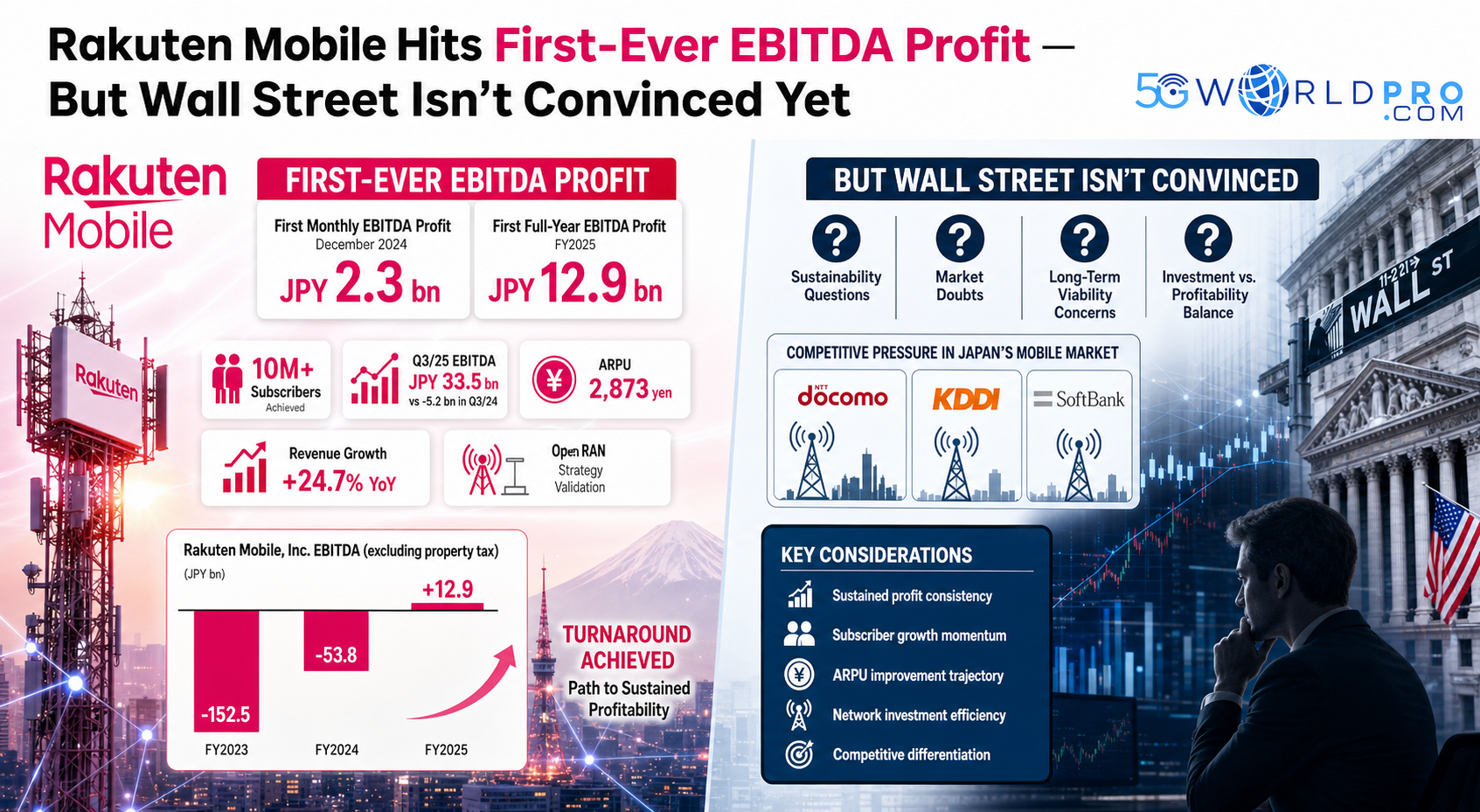
Rakuten Mobile just passed a milestone the Open RAN industry has been waiting years for: its first-ever quarterly EBITDA profit. This comes alongside record consolidated revenue for parent company Rakuten Group. Rakuten Mobile Hits First-Ever EBITDA Profit – But Wall Street Isn’t Convinced Yet, and on paper, that’s the vindication moment for the world’s most closely watched cloud-native, Open RAN-based mobile network. In fact, Rakuten Mobile Hits First-Ever EBITDA Profit – But Wall Street Isn’t Convinced Yet is the headline for this turning point. In practice, investors reacted by sending Rakuten’s stock down as much as 14% in a single day. It was the steepest drop in over two years. The gap between those two reactions says a lot about where Open RAN economics actually stand in 2026.
The numbers behind the milestone
Rakuten Mobile turned over JPY101.3 billion (about $637.8 million) in the quarter ending June 30, up 11.9% year-on-year. Its subscriber base grew by 1.78 million users to reach 10.75 million. Average revenue per user climbed to JPY2,516, an increase of JPY42 versus the prior year. This is evidence that Rakuten’s strategy of retaining loyal, longer-term subscribers rather than chasing short-term promotional sign-ups is starting to pay off. At the group level, Rakuten reported its first quarterly IFRS operating income since entering the mobile network operator business. This came alongside record-high consolidated revenue and further highlighting Rakuten Mobile Hits First-Ever EBITDA Profit – But Wall Street Isn’t Convinced Yet as a pivotal event.
Why the stock still fell
The market’s reaction wasn’t about the mobile division’s trajectory. Instead, it was about the scale of losses still on the books. Investors focused on continuing losses at Rakuten’s mobile operations, which were little changed from a year earlier. Meanwhile, one-time tax credits and strong fintech segment gains helped the wider Rakuten Group post its first net income in six years. In other words: the mobile unit is improving, but not yet fast enough to offset the years of cumulative investment that built the network from scratch. Wall Street priced that gap immediately.
Rakuten Mobile financial and technical snapshot Q2 FY2026
| Metric | Figure |
|---|---|
| Quarterly mobile revenue | JPY101.3B (~$637.8M), +11.9% YoY |
| Subscriber base | 10.75 million (+1.78M in the quarter) |
| ARPU | JPY2,516 (+JPY42 YoY) |
| Group-level milestone | First quarterly IFRS operating income since entering MNO business |
| Mobile division milestone | First-ever quarterly EBITDA profit |
| Stock reaction | Down as much as 14%, steepest drop in 2+ years |
What’s actually running under the hood
Rakuten’s mobile division isn’t just a financial story it remains the industry’s flagship proof point for cloud-native, disaggregated network architecture at national scale. Two recent technical milestones stand out:
Nokia’s IMS and SDM are now live on Rakuten Cloud, powering both 4G and 5G core voice and subscriber data management reinforcing that Rakuten’s cloud-native core strategy extends well beyond radio access into the full service layer.
Rakuten Mobile has received what it describes as a world-first Level 4 autonomy validation for RAN energy efficiency optimization in a live Open RAN network a concrete data point in the industry’s push toward the TM Forum’s higher autonomous-network maturity levels, and a rare case of that maturity being validated in a live commercial network rather than a lab environment.
Alongside this, Rakuten Mobile has continued expanding its RIC (RAN Intelligent Controller) footprint nationwide with third-party rApp integration. It has also announced plans to launch satellite-to-mobile service in Japan with AST SpaceMobile starting in 2026. This extends its converged connectivity ambitions beyond terrestrial 5G.
What this means for the Open RAN industry
Profitability is achievable, but the timeline is longer than early Open RAN pitches suggested. Rakuten launched its network in 2020. It took roughly six years to reach a first EBITDA-positive quarter at the mobile division level. This is now a useful, realistic data point for any operator or investor modeling the economics of a greenfield Open RAN buildout. Notably, Rakuten Mobile Hits First-Ever EBITDA Profit – But Wall Street Isn’t Convinced Yet continues to be discussed throughout the industry.
The technology case and the financial case are running on separate tracks. Rakuten’s technical achievements cloud-native core, validated AI-driven RAN autonomy, nationwide RIC deployment are arguably ahead of the rest of the industry. However, its financial case is only now catching up. Therefore, the two shouldn’t be conflated when evaluating Open RAN as a strategy.
Subscriber growth quality matters more than headline additions. The shift toward loyal, longer-term subscribers and a rising ARPU suggests Rakuten is prioritizing sustainable unit economics over raw subscriber count growth. This is a maturing signal for a network that spent its early years focused primarily on price-driven acquisition. Thus, Rakuten Mobile Hits First-Ever EBITDA Profit – But Wall Street Isn’t Convinced Yet is more than just a financial headline; it’s a reflection of shifting priorities for the company.
Frequently asked questions
Has Rakuten Mobile turned profitable? Its mobile division posted its first-ever quarterly EBITDA profit in Q2 FY2026, and Rakuten Group posted its first quarterly IFRS operating income since entering the mobile business. However, the mobile unit’s net losses were largely unchanged year-on-year, which is what drove the negative stock reaction.
Why did Rakuten’s stock drop after posting record revenue? Investors focused on persisting losses at the mobile division rather than the group-level revenue record. This is because one-time tax credits and fintech gains, not the mobile business, drove most of the group’s net income improvement.
What is Rakuten Mobile’s Level 4 autonomy validation? It refers to a world-first validation of RAN energy efficiency optimization operating at Level 4 autonomy. This is a high tier on the industry’s autonomous-network maturity scale. It is also running in a live, commercial Open RAN network rather than a lab trial.
Is Rakuten Mobile still expanding its network capabilities? Yes. Recent moves include Nokia’s cloud-native IMS/SDM going live on Rakuten Cloud, nationwide RIC deployment with third-party rApp integration, and a planned satellite-to-mobile service with AST SpaceMobile.
Going deeper
Rakuten Mobile remains one of the clearest real-world case studies for how Open RAN, cloud-native cores, and AI-driven RAN automation perform at national scale. This includes both the technical wins and the financial trade-offs. Our 5G training catalog and 5G Core and 5G Slicing training cover the architecture behind deployments like this one.
Sources: Rakuten Group Q1/Q2 FY2026 financial disclosures, Rakuten Mobile press releases, Bloomberg, Telecoms.com. This article is part of our ongoing coverage of Open RAN deployments and operator financial performance.
Benefit from Massive discount on our 5G Training with 5WorldPro.com
Start your 5G journey and obtain 5G certification
contact us: contact@5GWorldPro.com