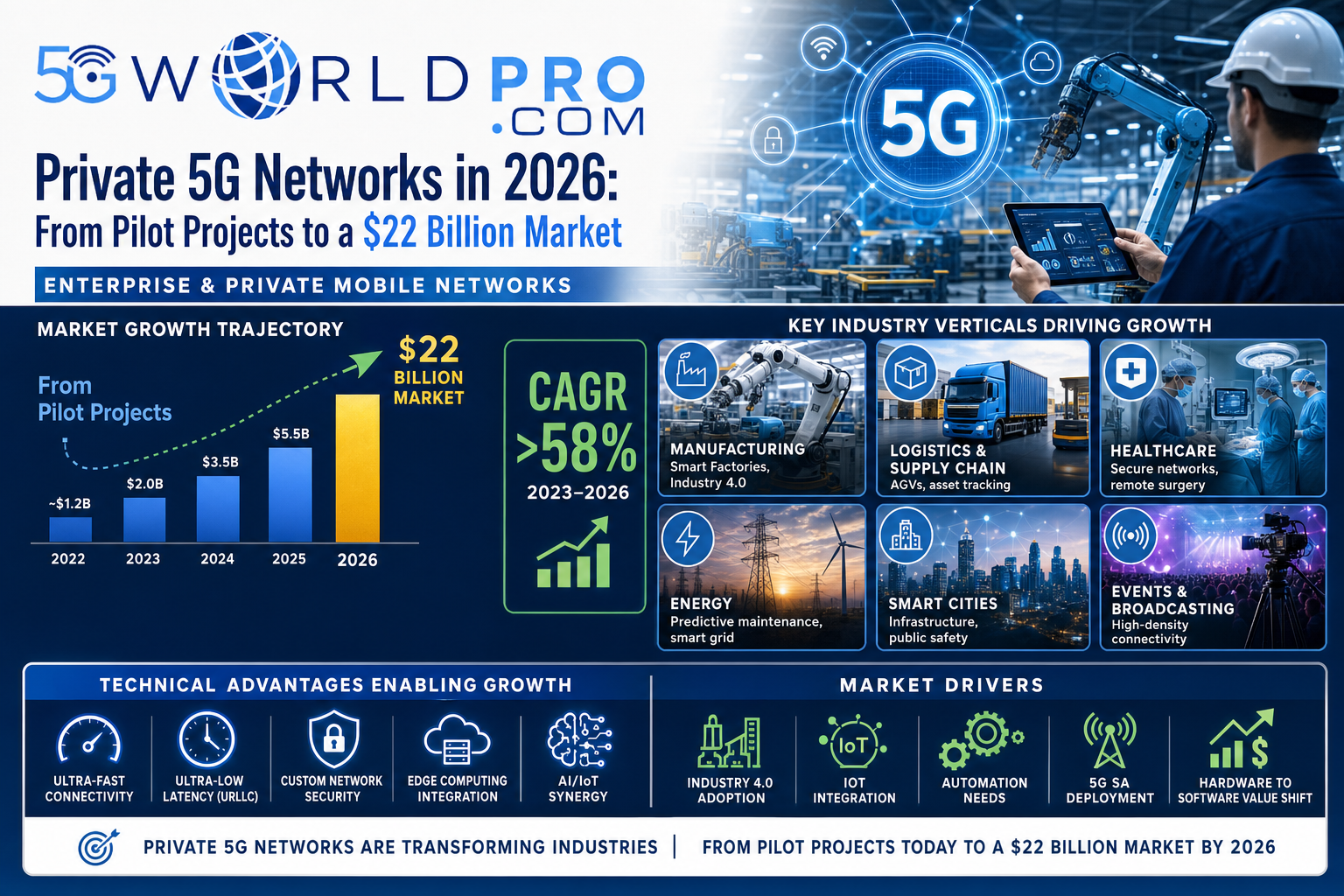
For most of the past five years, private 5G has been described the same way: a promising technology still looking for its first wave of real, paying deployments. That description no longer holds. Private 5G Networks in 2026: From Pilot Projects to a $22 Billion Market describes the transformation happening in this sector. Analysts now put the private networking market on track to top $22 billion by 2030. The deployments backing that forecast aren’t pilots anymore. Instead, they’re operational networks running ports, factories, and utilities. At the same time, the definition of “private network” itself is expanding. Vendors are now starting to bundle 5G, Wi-Fi, and satellite under a single, AI-managed connectivity layer.
Japan shows what “past the pilot stage” actually looks like
Japan’s private 5G sector offers one of the clearest signals of where the market is heading. Beyond nationwide coverage milestones, Japan’s private 5G sector is finally moving from demonstration projects into real operational deployments. Moreover, spending is forecast to grow at a 55% compound annual rate through 2030 as ports, manufacturers, and utilities put networks to work. That’s not a research budget growth rate. Instead, that’s the growth rate of a market that has found its use cases and is now scaling them.
The market is converging, not just growing
The more interesting shift isn’t the size of the market. Instead, it’s what’s being sold as “private 5G” today. Celona’s new Orion platform illustrates this well. It is described as an agentic converged wireless platform and adds Wi-Fi and satellite support on top of Celona’s traditional private 5G foundation. Agentic AI manages connectivity decisions across all three technologies. The pitch is no longer “deploy private 5G instead of Wi-Fi.” Rather, it’s a single management layer that decides which radio technology handles which device in real time, without an engineer manually configuring the handoff.
Globalstar’s Xcom RAN tells a similar story but from a different angle. Its private 5G platform leverages distributed MU-MIMO antenna technology and shared spectrum in the CBRS and C-band ranges. It is designed specifically to run mission-critical industrial workloads, which is the same enterprise segment driving Japan’s growth numbers.
Private 5G market snapshot, 2026
| Metric | Figure |
|---|---|
| Private networking market forecast by 2030 | $22 billion+ |
| Japan private 5G spending growth (CAGR through 2030) | 55% |
| Leading private 5G use cases | Ports, manufacturing, utilities, mining |
| Emerging convergence trend | 5G + Wi-Fi + satellite under one AI-managed layer |
| Key shared-spectrum bands in use | CBRS, C-band (mid-3 GHz) |
| Release 18 addition relevant to private networks | Sub-5 MHz bandwidth support for narrowband private deployments |
Spectrum is quietly becoming the real enabler
3GPP Release 18 the first set of 5G-Advanced specifications adds support for 5G NR equipment operating in dedicated spectrum with less than 5 MHz of bandwidth, opening the door to private 5G networks in sub-500 MHz, 700 MHz, 850 MHz, and 900 MHz bands built specifically for public safety broadband, smart grid modernization, and next-generation railway communication systems (FRMCS). This matters because it removes one of the biggest practical barriers to private network deployment: the assumption that you need wide, expensive spectrum blocks to make a private 5G network worthwhile. Narrowband private deployments open the door to use cases like distributed smart grid sensors that never needed broadband speeds in the first place.
What this means for enterprises evaluating private networks
Growth is now demand-driven, not vendor-driven. When a market grows at a 55% CAGR in a single country, that’s enterprises pulling deployments forward to solve real operational problems. It is not vendors pushing a narrative.
The build vs. converge decision is changing. Enterprises no longer have to choose a single wireless technology upfront. In contrast, platforms bundling 5G, Wi-Fi, and satellite under one AI-managed layer mean the deployment decision can shift. Instead of asking “which network do we build,” enterprises consider “which network handles which zone of our facility.”
Spectrum flexibility is lowering the entry point. Release 18’s narrowband support means private 5G is no longer only viable for enterprises that can secure wide spectrum allocations. Now, it’s a realistic option for narrower, sensor-heavy deployments too.
Frequently asked questions
How big is the private 5G market expected to become? Forecasts put the broader private networking market at over $22 billion by 2030. This is driven largely by industrial, port, and utility deployments.
Why is Japan’s private 5G market growing so fast? Japan’s private 5G sector has moved past demonstration projects into operational deployments across ports, manufacturing, and utilities. As a result, spending is forecast to grow at a 55% compound annual rate through 2030.
What does “converged” private networking mean? It refers to platforms like Celona’s Orion that manage 5G, Wi-Fi, and satellite connectivity together under a single AI-driven layer. This replaces the need for separate networks and separate management for each technology.
Does private 5G always require wide spectrum bands? No. 3GPP Release 18 added support for 5G NR in narrowband spectrum under 5 MHz. This enables private deployments in narrower bands for use cases like smart grid monitoring and public safety.
Going deeper
Understanding how private 5G architecture, spectrum options, and multi-technology convergence fit together is exactly the kind of foundation that turns a market forecast into a deployment plan. Our 5G private network training and full 5G training catalog cover this ground in depth.
Sources: GSA (Global mobile Suppliers Association), RCR Wireless, Light Reading, 3GPP Release 18 documentation, industry disclosures from Celona and Globalstar. This article is part of our ongoing coverage of private network deployment and 5G-Advanced spectrum developments.
Benefit from Massive discount on our 5G Training with 5WorldPro.com
Start your 5G journey and obtain 5G certification
contact us: contact@5GWorldPro.com