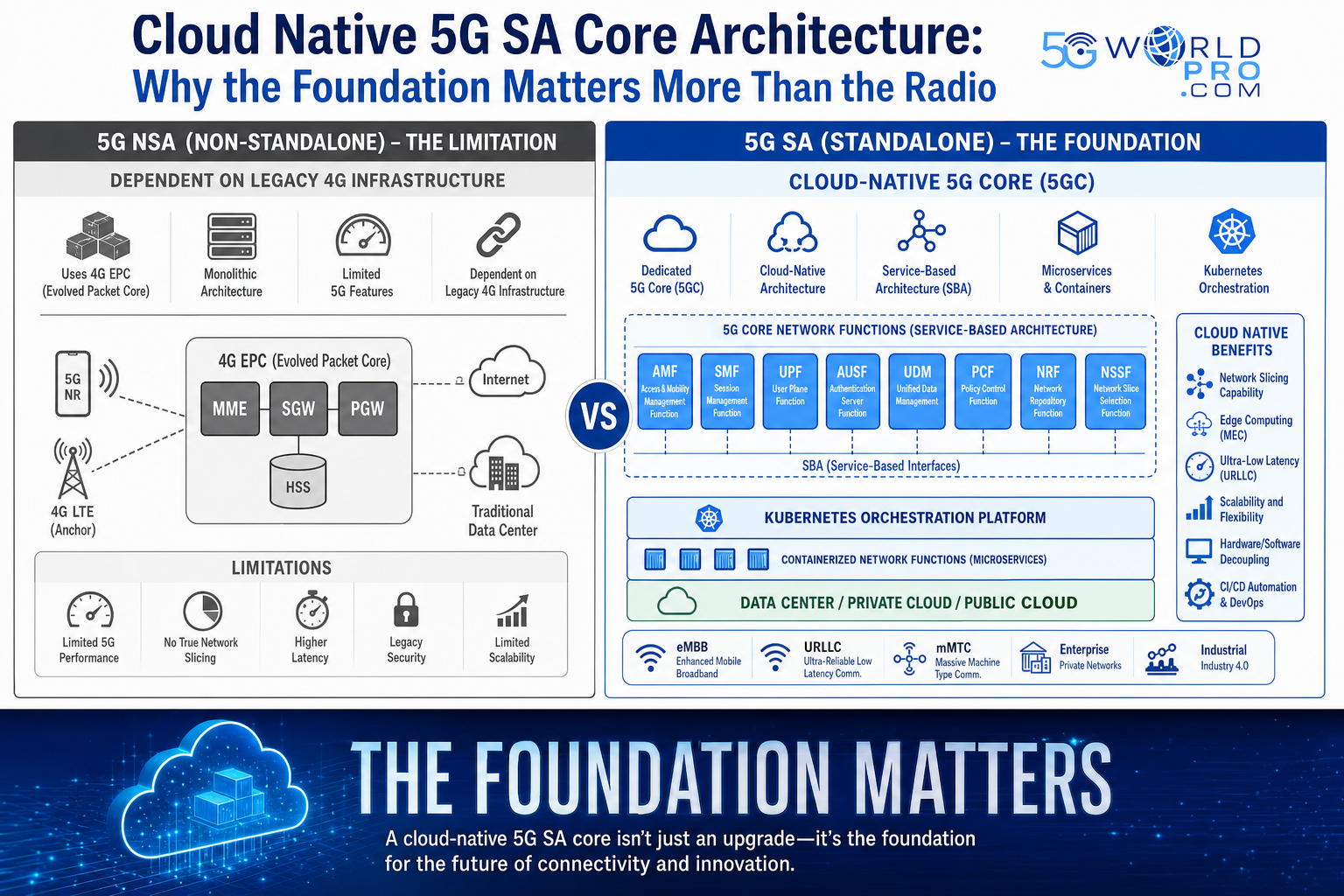
Most of the public conversation about 5G still centers on the radio faster speeds, lower latency, new spectrum bands. But the architectural shift that actually unlocks 5G’s differentiated features happens in the core, not the air interface. 5G Standalone (SA) is the deployment architecture where the gNB connects directly to the 5G Core without relying on 4G LTE infrastructure, handling both control plane and user plane independently. And that core is built from the ground up as a cloud-native, service-based system. This is a fundamentally different design philosophy from anything 4G ever ran on. Cloud Native 5G SA Core Architecture: Why the Foundation Matters More Than the Radio is central to understanding this transformation.
Service-Based Architecture (SBA): the core design shift
Unlike the point-to-point interfaces of 4G EPC, the 5G Core is built around a Service-Based Architecture, where network functions AMF (Access and Mobility Management Function), SMF (Session Management Function), UPF (User Plane Function), and others expose and consume services through standardized APIs over an HTTP/2-based service bus. Each function can be scaled, updated, or replaced independently. That modularity is precisely what makes network slicing viable. Every slice can instantiate the specific combination of core functions it needs, rather than sharing a single fixed monolithic core.
Containers, not virtual machines
The practical implementation of this cloud-native core increasingly runs on Kubernetes-orchestrated containers rather than traditional VMs. This isn’t a cosmetic infrastructure choice. It directly determines how fast an operator can scale core functions under load. Additionally, it affects how resilient the network stays when a single container fails. It also determines how quickly new features ship. The same cloud-native pattern extends into the RAN: Open RAN deployments already run as disaggregated, cloud-native systems on Linux containers, managed through APIs and increasingly automated through AI via the RAN Intelligent Controller meaning the skill set for operating a cloud-native core and a cloud-native RAN increasingly overlaps.
SA core building blocks at a glance
| Layer | Legacy 4G EPC | Cloud-native 5G SA Core |
|---|---|---|
| Architecture style | Monolithic, point-to-point interfaces | Service-Based Architecture (SBA), API-driven |
| Deployment unit | Dedicated hardware / VMs | Kubernetes-orchestrated containers |
| Key control functions | MME, HSS, PGW-C | AMF, SMF, UDM |
| Key user-plane function | SGW/PGW-U | UPF (distributable to the network edge) |
| Scaling model | Vertical (bigger boxes) | Horizontal (more container instances) |
| Enables network slicing | No | Yes – natively |
| Enables RedCap/eRedCap IoT | No | Yes – requires genuine SA |
Why SA is the prerequisite, not an optional upgrade
A recurring misunderstanding including among consumers checking whether their phone “supports 5G” is treating SA as a bonus feature layered on top of NSA (Non-Standalone) 5G. In practice, SA is the prerequisite architecture for nearly every advanced 5G capability: network slicing, native edge computing integration, reduced latency through direct NG interfaces (NG-C to AMF, NG-U to UPF), and newer device categories like RedCap, which cannot function the same way anchored to a 4G core.
What this means for network planning
For operators, the sequencing question isn’t “when do we add SA features” it’s “when is our SA core mature enough to support the features we’ve already promised the market.” Slicing SLAs, low-latency enterprise use cases, and RedCap-based IoT services all depend on core maturity, not radio coverage alone. That’s why SA rollout geography concentrated in dense urban and enterprise-heavy markets first tracks so closely with where these advanced use cases actually go live.
Frequently asked questions
What makes a 5G core “cloud-native”? It means the core network functions (AMF, SMF, UPF, etc.) run as containerized microservices orchestrated by platforms like Kubernetes, communicating through standardized APIs, rather than as dedicated hardware appliances or fixed VMs.
Do I need 5G SA to get network slicing? Yes. Network slicing depends on the Service-Based Architecture of the 5G Core to instantiate independent, isolated combinations of network functions per slice something a 4G-anchored NSA deployment cannot support.
Why does RedCap require SA? RedCap and eRedCap devices connect through the 5G RAN directly into the 5G Core’s native interfaces. Without a real SA core, the reduced-complexity connection path RedCap depends on isn’t available.
Is 5G SA the same everywhere a carrier advertises “5G”? No. Many “5G” deployments still run NSA, anchored to a 4G core. Genuine SA and everything built on top of it is currently concentrated in the markets and areas where operators have completed the core buildout.
Going deeper
Understanding Service-Based Architecture, container orchestration, and network slicing together rather than as separate topics is what actually maps to how operators plan real deployments. Our 5G Core and 5G Slicing training covers exactly this intersection, and our full 5G training catalog covers the surrounding architecture end to end.
Sources: 3GPP TS 23.501 (5G System Architecture), GSMA and operator public disclosures on SA rollout, industry analysis on cloud-native network functions and Open RAN. This article is part of our ongoing coverage of 5G core and RAN architecture.
Benefit from Massive discount on our 5G Training with 5WorldPro.com
Start your 5G journey and obtain 5G certification
contact us: contact@5GWorldPro.com