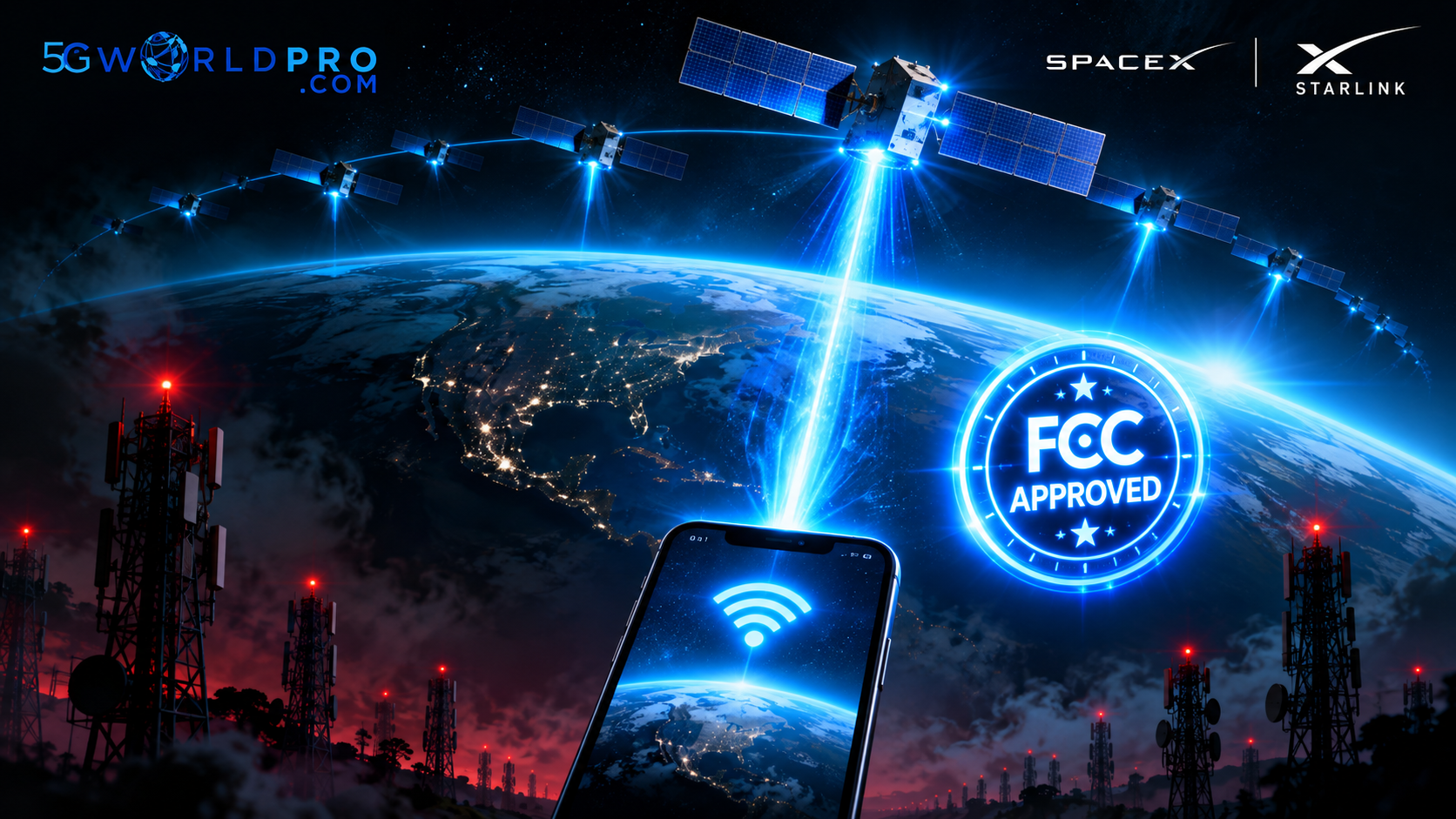
Starlink Mobile FCC approval just turned a domestic satellite service into a globally licensed carrier. On September 17, the Federal Communications Commission granted Space Exploration Holdings LLC global facilities-based and resale authority under Section 214. This is the specific license that lets a company legally act as the carrier of record for calls and data crossing international borders. It’s a procedural filing, not a flashy product launch. However, it removes one of the last regulatory walls standing between SpaceX’s satellite-to-phone ambitions and a genuinely global mobile service.
What the FCC Actually Approved
Section 214 authority is the FCC’s specific mechanism for clearing carriers to route telecommunications traffic between the United States and foreign destinations. Until this grant, SpaceX’s approvals covered US territory only. The company could build out Starlink Mobile domestically. However, cross-border service required this separate, additional authorization. That gap is now closed. Public Notice DA 26-998 confirms the grant covers both global facilities-based authority and global resale authority. As a result, this gives SpaceX the legal foundation to carry Starlink Mobile sessions that touch the United States rather than limiting the service to purely domestic routing.
Importantly, this approval doesn’t flip a global switch overnight. It doesn’t authorize Starlink Mobile in every foreign market outright. SpaceX still needs local spectrum rights and telecom permissions country by country. What it does is strengthen SpaceX’s ability to carry international traffic. This comes precisely as its satellite-to-phone footprint keeps expanding.
The Scale Already in Orbit
The approval lands on top of infrastructure that’s already substantial. SpaceX says roughly 650 direct-to-mobile satellites are currently in orbit. The network is positioned to reach approximately 1.9 billion people across six continents. Starlink Mobile today supplements terrestrial networks through carrier partnerships. These include T-Mobile in the US, KDDI in Japan, Rogers in Canada, and operators across Australia, New Zealand, and the Philippines.
The timing of the FCC grant is notable. On the same day, Starlink announced its next-generation Mobile service with Japan’s au. The service will lean on newer V2 satellites for denser capacity, native calls, and streaming. This explicitly targets full 5G-equivalent connectivity from space rather than the more limited messaging and data services of earlier generations.
Starlink Mobile FCC Approval Timeline at a Glance
| Date | Development |
|---|---|
| 2022 | SpaceX and T-Mobile first announce direct-to-cell partnership |
| Prior domestic approvals | SpaceX cleared to use T-Mobile’s cellular frequencies via Gen2 Starlink constellation for US coverage |
| September 17, 2026 | FCC grants international Section 214 authority (global facilities-based + resale) |
| Same week | Starlink Mobile V2 service with Japan’s au announced, targeting full 5G speeds |
| Satellites in orbit (direct-to-mobile) | ~650, with additional expansion pending separate FCC review |
| Estimated global reach | ~1.9 billion people across six continents |
| Still required for full international rollout | Local spectrum rights and telecom permissions, market by market |
Why a Procedural Filing Matters This Much
International carrier status is a prerequisite, not a formality. Without Section 214 authority, SpaceX could operate Starlink Mobile within US borders but had no legal path to bill, route, or carry traffic crossing into other countries a hard regulatory ceiling on any ambition to compete with the roaming and international plans traditional carriers already offer.
It arrives alongside real commercial momentum, not just paperwork. The same week produced a Starlink Mobile video call test with FASTWEB in central Italy and continued rollout momentum with Panama’s +Móvil signals that this approval is landing on top of an already-moving commercial pipeline, not a standalone announcement.
It’s a building block toward a genuinely independent carrier. Combined with SpaceX’s separately reported plans to build its own terrestrial base stations and its EchoStar spectrum acquisition, the international Section 214 grant is another piece of infrastructure a company would need if its ambition is ultimately to become a self-sufficient global carrier rather than a satellite supplement to existing networks like T-Mobile.
What This Means for the Industry
Satellite-to-mobile regulatory approval is accelerating, not stalling. SpaceX filed for its underlying satellite authorizations more than two years before winning approval. This is a reminder that today’s rapid succession of FCC clearances reflects years of groundwork finally converging, not a sudden regulatory softening.
Carriers should expect the roaming conversation to shift. As SpaceX gains the legal footing to carry international traffic directly, the current model where T-Mobile, KDDI, Rogers, and others each independently strike deals with SpaceX could evolve. Instead, SpaceX could carry more of that cross-border traffic itself.
This is infrastructure, not confirmation of a retail launch date. The public notice names no commercial launch date, no confirmed first batch of partner countries for US-linked roaming, and no consumer pricing. Read it as an enabling license, not proof that phones can already roam onto Starlink Mobile everywhere. Engineers and network planners tracking this space will recognize the underlying pattern from our earlier coverage of private 5G networks and cloud-native 5G SA core architecture: regulatory clearance almost always arrives well ahead of a polished commercial product.
Frequently Asked Questions
What did the FCC actually approve for Starlink Mobile? The FCC granted Space Exploration Holdings LLC international Section 214 authority on September 17, 2026. This is the specific license required to carry telecommunications traffic between the US and foreign countries, covering both global facilities-based and resale authority.
Does this mean Starlink Mobile is now available worldwide? Not automatically. The approval is a US-side enabling license. SpaceX still needs local spectrum rights and telecom permissions in each foreign market before offering commercial service there.
How many satellites does Starlink Mobile currently use? SpaceX reports approximately 650 direct-to-mobile satellites currently in orbit, with additional satellite expansion still under separate FCC review.
Which carriers currently partner with Starlink Mobile? T-Mobile in the US, KDDI in Japan, Rogers in Canada, and operators across Australia, New Zealand, and the Philippines, with Panama’s +Móvil and Italy’s FASTWEB among recent additions.
Going Deeper
Understanding how satellite-to-mobile connectivity, spectrum regulation, and terrestrial 5G networks are converging is exactly the kind of practical knowledge covered in our 5G training catalog, including the architecture behind non-terrestrial network integration.
Sources: Federal Communications Commission Public Notice DA 26-998, Benzinga, MediaSat, PhoneArena, TeslaNorth, BaseNor, TechRadar. This article is part of our ongoing coverage of satellite-terrestrial network convergence and regulatory developments shaping 5G and beyond.
Benefit from Massive discount on our 5G Training with 5WorldPro.com
Start your 5G journey and obtain 5G certification
contact us: contact@5GWorldPro.com