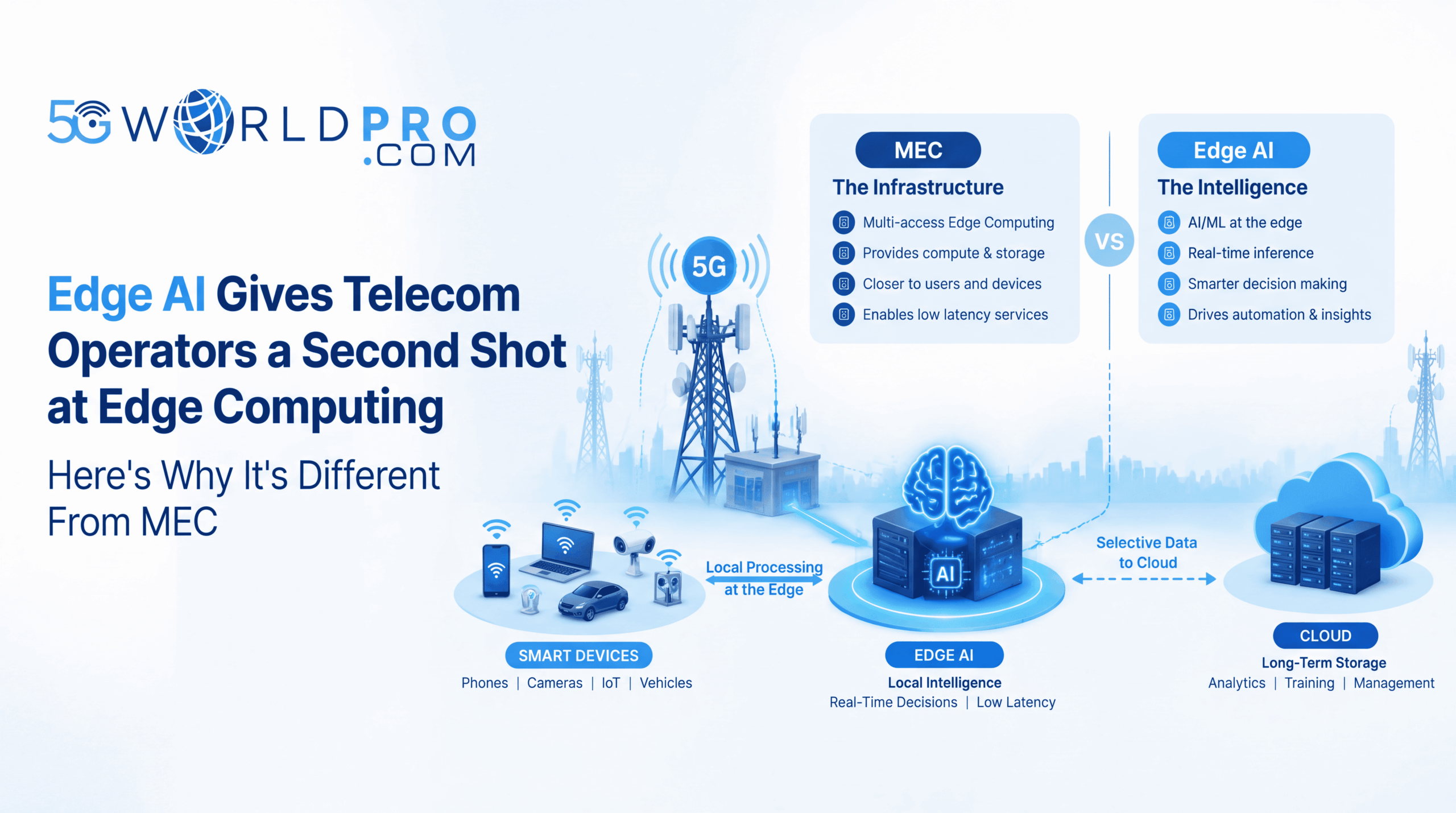
Telecom operators have been here before. A decade of multi-access edge computing (MEC) promised to turn cell sites and central offices into a compute platform enterprises would pay for and largely failed to generate the demand it was built on. Edge AI gives telecom operators a second shot at edge computing here’s why it’s different from MEC. A new strategy report from analyst firm Analysys Mason argues that edge AI is a fundamentally stronger proposition than MEC ever was, precisely because the demand, the ecosystem, and the underlying economics have changed. As AI workloads shift from training to inference, the question isn’t whether distributed compute matters again it’s whether operators will position themselves to capture it this time.
Why MEC Never Took Off
MEC’s core problem wasn’t the infrastructure it was the demand. The use cases were largely engineered top-down, built around what edge sites could theoretically support rather than validated needs enterprises were actually asking to solve. Latency gains were real but narrow, and difficult to translate into revenue. Standards adoption stayed weak, and operators often found themselves dependent on the very hyperscalers and cloud providers that competed with them for the same workloads. Demand never showed up to meet the infrastructure that was built for it.
What’s Actually Different About Edge AI
Analysys Mason’s report identifies five structural differences between the MEC era and today’s edge AI opportunity.
Demand is now organic, not manufactured. AI adoption across enterprise, government, and regulated sectors is generating real, sovereign-data-driven need for distributed inference demand operators don’t have to invent or subsidize into existence.
The use cases carry more value. Rather than just shaving milliseconds off existing applications, edge AI adds genuine intelligence to use cases like video analytics and personalization, while enabling categories that didn’t exist for MEC, such as agentic applications and AI-driven voice services.
The ecosystem has a real anchor. Where MEC relied on fragmented, poorly adopted standards, Nvidia’s compute stack has built a cross-vertical developer base with a direct commercial stake in making distributed inference work, since inference increasingly drives its own growth with other chipset makers now building competing ecosystems around the same opportunity.
Differentiation is harder to copy. MEC-era capabilities were largely interchangeable between providers. Edge AI lets operators bundle connectivity, local compute, and sovereign credentials into offers particularly in regulated industries that are genuinely difficult for non-operators to replicate.
Orchestration has matured. The control-plane tooling needed to manage distributed, GPU-based infrastructure at scale was immature during the MEC years. It’s now developing quickly, backed by open frameworks and real vendor investment.

Metro Edge, Not Far Edge, Is Where Most Operators Should Start
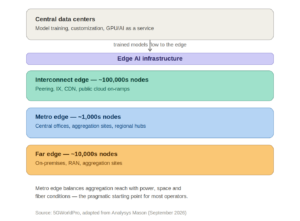
A lot of current industry attention centers on the far edge compute pushed all the way to individual cell sites, driven by AI-RAN. But the report argues metro-level sites central offices, aggregation points, and regional hubs are the more practical starting point for most operators.
The reasoning comes down to the shape of real workloads. Use cases like correlating data across a smart city’s traffic intersections, or supporting an emergency responder’s body camera running live facial or plate matching, depend on aggregating information across many endpoints rather than processing everything locally at a single site. Metro locations sit high enough in the network to pool that data efficiently, while staying close enough to preserve the strict performance guarantees consistent latency under mobility, high concurrency, data sovereignty that these use cases actually require. Metro sites also tend to offer more favorable power, space, fiber, and security conditions than far-edge locations, making them easier to scale as a near-term investment.
Edge AI vs. MEC Key Differences at a Glance
| Factor | MEC Era | Edge AI Era |
|---|---|---|
| Demand | Manufactured, speculative | Organic, driven by real AI adoption |
| Use case focus | Narrow latency gains | Intelligence layered onto existing and new use cases |
| Ecosystem | Fragmented, weak standards adoption | Anchored by Nvidia’s cross-vertical stack and competing chipset ecosystems |
| Operator differentiation | Easily replicated | Bundled connectivity + compute + sovereignty, hard to copy |
| Orchestration tooling | Immature | Maturing rapidly, GPU-aware, open frameworks |
| Recommended starting point | N/A | Metro edge (central offices, aggregation sites, regional hubs) |
| Estimated investment per metro site | N/A | Roughly $2–8 million or more |
What Operators Should Actually Do
Treat better conditions as an opening, not an advantage. Having favorable infrastructure doesn’t automatically translate into a defensible position. The report’s framing is clear: operators need to identify which specific use cases turn their network assets and local credentials into something genuinely hard to replicate.
Expect real capital requirements. Building out metro edge AI capacity realistically requires several million dollars or more per site, making this a serious opportunity mainly for operators with scalable metro footprints, existing enterprise relationships in target verticals, and the appetite to invest. Financial partnerships, co-investment, and leasing repurposed sites are viable ways to scale more capital-efficiently rather than building entirely alone.
Watch the core network’s own evolution. As operators disaggregate the 5G core and push functions like the User Plane Function (UPF) toward the network edge, connectivity and compute increasingly converge at the same metro locations easing the edge AI business case through shared infrastructure costs, and setting up 6G’s eventual move toward in-network inference directly in the data path.
Build toward network slicing and APIs, not just raw compute. Edge AI is likely to increase demand for network slicing and advanced APIs like quality-on-demand capabilities that have so far seen limited uptake, but that are exactly the tools operators need to actually monetize the deterministic connectivity these new use cases require.
Frequently Asked Questions
What is edge AI, and how is it different from MEC? Edge AI refers to running AI inference workloads on distributed infrastructure close to where data is generated, building on the same network sites MEC targeted but with organic enterprise demand, a more mature ecosystem, and stronger differentiation potential than MEC achieved.
Why didn’t MEC succeed for telecom operators? MEC’s use cases were largely built around speculative latency benefits rather than validated demand, standards adoption was weak, and operators often depended on competing hyperscalers to deliver the ecosystem around it.
Should operators prioritize far edge or metro edge for AI infrastructure? Most operators are better positioned starting with metro edge sites central offices, aggregation points, and regional hubs which balance aggregation-friendly positioning with stronger power, space, and connectivity conditions than far-edge cell sites.
How much does it cost to build out metro edge AI infrastructure? Estimates put the investment at roughly $2 to $8 million or more per site, which realistically limits this as a near-term opportunity to operators with scalable metro footprints and existing enterprise relationships.
Going Deeper
Understanding how distributed AI infrastructure, 5G core disaggregation, and network slicing intersect is exactly the kind of forward-looking knowledge covered in our 5G Core and 5G Slicing training and full 5G training catalog.
Source: Analysys Mason, “Edge AI: why telecoms operators should look again at edge computing” (September 2026), based on the firm’s report “From MEC to edge AI: capturing the distributed AI infrastructure opportunity.” This article is part of our ongoing coverage of edge computing and AI infrastructure strategy for telecom operators.
Benefit from Massive discount on our 5G Training with 5WorldPro.com
Start your 5G journey and obtain 5G certification
contact us: contact@5GWorldPro.com