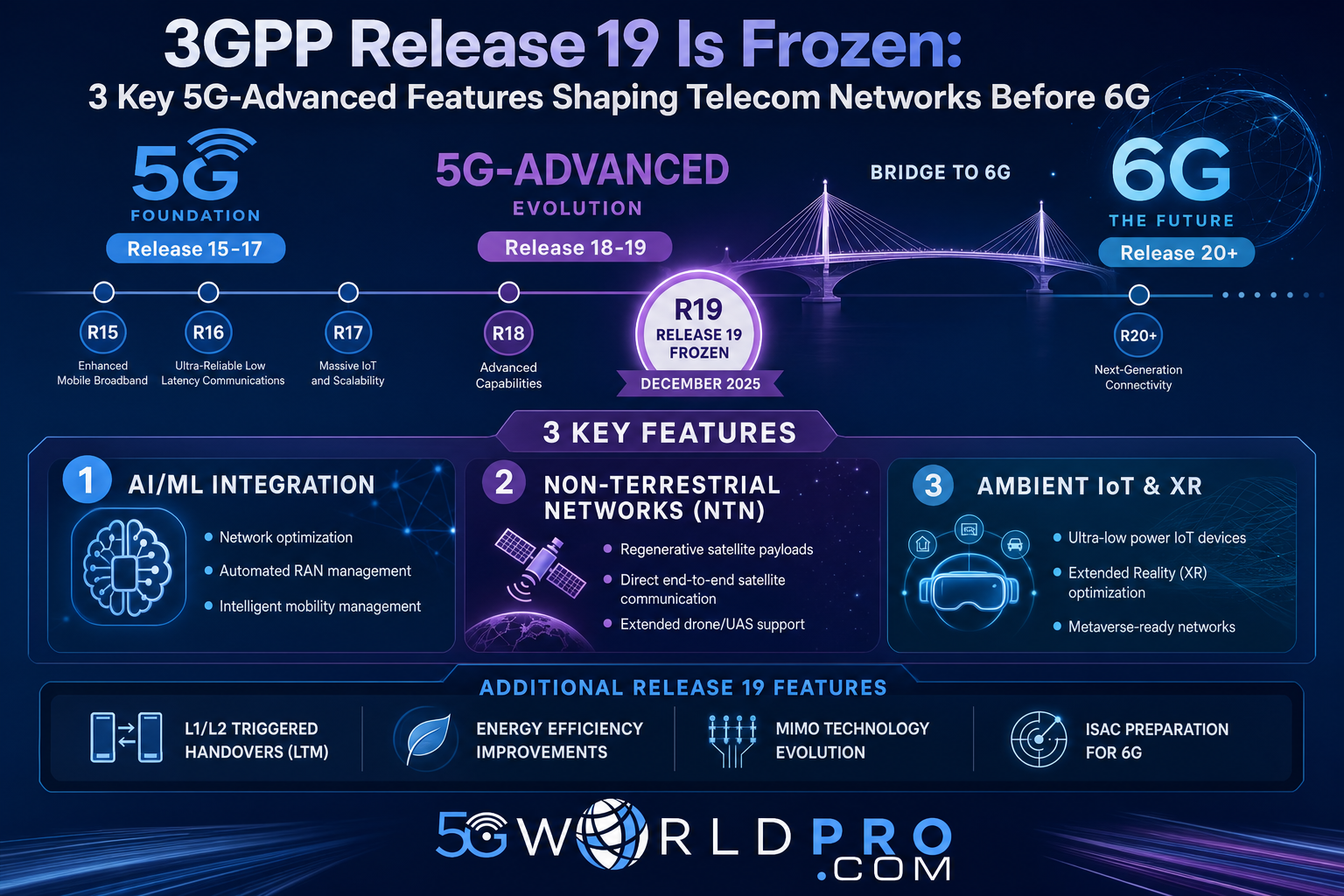
3GPP officially froze Release 19 following the quarterly Technical Specification Group plenary meetings held in Baltimore in December 2025. With Release 19 now closed to further development beyond corrections and implementation fixes, the standards body has shifted its full attention to Release 20. Notably, Release 20 combines further 5G-Advanced enhancements with the first formal study phase for 6G. If you’re following telecom innovation, it’s important to note that 3GPP Release 19 Is Frozen: 3 Key 5G-Advanced Features Shaping Telecom Networks Before 6G. Therefore, that makes Release 19 a genuine milestone. It’s widely described as the last release fully dedicated to 5G evolution before the industry’s attention formally splits toward 6G.
Release 19 doesn’t reinvent 5G. Rather, it consolidates and matures it. But three feature areas stand out as the ones that will actually shape live networks over the next two to three years. This will occur well before any 6G specification exists to replace them.
1. Non-Terrestrial Networks move from “connected” to “onboard intelligence”
Release 17 first brought normative satellite connectivity to 5G. Release 18 added FR2 (Ku/Ka-band) support for higher-bandwidth terminals. Release 19 pushes NTN further with regenerative payload support. This allows satellites to run 5G system functions directly onboard, rather than simply relaying signal transparently back to a ground station. The release also adds new reference satellite payload parameters to handle reduced power density per beam. In addition, there are uplink capacity improvements for IoT-NTN traffic, and notably RedCap device support extended into satellite connectivity itself.
This matters because it changes what “satellite-to-mobile” actually means architecturally. A regenerative payload can perform onboard processing instead of routing every signal back through a terrestrial gateway. As a result, this materially improves latency and resilience for direct-to-device satellite services. This is the same category of service several major operators are now actively rolling out.
2. AI/ML becomes a native part of the radio and core, not an add-on
Release 18 introduced the first data collection and signaling framework for AI/ML-based network energy savings, load balancing, and mobility optimization at the RAN level. Release 19 goes further, introducing AI/ML support for optimizing network slicing resource allocation and for dynamically adapting cell and beam coverage through cell shaping. On the core side, Release 19 prioritizes AI/ML-assisted positioning through a Location Management Function (LMF)-based model. This covers how the model is trained, how data is collected, and how inference is performed.
This is a meaningful shift from earlier releases, where AI/ML was largely confined to isolated optimization tasks. Release 19 starts treating AI/ML as infrastructure. Now, different network functions slicing, mobility, and positioning can draw on it directly. This is precisely the direction the industry needs standardized before autonomous network operations can scale beyond single-vendor pilots.
3. Energy efficiency becomes a design principle, not a patch
Building on Release 18’s network energy consumption model, Release 19 introduces on-demand Synchronization Signal Block (SSB) transmission in secondary cells and adaptive periodicity for SSB, paging, and random access occasions. These are both triggered dynamically rather than transmitted continuously. Combined with low-power wake-up signal and receiver (LP-WUS/WUR) specifications, these changes reduce always-on transmissions. Furthermore, they enable deeper device sleep states.
The significance here isn’t a single dramatic feature. Rather, it’s that energy efficiency is now treated as a first-class design criterion across both network and device sides. This comes instead of being a secondary optimization layered on top of already-finalized architecture.
Release 19 at a glance
| Area | Release 18 (baseline) | Release 19 (this freeze) |
|---|---|---|
| NTN | FR2 (Ku/Ka-band) support, mobility between terrestrial/NTN | Regenerative payloads, RedCap over satellite, uplink capacity gains |
| AI/ML | Data collection framework for energy savings, load balancing | Slicing resource allocation, cell shaping, LMF-based positioning |
| Energy efficiency | Network energy consumption model | On-demand SSB, adaptive periodicity, LP-WUS/WUR |
| IoT / RedCap | RedCap introduced | RedCap Phase 2 (NR-Light enhancements), power class 2 RedCap in FR1 |
| Broadcast | – | Native NR replacement for LTE eMBMS (5G Broadcast/MBS, SFN mode) |
| Status (2026) | Implementation phase | Frozen – corrections and fixes only |
Why this matters beyond the standards documents
Field deployments start in 2026, not years from now. Freezing Stage 3 specifications means protocols, message formats, and procedures are stable enough for vendors and operators to build against. Engineers already working with RAN and core signaling should expect to see the first Release 19 information elements appearing in live network traces this year.
Release 19 is a bridge, not a dead end. Several of its key technology components AI/ML integration, NTN maturity, energy efficiency mechanisms are explicitly positioned as precursors to 6G building blocks, alongside two new Release 19 study items on channel modeling for Integrated Sensing and Communication (ISAC) and 7–24 GHz spectrum, both feeding directly into early 6G work.
5G Broadcast finally replaces LTE eMBMS. The native NR mechanism, including Single Frequency Network (SFN) mode, unlocks broadcast over wide geographic areas without consuming unicast resources with immediate applications in public warning systems, stadium event streaming, and over-the-air firmware updates for IoT fleets.
Frequently asked questions
When was 3GPP Release 19 frozen? Release 19 was frozen following the December 2025 TSG plenary meetings in Baltimore, with protocol stability and ASN.1 freeze finalized by SA#110 in December 2025.
Is Release 19 the last 5G release? It’s widely described as the last release fully dedicated to 5G evolution. Release 20 continues 5G-Advanced work but also opens the first formal 6G study items.
What’s the biggest NTN change in Release 19? Support for regenerative payloads satellites running 5G system functions onboard rather than transparently relaying signal. This is combined with RedCap device support extended to satellite connectivity.
Does Release 19 change how AI/ML is used in 5G networks? Yes. It extends AI/ML beyond isolated optimization tasks introduced in Release 18 into network slicing resource allocation, dynamic cell/beam shaping, and core-level positioning support.
Going deeper
Release 19’s AI/ML, NTN, and energy-efficiency features build directly on 5G-Advanced foundations. These are increasingly central to how operators plan next-generation deployments. Our 5G training catalog and 5G Core and 5G Slicing training cover this architecture in depth.
Sources: 3GPP TR 21.919 (Release description; Release 19), 3GPP TSG plenary reports (Baltimore, December 2025), Ericsson Release 19 technical overview, industry analysis from Critical Communications Review, HiCellTek, and 3G4G Blog. This article is part of our ongoing coverage of 3GPP standards evolution toward 6G.
Benefit from Massive discount on our 5G Training with 5WorldPro.com
Start your 5G journey and obtain 5G certification
contact us: contact@5GWorldPro.com