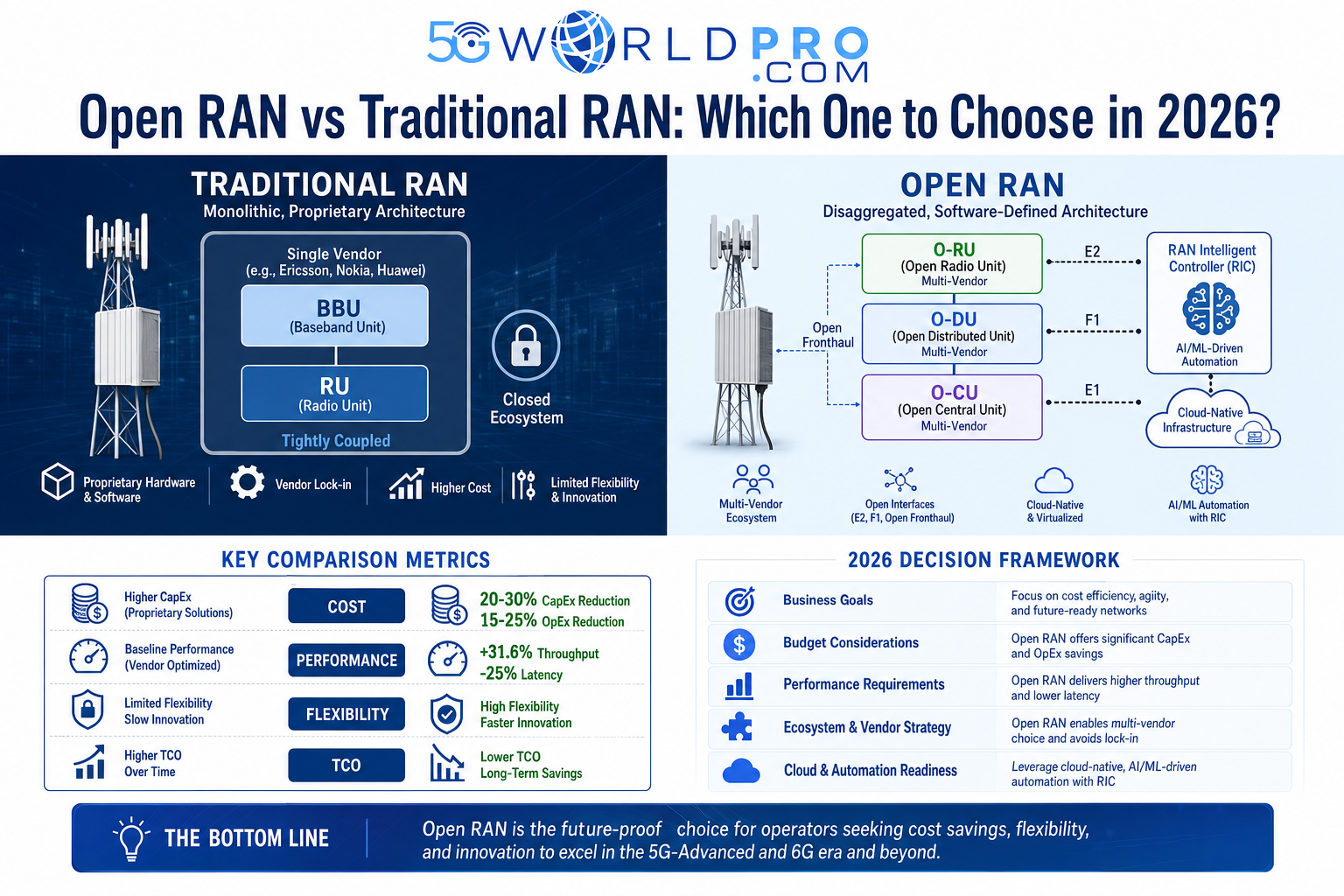
Search “Open RAN cost savings” and you’ll find studies claiming anywhere from 30% cheaper to 20% more expensive than traditional RAN for the same basic technology. That’s not analysts disagreeing on facts. Instead, it’s a sign that “Open RAN vs. traditional RAN” isn’t a single question with a single answer. The debate of Open RAN vs Traditional RAN: Which One to Choose in 2026? depends heavily on deployment scenario and vendor maturity. Moreover, it also depends on what an operator is actually optimizing for. Here’s an honest breakdown of where things actually stand in 2026.
The core architectural difference
Traditional RAN ships hardware and software tightly integrated from a single vendor. Ericsson, Nokia, or Huawei, historically. That integration is exactly why it works reliably out of the box. Furthermore, it’s why switching vendors later is expensive and slow. Everything is built to work with everything else from the same supplier, by design.
Open RAN, based on O-RAN Alliance specifications, disaggregates that stack. It separates radio units (RU), distributed units (DU), and centralized units (CU), so components from different vendors can interoperate through open, standardized interfaces. The goal is to let operators mix and match best-of-breed components. This avoids being locked into one supplier’s full stack.
| Traditional RAN | Open RAN | |
|---|---|---|
| Vendor model | Single vendor, tightly integrated | Multi-vendor, standardized interfaces |
| Upfront deployment complexity | Lower one vendor manages integration | Higher operator or integrator manages multi-vendor integration |
| Vendor lock-in | High | Low, by design |
| Maturity | Decades of field-proven deployment | Still early-stage at scale |
| Innovation velocity | Tied to one vendor’s roadmap | Faster in theory no single-vendor bottleneck |
The TCO debate: why the numbers don’t agree
This is the part most comparison articles gloss over. Total cost of ownership (TCO) studies on Open RAN genuinely disagree, and it’s worth understanding why rather than just picking one number to quote:
- Analysys Mason (2022) found Open RAN could deliver up to 30% TCO savings but only “with the right platform strategy and skill set,” a significant caveat.
- NEC puts average structural cost-cutting closer to 20%, achieved mainly through cloud-native, general-purpose hardware replacing proprietary equipment.
- A 2026 industry analysis found the opposite: Open RAN deployments currently cost 10–20% more than traditional solutions over a five-year TCO horizon, once integration complexity and multi-vendor support overhead are factored in.
- Broadband Library / 5G Challenge summarized the state of research bluntly: TCO estimates range from 10% to 50% savings, “with a few suggesting it will actually cost more than traditional deployments.”
The honest takeaway: Open RAN’s cost advantage is not guaranteed. It depends heavily on deployment scenario (greenfield vs. brownfield), how mature the operator’s integration skills and platform strategy are, and how much of the “savings” get eaten by fronthaul and integration costs that traditional single-vendor deployments don’t have to deal with.
What’s actually driving up Open RAN costs in real deployments
A few specific, recurring cost and complexity issues show up across multiple 2026 analyses:
- Integration timelines run 30–50% longer than traditional RAN rollouts, since the operator (or a systems integrator) now owns work a single vendor used to handle internally.
- Fronthaul requirements are expensive. Enhanced Common Public Radio Interface (eCPRI) fronthaul needs 25G+ bandwidth to support massive MIMO infrastructure spending that can exceed whatever vendor-diversification savings Open RAN was supposed to deliver.
- Supply chain overlap undercuts the diversification pitch. Even when RAN components come from different named vendors, many rely on the same small set of underlying chipsets meaning “multi-vendor” doesn’t always mean genuinely independent supply chains.
Where the market actually stands in 2026
Despite the cost debate, adoption keeps climbing for reasons that go beyond pure TCO. Open RAN accounted for roughly 5% of the total RAN market in 2025, with projections putting that figure as high as 28% by 2029. Dell’Oro Group has forecast Open RAN revenue could reach close to $20 billion, roughly double its February 2021 projection, with as much as a third of total global RAN spend by 2026 an estimated $11 billion going toward open RAN investment specifically.
A meaningful share of that momentum is policy-driven rather than pure cost-driven. Open RAN has become central to telecom policy in Western markets largely due to security concerns about Chinese equipment vendors. For example, the US NTIA’s $1.5 billion Open RAN funding program and the UK’s £250 million Open Networks R&D Fund are both explicitly aimed at building out alternative, trusted vendor ecosystems, not just chasing lower TCO. As a result, that’s created genuinely distinct regional markets. Western operators are increasingly adopting Open RAN from approved vendor lists. Meanwhile, other regions continue with integrated solutions from traditional suppliers.
On the operator commitment side, AT&T’s $14 billion deal with Ericsson aims to route 70% of its US wireless traffic through open platforms by the end of 2026. Notably, this is a deal structured with a traditional incumbent vendor. It illustrates a broader trend. Analyst estimates suggest as much as 80% of the Open RAN budget through 2026 will actually go to traditional incumbent vendors. These vendors are offering pre-integrated, proprietary vRAN solutions with some open interfaces, rather than fully disaggregated multi-vendor deployments. Vodafone, NTT DoCoMo, and Rakuten continue expanding their own deployments. For example, Rakuten Mobile notably deployed the world’s first cloud-native 5G network with a genuine multi-vendor approach.
We looked at where the broader Open RAN numbers stand industry-wide in our dedicated 2026 data breakdown. It’s worth reading this alongside this piece for the adoption-side picture.
A practical decision framework
Given the genuinely mixed evidence, here’s a more useful way to frame the decision than “which is cheaper”:
| If your priority is… | Traditional RAN is likely the better fit | Open RAN is likely the better fit |
|---|---|---|
| Fastest, lowest-risk deployment | ✓ | |
| Avoiding long-term vendor lock-in | ✓ | |
| Regulatory/security requirements (Western markets) | ✓ | |
| Limited in-house integration expertise | ✓ | |
| Greenfield deployment with strong systems integration partner | ✓ | |
| Brownfield network with existing single-vendor investment | ✓ | |
| Long-term innovation velocity across multiple vendors | ✓ |
Where this is heading
Most industry commentary agrees Open RAN’s full disaggregation ambitions genuinely open, multi-vendor deployments rather than pre-integrated vRAN from incumbents may not be fully realized until 6G. In the near term, vRAN (cloud-native but often still effectively single-vendor) is likely to remain the practical stepping stone for most operators rather than a wholesale jump to disaggregated Open RAN.
Frequently asked questions
Is Open RAN actually cheaper than traditional RAN? Not conclusively, and not yet on a straightforward basis. Estimates range from 30% savings to 20% more expensive depending on the study, deployment scenario, and operator maturity. A 2026 industry analysis found Open RAN currently costs 10–20% more over a five-year TCO horizon. This is true once integration complexity is factored in.
Why are operators adopting Open RAN if it might cost more? Beyond TCO, operators cite reduced vendor lock-in, faster innovation velocity, and particularly in Western markets policy and security considerations tied to reducing dependence on specific equipment vendors.
What’s the difference between Open RAN and vRAN? vRAN (virtualized RAN) refers to cloud-native RAN software running on general-purpose hardware, which can still come from a single vendor. Open RAN specifically requires standardized, open interfaces enabling genuine multi-vendor interoperability. Most current “Open RAN” spending is actually going toward vRAN from traditional incumbents.
When will Open RAN be the clear default choice? Most analysts don’t expect Open RAN’s full disaggregation promise to be fully realized until the 6G era. In the meantime, vRAN serves as the more common near-term stepping stone for most operators.
Going deeper
If you want to understand Open RAN and traditional RAN architecture well enough to make this decision for your own network, not just repeat the marketing claims, our 5G open ran training program covers exactly that.
Benefit from Massive discount on our 5G Training with 5WorldPro.com
Start your 5G journey and obtain 5G certification
contact us: contact@5GWorldPro.com