Search “5G vs 6G” and nearly every result leads with the same headline: 6G will be “50x faster” than 5G. That number shows up everywhere and gets repeated without context. It is technically true only under one narrow theoretical comparison. Meanwhile, other credible estimates put the gap anywhere from 10x to 1,000x. 6G isn’t standardized yet, so precise numbers don’t exist. However, what does exist is a fairly clear picture of the direction of change. That’s a far more useful thing to understand than any single speed claim.
The honest speed comparison
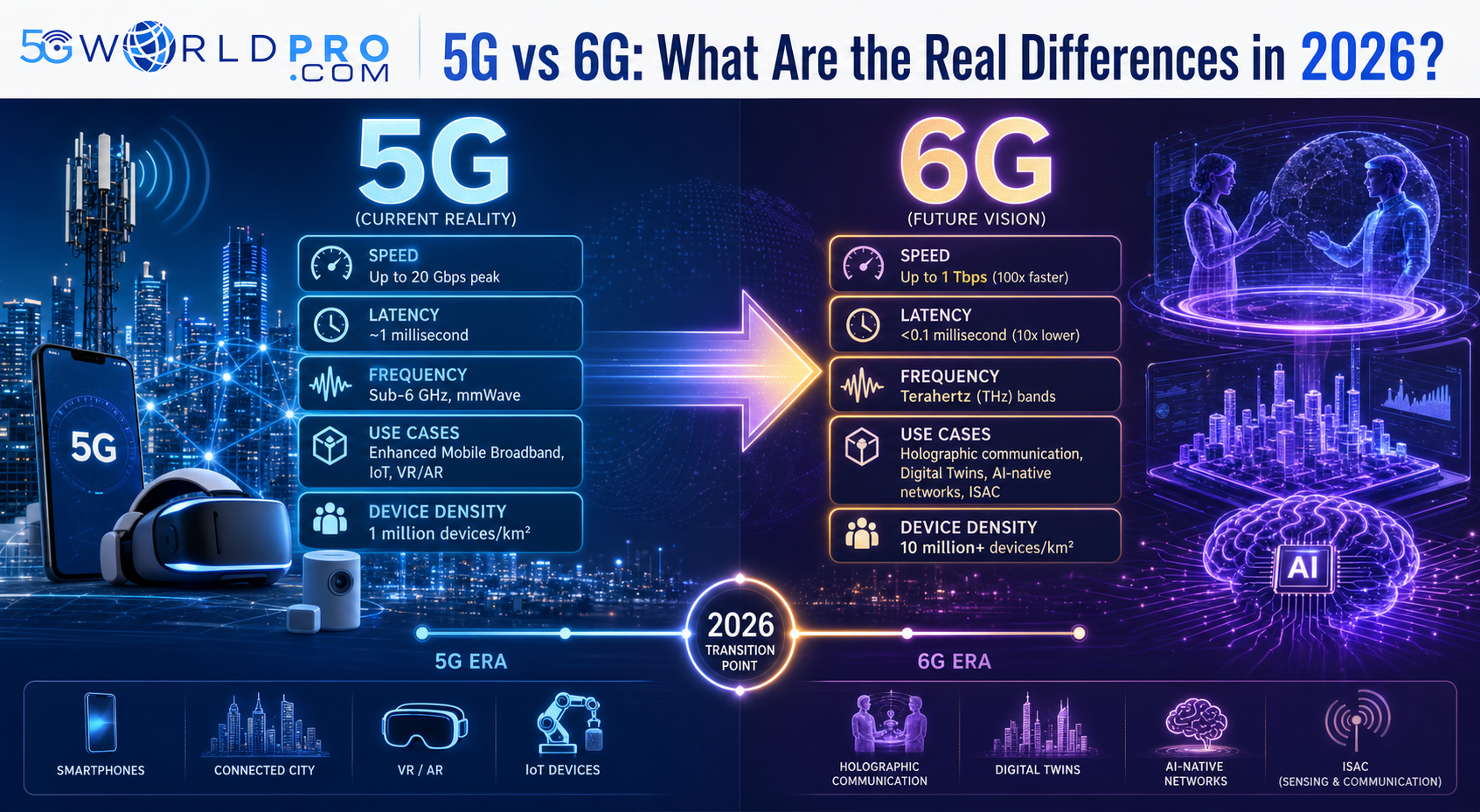
5G’s theoretical peak speed is up to 20 Gbps, though real-world speeds are far lower. Typically, these are in the hundreds of Mbps range, as covered in our carrier comparison coverage. 6G’s target, according to most industry and academic sources, is around 1 Tbps (1,000 Gbps) at the theoretical peak. This is a genuinely large jump. However, the “how many times faster” framing varies wildly depending on which numbers get compared. Some sources cite 50x, others cite 100x, and a few laboratory demonstrations have shown results in the 200x range. One frequently cited figure of “1,000x” appears to conflate different baseline assumptions. None of these are wrong exactly; they’re measuring different things (theoretical peak vs. typical real-world throughput vs. lab demo conditions). That is exactly why the comparison is so inconsistently reported.
| Metric | 5G (deployed) | 6G (target, pre-standardization) |
|---|---|---|
| Theoretical peak speed | Up to 20 Gbps | Up to 1 Tbps |
| Typical real-world speed | Low hundreds of Mbps | Not yet measurable no live networks |
| Latency | 1–10 ms (as low as ~1ms in ideal SA conditions) | Target: sub-millisecond, potentially microsecond-level |
| Frequency range | Sub-6GHz + mmWave (up to ~100 GHz) | Sub-6GHz + mmWave + newly explored terahertz bands (100 GHz – 10 THz) |
| Device density | Up to ~1 million endpoints per km² | Target: significantly higher, exact figures TBD |
| Standardization status | Fully standardized (3GPP Releases 15–18/19) | Pre-standardization; first full spec expected ~3GPP Release 21 |
| Commercial availability | Live since 2019 | Earliest commercial launches expected ~2029–2030 |
Why the numbers are still moving targets
It’s worth being direct about this: 6G doesn’t have a finalized technical specification yet. 3GPP the body that standardizes mobile network generations hasn’t locked in 6G’s Release, which means every “6G will do X” claim you read right now is a target or a lab result, not a deployed capability. That’s very different from 5G, which has had a stable, ratified specification since Release 15 back in 2018.
This is also why credible sources disagree on details like exact latency (targets range from “significantly lower than 1ms” to specific microsecond figures) and exact speed multipliers. Anyone giving you a single precise number for 6G performance right now is rounding off genuine uncertainty the honest answer is a range, not a headline figure.
The frequency shift that actually matters
The most concrete, least disputed difference between 5G and 6G is frequency range, and it’s arguably more consequential than the speed headline. 5G already uses three tiers low-band (below 1 GHz, wide coverage), mid-band (sub-6GHz, the practical workhorse), and high-band mmWave (24–100 GHz, high speed but very short range). 6G is expected to push into terahertz frequencies (100 GHz to 10 THz) spectrum that’s never been used for consumer mobile connectivity before.
That shift explains both 6G’s speed potential and its biggest practical limitation: terahertz waves carry enormous bandwidth but travel extremely short distances and are easily blocked by physical obstacles, humidity, and even foliage. Whatever infrastructure challenges mmWave created for 5G indoor and long-range coverage, terahertz will make significantly more pronounced which is a major reason full 6G rollout is expected to take years longer than most consumer coverage acknowledges.
It’s not just about speed the bigger shift is architectural
The more meaningful distinction between the generations isn’t the peak speed number it’s what each generation was fundamentally built to prioritize. 5G was built primarily to make existing mobile broadband dramatically faster and more reliable, with network slicing and ultra-reliable low-latency communication (URLLC) added as advanced capabilities layered on top of a connectivity-first design. 6G is being designed from the ground up around AI-native operation and sensing integration meaning AI isn’t a feature added later, but a core assumption baked into how the network manages itself, and the network itself is expected to double as a sensing system (detecting objects and movement via radio signals, not just carrying data about them).
That AI-native design philosophy connects directly to work already happening today under 5G-Advanced. We’ve covered this convergence in our breakdown of how near-real-time RAN intelligent controllers are becoming the brain of the entire RAN. In fact, much of the AI-RAN groundwork being laid now under 5G-Advanced is explicitly designed as a bridge toward 6G’s architecture, not a separate track.
Timeline: when does any of this actually arrive?
Despite the “6G is coming” headlines, deployment timelines remain consistently years out across every credible source. Standardization isn’t expected to be finalized until roughly 2028–2029. The earliest commercial launches are likely in South Korea, China, and possibly the US around 2029–2030. Broader global availability will likely push into the early-to-mid 2030s. We looked at exactly which countries and companies are positioning for that race in our coverage of the global 6G leadership landscape. Also, we looked at how vendor training programs are already preparing for it in our look at Qualcomm’s 6G training initiatives.
What this means in practice, today
If you’re a consumer: 5G is the technology that matters for the rest of this decade. 6G is genuinely years from being something you’d interact with on a device, regardless of what any single headline speed comparison implies.
If you work in telecom: the practical takeaway isn’t to wait for 6G. Instead, it’s that the AI-native, sensing-integrated principles 6G is being built around are already showing up in 5G-Advanced deployments today. Understanding that continuity matters more than memorizing a “1 Tbps” figure. That figure isn’t standardized yet and may well change before it’s finalized.
Frequently asked questions
Is 6G actually 50 times faster than 5G? That’s one commonly cited comparison, but the real answer is “it depends which numbers you compare.” Estimates range from roughly 10x to over 200x faster depending on whether you’re comparing theoretical peaks, real-world throughput, or lab demonstration results because 6G isn’t standardized yet, there’s no single agreed figure.
When will 6G actually be available? Standardization is expected around 2028–2029, with the earliest commercial launches (South Korea, China, potentially the US) targeted for roughly 2029–2030, and broader availability into the early-to-mid 2030s.
What’s the biggest real difference between 5G and 6G? Beyond speed, the most significant shifts are the move into terahertz frequency bands (with major coverage and obstruction tradeoffs). There is also a fundamentally AI-native, sensing-integrated network design, rather than connectivity-first architecture with AI added later.
Should I wait for 6G instead of using 5G now? No 5G is fully standardized, live, and will remain the primary mobile technology for the rest of this decade. 6G won’t be commercially relevant to most users until around 2030 at the earliest.
Going deeper
If you want to understand the AI-native and architectural fundamentals that connect today’s 5G-Advanced networks to tomorrow’s 6G not just the headline speed comparisons our 5G Direct-to-Cell Training program at 5G World Pro covers exactly that.
Benefit from Massive discount on our 5G Training with 5WorldPro.com
Start your 5G journey and obtain 5G certification
contact us: contact@5GWorldPro.com