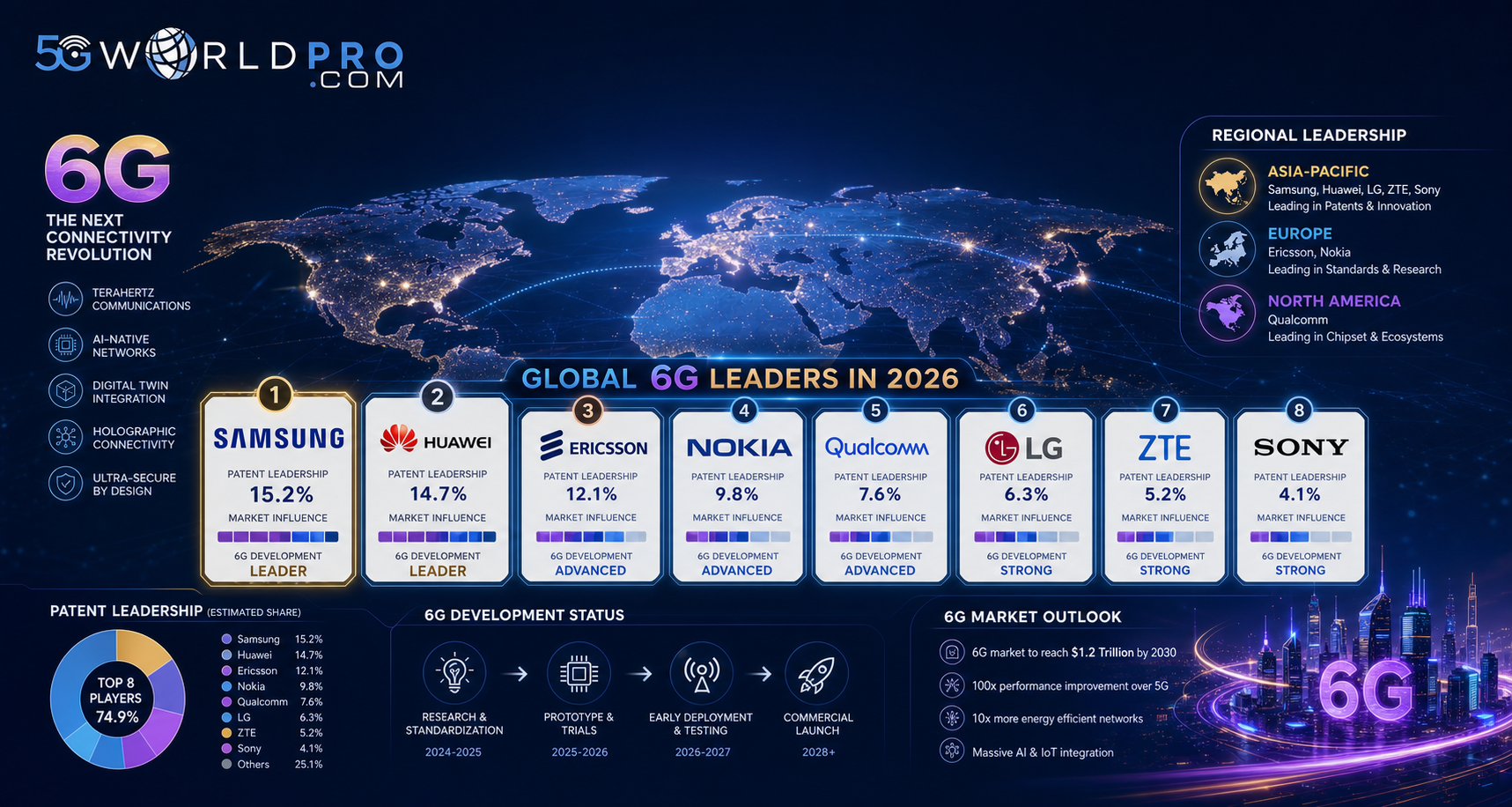
6G is still years from commercial service, but the race to define who leads it is already well underway and “leading” doesn’t mean the same thing to every country. Some are racing on patents and lab breakthroughs, some on spectrum policy, some on the vendor ecosystem that will actually build the networks. Here’s how the picture actually looks in 2026, country by country and company by company.
The short version
Analysts consistently group the race into five “Tier 1” actors: China, South Korea, the United States, the European Union, and Japan the countries combining research output, standards participation, domestic vendor ecosystems, and semiconductor capability strong enough to actually capture value from 6G, not just talk about it.
| Country/Region | Primary strength | Target commercial timeline |
|---|---|---|
| China | Aggressive state-backed investment, patent volume, early field trials | Regionally earliest, ~2030 |
| South Korea | Early roadmap commitment, historically first-to-5G | Targeting early, alongside China |
| United States | Vendor ecosystem (Nvidia, Qualcomm), spectrum policy, AI-native focus | 2031–2032 |
| European Union | Coordinated multi-country rollout, standards influence | 2032–2033 |
| Japan | Corporate R&D depth (NTT DoCoMo, Toshiba), Beyond 5G Consortium | Aligned with US/EU timeline |
(Timelines vary meaningfully by source and are best read as directional, not fixed see the forecasting section below.)
Just how big is the market, and how soon?
Market research firms put the 6G market at a modest $500 million to $1 billion in 2026 still overwhelmingly pre-commercial with projections reaching $150 billion to $300 billion annually by 2036 as commercial networks scale. That’s not a typo: most forecasts agree the real revenue only starts arriving in the 2030s, which is exactly why “who’s leading” in 2026 is a question about research and positioning, not market share.
Forecasts on exact timing vary. Juniper Research projects the first 6G connections arriving in 2029, reaching roughly 4.1 million connections that year, with the US and South Korea leading early commercialization in late 2029 and broader launches following in 2030. By 2030, Juniper expects nine countries to have launched 6G commercially, with North America and the Far East/China leading regionally a timeline that roughly lines up with the regional launch windows in the table above (Asia-Pacific first, North America next, Europe last).
China: the aggressive frontrunner
China remains the region’s most aggressive investor in next-generation telecom infrastructure, with Chinese technology giants and state-backed research institutions already operating extensive 6G laboratories and experimental satellite programs. China Mobile has run small-scale 6G network demonstrations, and Chinese entities have consistently led global patent filings in 6G-related research a metric several analyses point to when explaining why China is treated as the pace-setter, even though nobody expects full commercial 6G before 2030 anywhere.
South Korea: betting on being first again
South Korea was first to commercially launch 5G in 2019, and its 6G strategy is built on repeating that timing advantage. Despite starting formal 6G research later than China or the US, South Korea has set an aggressive internal target some industry roadmaps put South Korea’s initial 6G push as early as 2026 for foundational technology work, well ahead of most competitors’ commercial timelines, even if full public commercial service remains a late-2020s target like everyone else’s.
The United States: vendor ecosystem and AI-native positioning
The US approach leans heavily on its private vendor ecosystem rather than a single centralized push. The FCC has opened terahertz-wave spectrum bands for experimental 6G use, and companies including AT&T, Verizon, and the Next G Alliance are actively shaping 6G direction domestically. The more distinctive US angle in 2026 is the AI-native framing: Nvidia has rallied a coalition of major telecom players including T-Mobile, Cisco, Booz Allen, and MITRE around the AI-Native Wireless Networks (AI-WIN) project, an all-American AI-RAN stack explicitly positioned to accelerate the path to 6G. That effort sits alongside the wider AI-RAN Alliance, which has grown past 130 member organizations globally as of MWC 2026 see our breakdown of that Alliance’s momentum for how AI-native RAN work connects directly to the 6G roadmap.
Japan and the EU: depth over speed
Japan’s 6G push is anchored by corporate R&D heavyweights NTT DoCoMo and Toshiba, organized under the Beyond 5G Promotion Consortium, with government policy moves aimed at giving NTT more flexibility to compete globally. The European Union’s approach is less about any single national push and more about coordinated multi-country rollout and standards influence the EU’s real leverage in 6G is less about being first and more about shaping the global rules everyone else has to follow, particularly through its role in 3GPP standardization and WRC spectrum negotiations.
The Middle East: a wildcard worth watching
The UAE has published a comprehensive 6G roadmap through its Telecommunications and Digital Government Regulatory Authority (TDRA) and is positioning itself as a regional 6G hub, backed by strong 5G/5G-Advanced infrastructure already in place. Saudi Arabia’s digital investment arm has been in talks around billion-dollar-scale telecom investment tied to Vision 2030, and Ericsson has extended its 6G research partnership with Saudi Arabia’s KAUST university through 2026. None of this puts the Middle East in Tier 1 yet, but the region is investing well ahead of its current market size, which is exactly the pattern that produced South Korea’s 5G lead.
It’s not just countries: the vendor race matters just as much
National leadership only tells half the story. A recent industry market report identified 49 companies actively shaping the 6G ecosystem across infrastructure, devices, and standards. The names will be familiar from 5G: Huawei, Nokia, Ericsson, Samsung, and ZTE on the infrastructure side; Qualcomm and Nvidia increasingly central on the silicon and AI-native side. We looked at how one of these vendor relationships is already shaping practical 6G training and deployment in our coverage of Qualcomm’s 6G training initiatives, and at how the broader telecom brand landscape is shifting in our ranking of the top global telecom brands in 2026.
What “leading” will actually require, long-term
Analysts are consistent on one point: leadership in 6G won’t come down to spectrum allocation or network rollout speed alone. Countries that combine research output, standards participation, a domestic vendor ecosystem, semiconductor capability, and cloud/software strength are expected to capture the largest share of long-term value which is exactly why the race is concentrated among a small group of Tier 1 economies rather than being wide open. The World Radiocommunication Conference in 2027 is widely viewed as the decisive milestone, since it’s where governments will negotiate the globally harmonized spectrum 6G ultimately depends on.
Frequently asked questions
When will 6G actually be commercially available? Most credible forecasts point to the late 2020s for the earliest markets (South Korea, China, US) and the early-to-mid 2030s for broader global commercial availability. Juniper Research specifically projects first connections in 2029.
Which single country is “winning” the 6G race? There isn’t a clean single answer China leads on investment volume and patents, South Korea on speed-to-market ambition, the US on AI-native vendor ecosystem strength, and the EU on standards influence. Different metrics produce different leaders.
Do I need to worry about 6G yet if I work in 5G? Not urgently, but the overlap is growing fast AI-native RAN work happening now under the AI-RAN Alliance and similar initiatives is explicitly being built as a bridge toward 6G, not a separate track.
What role does spectrum play in who leads? A significant one. The GSMA estimates countries will need an average of 2–3 GHz of additional mid-band spectrum between 2035 and 2040 to support 6G capacity in dense urban areas decisions largely settled at the WRC-27 conference in 2027.
Going deeper
If you want to understand where 6G fundamentals actually connect to what’s deployable today, our 5G training programs cover the architecture that today’s 5G-Advanced networks and tomorrow’s 6G networks are being built on.
Benefit from Massive discount on our 5G Training with 5WorldPro.com
Start your 5G journey and obtain 5G certification
contact us: contact@5GWorldPro.com