Is the Google Pixel 10 5G mmWave and Sub-6GHz Compatible?
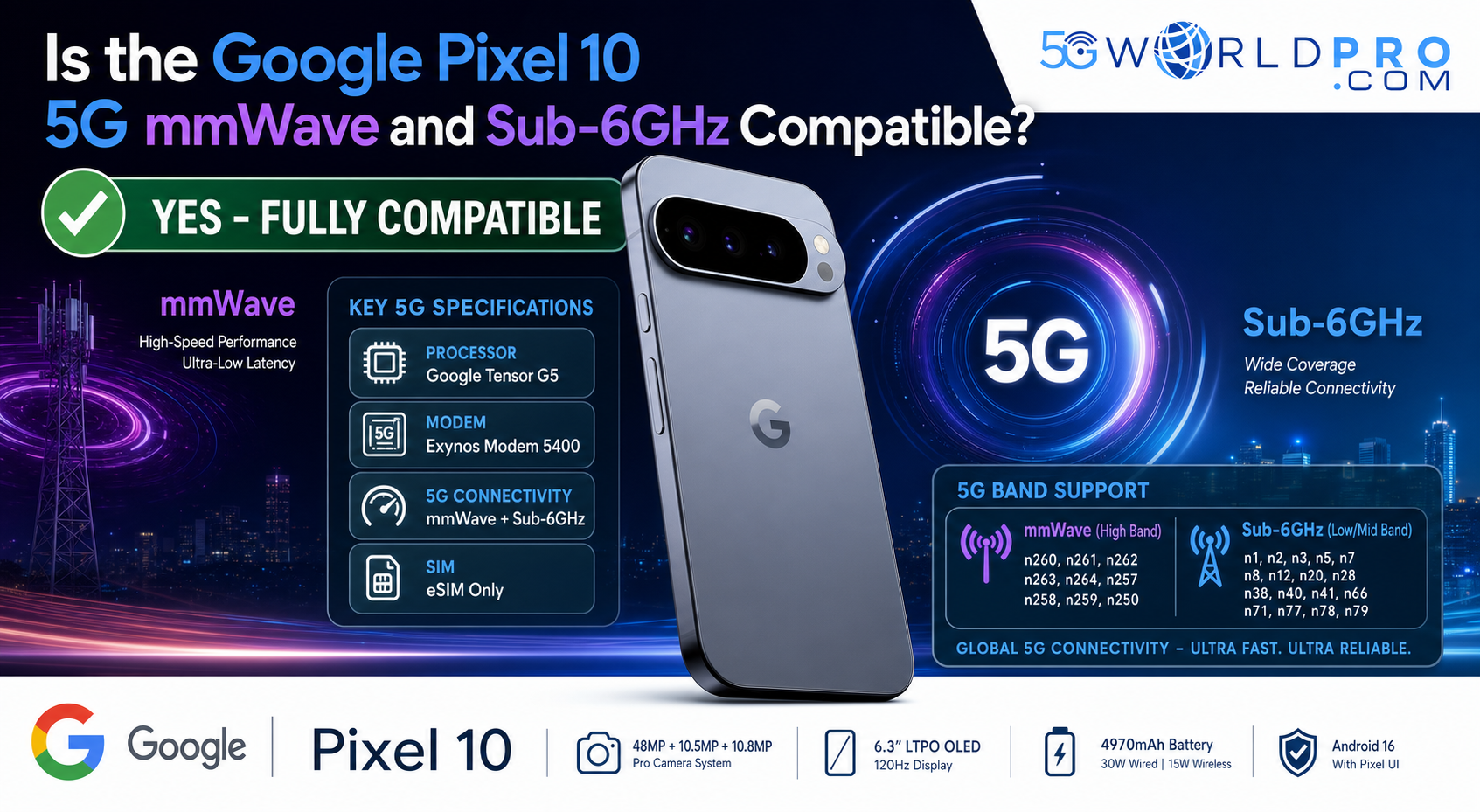
Short answer: yes the Google Pixel 10, released August 28, 2025, supports both Sub-6GHz and mmWave 5G, but which one you actually get depends entirely on which regional model you’re holding. Is the Google Pixel 10 5G mmWave and Sub-6GHz Compatible? That distinction matters more than most buying guides admit, and it follows a pattern that will look familiar if you’ve compared flagship iPhones across regions too.
Sub-6GHz vs. mmWave and why your region decides which one you get
5G comes in two genuinely different flavors. Sub-6GHz 5G is the version most people actually use day to day wide coverage, decent wall penetration, a real but not extreme speed boost over 4G. mmWave 5G is the short-range, ultra-high-speed version, capable of multi-gigabit speeds but usually only within line of sight, in places like stadiums, airports, and dense downtown cores.
Every Pixel 10 supports Sub-6GHz 5G, everywhere. mmWave is a different story: it’s only enabled on the US model (GLBW0). International variants including the models sold in most of Europe, Asia, and other markets carry Sub-6GHz-only radios, without the mmWave hardware at all. This is the same regional split Apple uses with the iPhone: mmWave has consistently been a US-market feature across both ecosystems, not a global standard rollout.
Full 5G band support (US model)
For readers who want the specifics: the US Pixel 10 (model GLBW0) supports the following 5G bands:
- Sub-6GHz 5G NR: 1, 2, 3, 5, 7, 8, 12, 14, 20, 25, 26, 28, 29, 30, 38, 40, 41, 48, 66, 70, 71, 77, 78
- mmWave 5G NR: bands 258, 260, 261
That’s a broad Sub-6 footprint wide enough that the Pixel 10 works reliably across nearly every major global carrier’s 5G network, even in regions where the mmWave radio itself stays inactive because the hardware isn’t present.
International variants, such as the G4QUR and GUL82 models sold outside the US, carry a similar Sub-6GHz band list but omit the mmWave bands entirely the tradeoff Google makes to keep international units simpler and avoid unnecessary radio hardware in markets where mmWave infrastructure is essentially nonexistent anyway.
Does the Pixel 10 support 5G Standalone (SA)?
Yes. Like recent iPhones and other current flagship Android devices, the Pixel 10 supports both 5G NSA (Non-Standalone), which anchors to a 4G core network for signaling while using 5G for data, and 5G SA (Standalone), where the full connection runs natively on the carrier’s 5G core. Which mode you actually connect through depends on your carrier’s network configuration in your specific area, not anything you need to set manually on the device. We’ve covered which devices support SA more broadly in our dedicated breakdown of 5G Standalone phone compatibility in 2026.
What about the Pixel 10 Pro and Pro Fold?
The Pixel 10 Pro and Pro XL follow the same regional pattern as the standard Pixel 10 mmWave on the US model, Sub-6GHz-only internationally. The Pixel 10 Pro Fold’s US model adds one additional mmWave band (257) alongside 258/260/261, and steps up to Wi-Fi 7, but the core 5G story is the same: mmWave capability is a US-market feature layered on top of a globally consistent Sub-6GHz foundation.
What this actually means for you
If you’re deciding whether the Pixel 10 “supports 5G” in a way that matters for your situation, here’s the honest breakdown:
- Everyday use, anywhere in the world: fully covered by Sub-6GHz 5G no compromise, regardless of which regional model you own.
- Maximum peak speeds in dense US venues (stadiums, airports, downtown cores): only the US model carries the mmWave hardware needed to take advantage of it.
- Bringing a US Pixel 10 abroad, or an international unit into the US: the mmWave radio, where present, is genuinely regional hardware carrying a US unit overseas doesn’t help if there’s no mmWave network to connect to, and an international unit brought into the US simply won’t have the mmWave radio at all.
- 5G Standalone networks: supported natively on every regional variant, handled automatically by the network and device.
How this compares to the iPhone pattern
If you’ve read our breakdown of which iPhones support 5G, this regional split will look familiar Apple has followed the same US-only mmWave approach for years. The practical takeaway is the same for both ecosystems: don’t assume “5G” means the same capability everywhere a phone is sold. The marketing spec sheet usually lists the best-case (US) configuration, and it’s worth checking your specific regional model before assuming you have mmWave hardware at all.
Going deeper
If you’re on the professional side of this question evaluating how device-side band support interacts with actual RAN and core deployment, rather than just buying a phone our 5G Direct-to-Cell Training program goes into exactly that level of detail.
Sources: Google Store official Pixel 10 specifications, Google Fi device specs, GSMArena. This article is part of our ongoing series on 5G device compatibility and network fundamentals.
Benefit from Massive discount on our 5G Training with 5WorldPro.com
Start your 5G journey and obtain 5G certification
contact us: contact@5GWorldPro.com