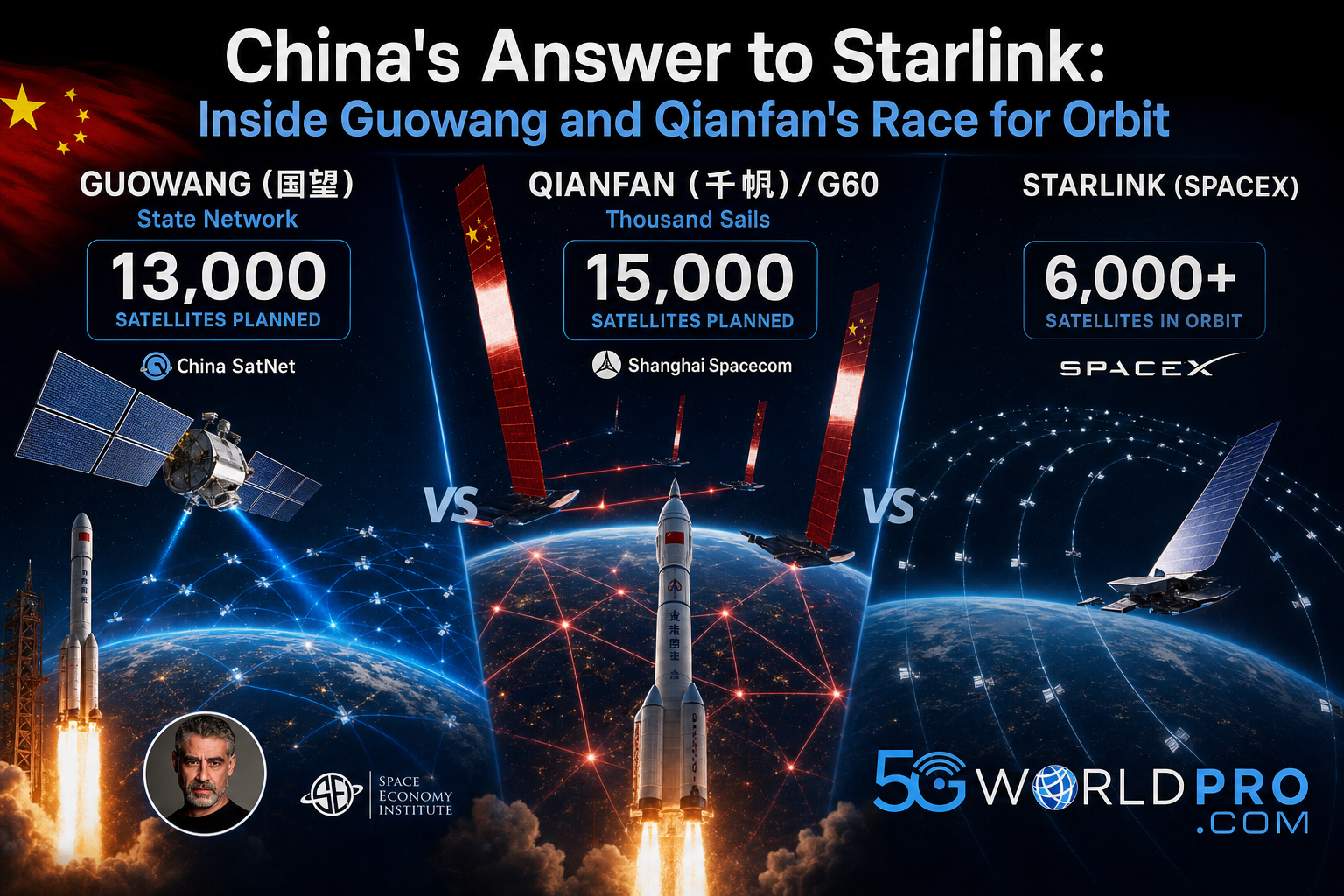
While most satellite-to-phone coverage in the West fixates on SpaceX, Amazon, and Apple, China has spent the past two years quietly building not one but two state-backed mega-constellations designed to end its dependence on foreign satellite infrastructure entirely. Neither is remotely close to Starlink’s scale yet but the strategy behind them is more ambitious, and more geopolitically loaded, than a simple copy of SpaceX’s playbook. This is the story of China’s Answer to Starlink: Inside Guowang and Qianfan’s Race for Orbit, and what it means for global connectivity.
The two constellations, at a glance
| Guowang (国网) | Qianfan / SpaceSail (千帆) | |
|---|---|---|
| Operator | China SatNet state-owned, reports to SASAC | Shanghai Spacesail Technologies municipally backed |
| Planned satellites | ~13,000 | ~15,000 |
| Satellites in orbit (mid-2026) | ~168–180 | ~200 |
| Payload focus | Broadband plus laser comms, SAR, optical remote sensing | Primarily commercial broadband |
| Primary market | Domestic and government/military use | International commercial expansion |
| Commercial customers | Not primary focus | In talks with ~30 countries; Brazil targeted as first market, 2026 |
For scale, Starlink alone had more than 10,400 active satellites in orbit as of mid-2026 meaning China’s combined constellations, even added together, represent roughly 3–4% of Starlink’s current fleet. The gap is closing, but slowly, and not evenly across both programs.
Guowang isn’t really “China’s Starlink” that framing undersells it
It’s become a media shorthand to call Guowang “China’s Starlink,” but that comparison misses the point of what China is actually building. Starlink is fundamentally a commercial broadband product that the US Department of Defense later bought into through a customer modification called Starshield. Guowang was designed the other way around from the start: filed with the International Telecommunication Union in September 2020 as a state-owned project, it’s built from day one to carry a payload mix broadband alone wouldn’t require Chinese state sources have confirmed it carries laser communication, synthetic aperture radar, and optical remote sensing payloads alongside broadband connectivity.
In practice, that makes Guowang closer to a single integrated platform fusing communications, sensing, relay, and positioning a role the US fills instead through several separate systems run by different agencies (Starlink/Starshield for connectivity, the Space Development Agency’s Proliferated Warfighter Space Architecture for tracking and transport, the National Reconnaissance Office’s own proliferated layer for intelligence collection). China consolidated into one program what the US built as several.
Qianfan is playing a different game: commercial expansion abroad
Qianfan, also known as SpaceSail or by its earlier name G60 Starlink, is the more commercially minded of the two, developed by Shanghai Spacecom Satellite Technology with municipal government backing rather than a purely central state mandate. Its ambitions are explicitly international: the operator is reportedly in talks or has signed agreements with roughly 30 countries, including Brazil, Malaysia, Thailand, Kazakhstan, and South Africa, with Brazil expected to become its first commercial market sometime in 2026.
That’s a notably different strategy than Guowang’s Qianfan is positioning itself as a genuine Starlink alternative for countries that, for political or strategic reasons, would rather not depend on a US company for satellite broadband. It’s a soft-power and market-access play as much as a technology one.
Qianfan has also quietly entered the direct-to-cell race: in June 2026, a Qianfan launch carried a dedicated direct-to-cell test satellite (Qianfan DTC-01) alongside a satellite from China Mobile a signal that China’s telecom giants are already testing the same phone-to-satellite capability SpaceX has been rolling out through T-Mobile.
Why deployment has been slower than planned
Despite the scale of the ambition, both constellations have consistently missed their own filed deployment targets, and Western and Chinese press coverage alike have flagged the pace as a real concern. As of mid-2026, more than 350 satellites have launched combined across Guowang and Qianfan over roughly two years and about 30 launches — a fraction of what would be needed to hit their 2030 targets of 13,000 and 15,000 satellites respectively.
The bottleneck is largely structural. Unlike SpaceX, which owns both an affordable, reusable launch vehicle (Falcon 9) and the constellation itself, Guowang and Qianfan currently rely entirely on state-owned, non-reusable Long March rockets launched from just three sites, operated by China Aerospace Science and Technology Corporation — which also has to fit in government and military launch missions competing for the same limited manifest. One recent industry analysis bluntly questioned whether Qianfan’s rollout is simply “too slow and costly” to hit its targets at the current pace, even as launch frequency has been accelerating through 2026.
There’s a silver lining on the sustainability side: as part of a broader regulatory overhaul, China has legally required commercial space operators to deorbit spent rocket stages after completing their missions including for Guowang and Qianfan launches addressing one of the more legitimate criticisms of mega-constellation growth generally.
The bigger picture: six constellations, one strategic goal
Guowang and Qianfan aren’t China’s only LEO broadband efforts. Tracking projects also account for Honghu-3, Geely’s Future Mobility constellation, Tianqi, and Three-Body Computing six Chinese constellations in total, expected to reach a combined satellite count of roughly 50,730 once fully deployed. Individually, none of these come close to Starlink’s current scale. Collectively, they represent a deliberate national strategy to ensure China never depends on foreign-controlled satellite infrastructure for connectivity, sensing, or military communications regardless of how long full deployment takes.
What this means for the global satellite competition
For operators, regulators, and anyone tracking non-terrestrial network (NTN) standardization, China’s dual-track approach adds a genuinely new dimension to a race that Western coverage has mostly framed as SpaceX versus Amazon versus AST SpaceMobile. Qianfan’s international expansion in particular puts it in direct competition with Starlink for the same underserved and geopolitically non-aligned markets Brazil, Southeast Asia, parts of Africa and Central Asia where satellite broadband is often the only realistic path to connectivity.
We’ve covered the Western side of the satellite-to-phone race in detail, including where Starlink’s own T-Satellite rollout actually stands in 2026 and how Amazon’s Globalstar acquisition reshaped its position in the sector. China’s entry adds a third, state-driven axis to that competition one measured as much in geopolitical alignment as in satellite count.
Frequently asked questions
Is Guowang the same thing as Starlink? Not really. Both are LEO broadband constellations, but Guowang is a state-owned, dual-use platform combining broadband with military-relevant payloads like radar and laser communications a different design philosophy than Starlink’s commercial-first approach.
How many satellites does China have in orbit compared to Starlink? As of mid-2026, Guowang and Qianfan combined have roughly 350–380 satellites in orbit, compared to Starlink’s more than 10,400 active satellites a significant gap, though both Chinese programs are accelerating their launch pace.
Will Qianfan compete with Starlink outside China? Yes, that’s its explicit strategy. Qianfan is in discussions with around 30 countries and is targeting Brazil as its first international commercial market in 2026, directly competing with Starlink for customers in markets seeking alternatives to US-based satellite providers.
Does China have its own direct-to-cell satellite service? Testing has begun. Qianfan launched a dedicated direct-to-cell test satellite in June 2026 alongside a China Mobile payload, suggesting China’s carriers are pursuing the same phone-to-satellite capability SpaceX has rolled out through T-Mobile, though it remains in early testing rather than commercial service.
Going deeper
If you want to understand how satellite constellations commercial or state-driven integrate with 5G-Advanced and 6G non-terrestrial network standards, our 5G Direct-to-Cell Training program covers exactly that.
Benefit from Massive discount on our 5G Training with 5WorldPro.com
Start your 5G journey and obtain 5G certification
contact us: contact@5GWorldPro.com