Three and a half years after SpaceX first announced direct-to-cell, the service is live and working. It is already the largest cellular-band network on the planet by coverage area. However, most people just don’t know it yet. Here’s exactly where T-Mobile’s Starlink-powered T-Satellite service stands today. Also, here’s what’s changing with SpaceX’s next-generation satellites and how the competition is responding.
The rollout, phase by phase
| Date | Milestone |
|---|---|
| July 23, 2025 | T-Satellite launches commercially SMS, MMS, and location sharing live in the US |
| October 2025 | Limited app-based data added (WhatsApp, Google Maps, weather, basic browsing) |
| Early 2026 | UK launch via Virgin Media O2; more countries in Europe, Asia, Africa, Latin America through 2026–2027 |
| 2026 | Voice calling enters testing |
| Mid-2027 | Starlink V2 satellites (launched via Starship) begin full voice/data rollout |
The pattern is deliberate, not accidental: SMS arrived first because it’s the easiest technical problem short bursts of data that can wait a few seconds. Full mobile data and voice are harder, since they need sustained, real-time connections, which is why they’re arriving in stages rather than all at once.
What’s actually live right now
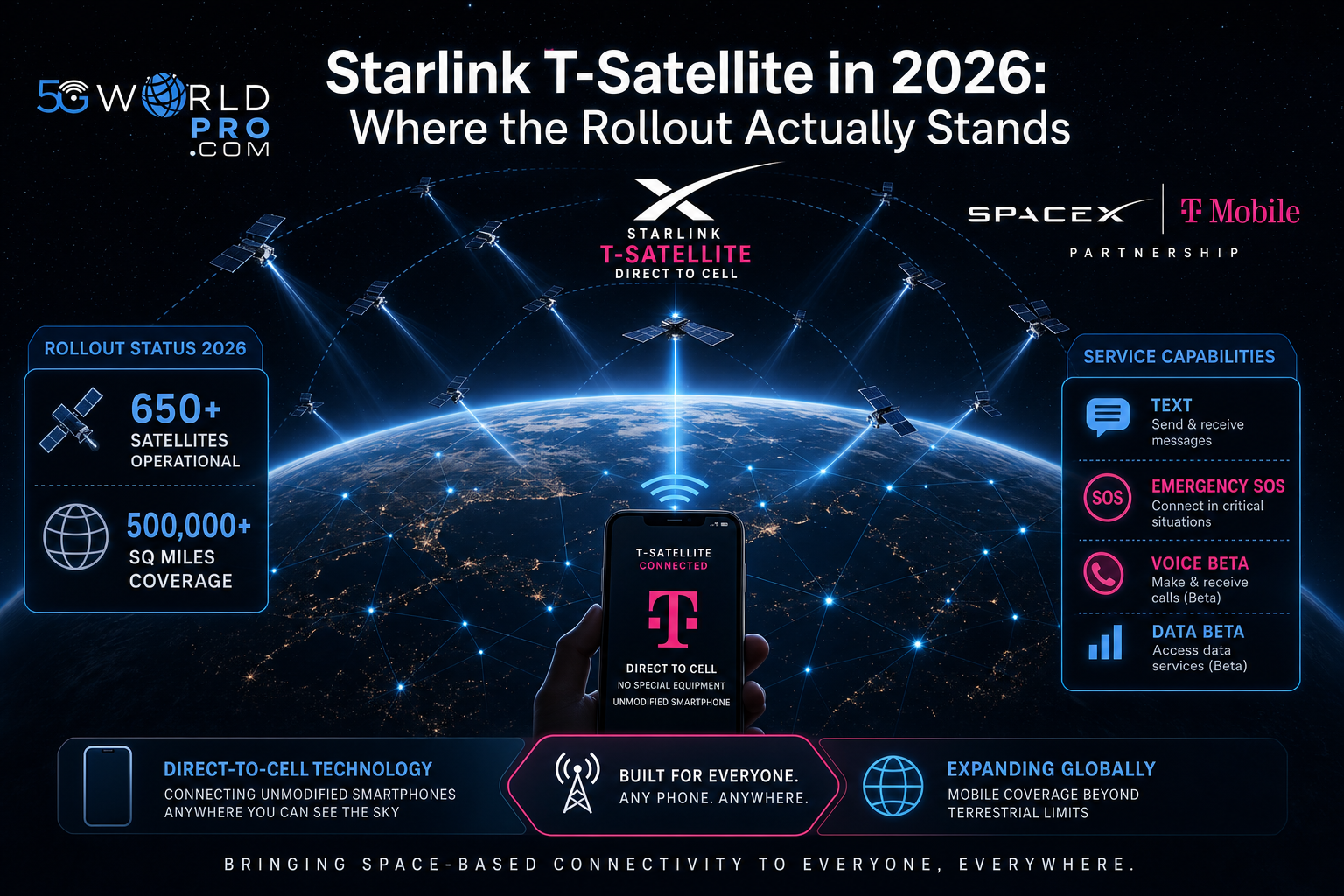
As of early 2026, Starlink has more than 650 direct-to-cell satellites in orbit, providing service across 22 countries to more than 400 million people. Around 60 phone models are currently compatible mostly recent Samsung, Motorola, and iPhone devices and the service runs as a $10/month add-on called T-Satellite through T-Mobile, with the phone automatically recognizing Starlink satellites the way it would a normal cell tower, no separate app or activation step required for basic messaging.
Real-world use cases are already proving the concept beyond the demo stage. One widely cited case involved a woman in New Zealand who used T-Satellite to text her partner her location after a car crash left her in a cellular dead zone first responders reportedly arrived within minutes. SpaceX has also successfully tested video calls over X and WhatsApp during trials, along with basic IoT device connectivity, ahead of those features reaching general availability.
Coverage isn’t limited to land, either. The service currently works on boats and ships up to 12 nautical miles offshore under existing FCC authorization. As of 2026, T-Satellite customers can also roam onto the service in Canada and New Zealand.
Why this is harder than it looks
It’s worth understanding why voice and full data took and are still taking so long. This delay is due to physics, not corporate foot-dragging. A satellite in low Earth orbit is much farther from your phone than a cell tower. Additionally, your phone has almost no extra power or antenna gain to compensate. Getting a usable signal out of that gap has required SpaceX to essentially brute-force the problem. They use extremely large phased-array antennas on each satellite. There are also careful spectrum-sharing arrangements with T-Mobile’s existing terrestrial bands. Furthermore, SpaceX makes constant beamforming adjustments as low-orbit satellites move quickly overhead.
That’s also why initial data speeds, once they roll out more broadly, are expected to be modest. SpaceX has indicated a range of roughly 2–4 Mbps per user in the first phase. This is enough for messaging, email, maps, and low-resolution video, but not competitive with typical terrestrial 5G. Moreover, call quality in testing has been described as comparable to a standard cellular call in a moderate-signal area. It is clear and reliable, if not HD Voice quality.
The real leap: Starlink V2 and Starship
The current generation of direct-to-cell satellites is really a first-generation proof of concept. The bigger shift comes with Starlink V2, which SpaceX plans to begin launching via Starship in mid-2027. They plan to deploy more than 50 satellites per flight. According to Starlink VP Mike Nicolls, speaking at Mobile World Congress in Barcelona, the goal is a constellation of roughly 1,200 satellites. This would be capable of global, contiguous coverage within six months of the start of V2 deployment. It is an aggressive target, but one that looks credible given Starship’s improving launch cadence.
For T-Mobile customers, that means the current V1-based T-Satellite service will keep improving through 2026 and early 2027. The more significant capability jump—full voice and data indistinguishable from a normal cellular connection—arrives with V2 in the second half of 2027. SpaceX has also secured regulatory room to grow. The FCC approved an additional 7,500 Gen2 Starlink satellites in January 2026, bringing its total approved constellation to 15,000. At the same time, they’re working to secure additional spectrum and higher operating power to push data capability further.
How the competition is responding
T-Mobile isn’t the only US carrier chasing satellite coverage, and the approaches genuinely differ:
| Carrier | Satellite partner | Approach |
|---|---|---|
| T-Mobile | SpaceX (Starlink) | Exclusive partnership; furthest along with live SMS, data, and voice in testing |
| Verizon | AST SpaceMobile | Multi-carrier satellite partner also working with AT&T and Orange internationally |
| Verizon | Skylo | Separate, free satellite texting offering on newer phones |
| AT&T | AST SpaceMobile | Pursuing its own direct-to-cell rollout on the same shared satellite partner as Verizon |
Verizon and AT&T’s shared reliance on AST SpaceMobile rather than each building or exclusively licensing their own satellite network has been slower to reach commercial service than T-Mobile’s SpaceX partnership. However, it also means neither carrier is dependent on a single company’s launch cadence the way T-Mobile is tied to SpaceX’s. We’ve covered AST SpaceMobile’s approach directly in our dedicated breakdown of the company. We’ve also looked at how Amazon’s satellite ambitions fit into this same competitive picture in our coverage of the Amazon-Globalstar-Apple agreement.
There’s also a spectrum dimension to this competition worth flagging: SpaceX has been pushing the FCC to open sharing of EchoStar’s 2GHz band for direct-to-cell use a request EchoStar has fiercely opposed and has separately signaled interest in upper C-band spectrum the FCC is looking to put to more intensive use. Spectrum access, as much as satellite count, is shaping up to be the real long-term battleground between these providers.
What this means if you work in telecom
For network professionals, T-Satellite’s trajectory is a useful real-world case study in exactly the kind of spectrum-sharing, non-terrestrial network (NTN) integration that 3GPP has been standardizing for 5G-Advanced and is expected to deepen further in 6G. The gap between “SMS works” (2025) and “voice and data indistinguishable from cellular” (targeted for late 2027) is a good illustration of how much harder each successive capability tier gets a pattern worth understanding whether you’re evaluating vendor roadmaps or explaining timelines to stakeholders who expect satellite connectivity to work exactly like a cell tower on day one.
Frequently asked questions
Is Starlink T-Satellite available outside the US? Yes, though coverage is still expanding. As of early 2026 it’s live in 22 countries, with UK service starting via Virgin Media O2 and further European, Asian, African, and Latin American rollouts planned through 2026–2027.
Does T-Satellite work with any phone? No around 60 phone models are currently compatible, mostly recent Samsung, Motorola, and iPhone devices with LTE Release 10+ support. Check T-Mobile’s current compatibility list before assuming your device qualifies.
When will Starlink direct-to-cell support full voice and data everywhere? Voice is in testing during 2026, with broader rollout expected into 2027. The bigger jump full voice and data comparable to normal cellular service is tied to the Starlink V2 satellite generation, targeted for the second half of 2027.
How does this compare to Verizon and AT&T’s satellite plans? Verizon and AT&T both rely on AST SpaceMobile rather than SpaceX, and their commercial rollout has generally lagged T-Mobile’s. Verizon separately offers free satellite texting through Skylo on supported newer phones.
Going deeper
If you want to understand how Direct-to-Cell (D2C), Non-Terrestrial Networks (NTN), and satellite communications integrate with 5G-Advanced and future 6G networks, explore our dedicated 5G Direct-to-Cell (D2C) Training. The course provides a comprehensive understanding of the technology, 3GPP standards, network architectures, deployment strategies, and real-world use cases that are shaping the future of global mobile connectivity.
Learn more: https://5gworldpro.com/5g-direct-to-cell-training/
Benefit from Massive discount on our 5G Training with 5WorldPro.com
Start your 5G journey and obtain 5G certification
contact us: contact@5GWorldPro.com