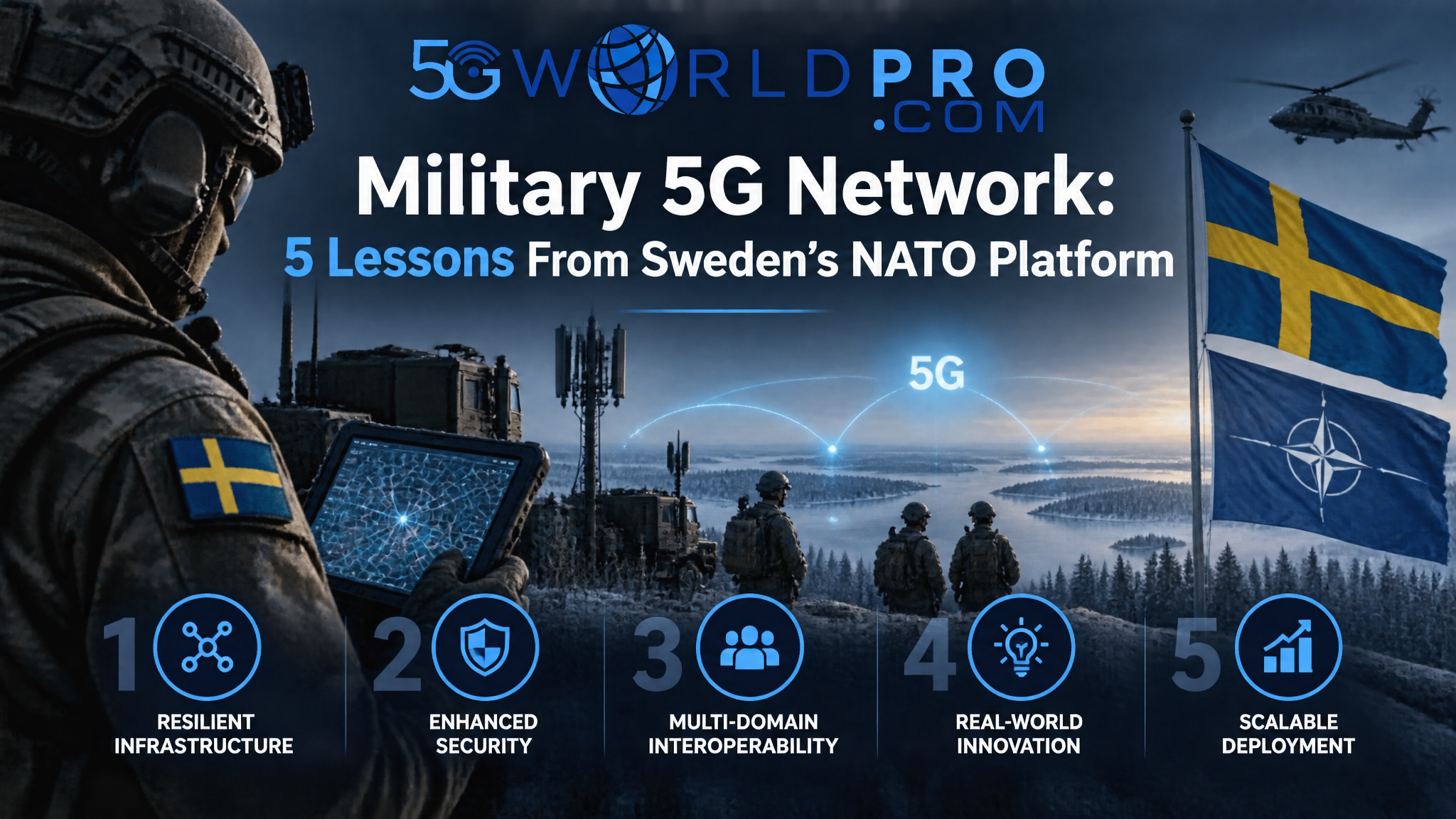
A military 5G network is moving from trial to operation in Sweden. On 4 November 2026, the Swedish Armed Forces, supported by the Defence Materiel Administration (FMV), announced that they will use 5G for military capabilities and communications. According to TelecomTV, Telia and Ericsson were selected to develop, build and manage a dedicated 5G network and to provide advanced 5G capabilities for a new military innovation platform. The platform is part of NATO’s Innovation Range, where Sweden and Finland have been tasked with advancing military communications technology.
What the Military 5G Network Will Do
The new 5G capability is meant to complement existing military communication systems, not replace them. According to Ericsson, the network can tap Telia’s nationwide infrastructure, extend coverage at military bases, deploy temporary solutions in the field such as unit locations and emergency airbases, and put 5G equipment on assets such as amphibious craft, frigates and transport aircraft.
Importantly, this follows a path from testing to operations. The initiative builds on the NorthStar innovation program that Telia and Ericsson launched in 2023, which the Armed Forces joined in 2025 to test 5G Standalone features for military use. As reported by TelecomTV, the new step moves toward dedicated operational 5G capabilities.
Military 5G Network Key Facts
| Detail | Fact |
|---|---|
| Announcement | 4 November 2026, Swedish Armed Forces with FMV support |
| Partners | Telia and Ericsson |
| Scope | Develop, build and manage a dedicated 5G network plus an innovation platform |
| NATO link | Part of NATO Innovation Range and NATO’s Rapid Adoption Action Plan |
| Field use | Bases, temporary field sites, emergency airbases, amphibious craft, frigates, transport aircraft |
| Role | Complements existing military communication systems |
| ISAC demo | Ericsson drone detection using Integrated Sensing and Communication |
| ISAC timeline | Sensing-only commercial pilots expected from 2027, wider deployments in 2028 |
| EU proposal | EU Critical Communication System proposed on 30 September 2026 |
Drone Detection: The ISAC Angle
Attendees at the announcement saw a demonstration of Ericsson’s drone detection, built on the Integrated Sensing and Communication (ISAC) capabilities of 5G. In this approach, the mobile network can detect and track moving objects over wide areas, including objects that are not connected to the network.
Ericsson says it recently introduced an ISAC System, with selected small-scale, sensing-only commercial pilots expected to begin in 2027 and wider sensing deployments to follow in 2028. For defence and critical infrastructure, a military 5G network that also senses its surroundings could add a new layer of awareness, although these are early plans, not delivered capability.
Cross-Border Emergency Communication
The same Ericsson article points to civilian use. On 30 September 2026, the European Commission proposed an EU Critical Communication System to connect emergency services across the 31 countries of the EU and Schengen areas. According to the European Commission, member states would keep full control over their national networks.
If adopted by the European Parliament and the Council, the system would launch gradually, with member states starting to connect from 2030. Moreover, the proposal recognises that current national systems are not interlinked or technically compatible, which is where 5G could help.
How a Military 5G Network Differs From Enterprise Private 5G
A military 5G network shares technology with enterprise private networks, but its requirements are different. Users move constantly, sites can be temporary, and equipment may sit on ships and aircraft. The Ericsson description of temporary field solutions and platform-mounted equipment points to that mobility.
Moreover, trust and control matter more than in most commercial projects. A military 5G network must work alongside existing systems, stay available under stress and meet national security rules. For operators, this means selling resilience and governance, not only coverage.
5 Lessons From the Military 5G Network
Commercial networks can serve defence. Using an operator’s nationwide network, plus a dedicated layer, shows how public infrastructure and mission-critical needs can combine.
Dedicated and public work together. The model mixes dedicated capacity with national coverage, which echoes how enterprises mix private and public networks. Our article on the private 5G reset covers that trade-off.
Sensing is becoming a network feature. ISAC extends networks from connecting devices to detecting objects, if pilots succeed.
Standards and interoperability matter. The EU proposal shows that cross-border use depends on compatible systems, not only on faster radios.
Timelines are long. Pilots in 2027, deployments in 2028 and EU connections from 2030 show that critical communications evolve over years.
What This Means for the Industry
A military 5G network turns operators into defence partners over the long term. Telia’s role suggests that mobile operators and vendors can win long-term, high-trust contracts beyond consumer and enterprise markets. That requires security, resilience and governance capabilities that many operators are still building.
Mission-critical 5G is a growth area for specialist skills. Engineers who understand standalone core, slicing, resilience and spectrum for critical users will be in demand as these programs expand.
Going Deeper
Understanding mission-critical 5G, standalone networks, slicing and sensing is exactly the kind of context covered in our 5G training courses and the full 5G training catalog.
Benefit from Massive discount on our 5G Training with 5WorldPro.com
Start your 5G journey and obtain 5G certification
contact us: contact@5GWorldPro.com