Most coverage of Amazon and SpaceX’s satellite rivalry has focused on phones direct-to-cell messaging, Globalstar, Emergency SOS. That’s a real story, but it’s not the biggest one. The actual center of gravity for both companies is home and enterprise broadband getting fast internet to the roughly 2.6 billion people worldwide who still don’t have reliable access. Here’s how Amazon Leo and Starlink actually compare on the fight that matters more to Amazon’s bottom line than any phone feature.
Two very different architectural bets
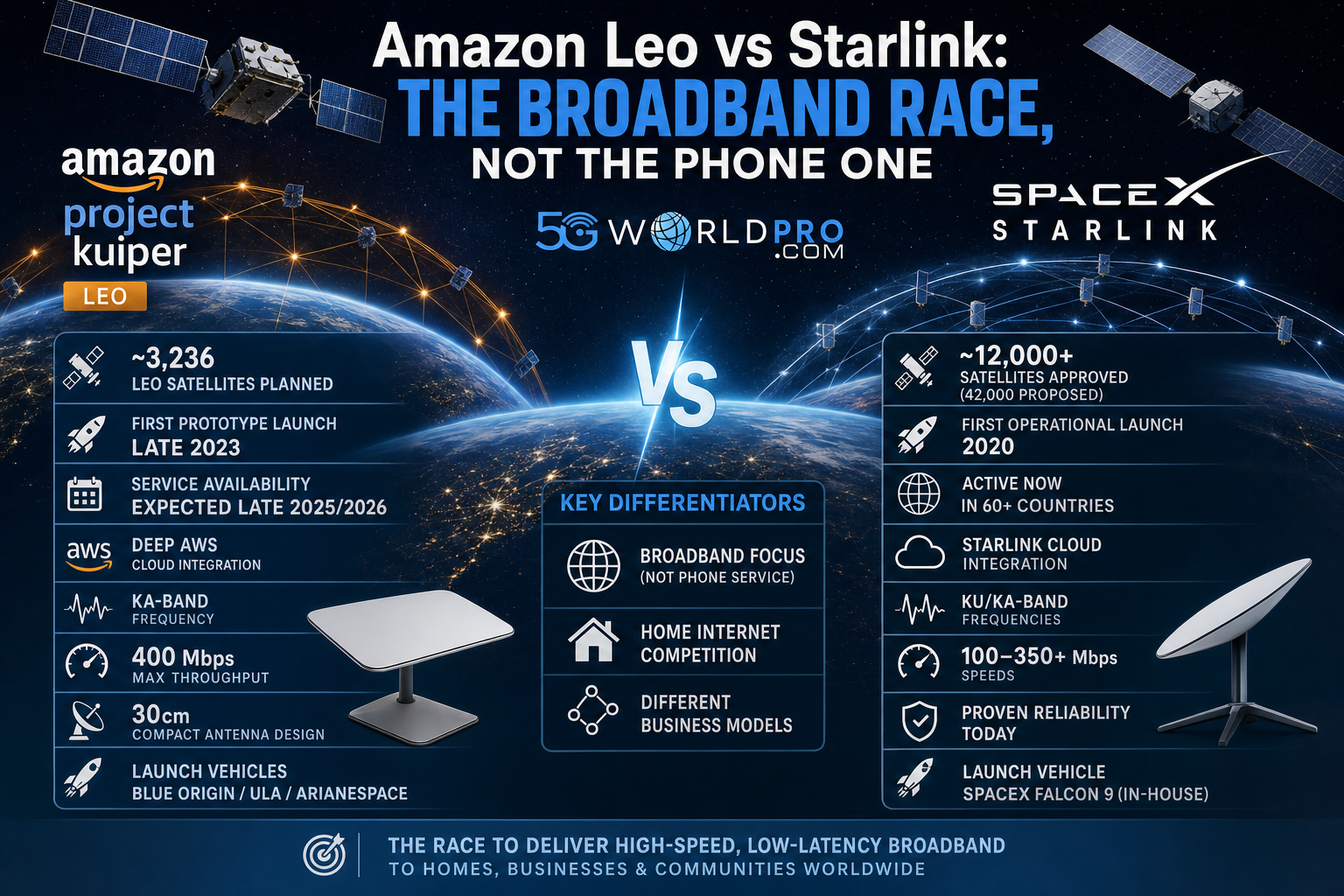
Starlink and Amazon Leo are solving the same problem beam broadband from low Earth orbit with genuinely different engineering approaches.
| Starlink (SpaceX) | Amazon Leo | |
|---|---|---|
| Satellites in orbit (mid-2026) | 10,000+ (targeting ~42,000 long-term) | ~150–240 (targeting 3,236) |
| Orbital shells | Single-layer approach, 340–570 km altitude | Three concentric shells: 590 km, 610 km, 630 km |
| Orbital planes | ~72 | 98 |
| Inter-satellite links | Laser links between satellites | Optical Inter-Satellite Links (OISL), 100 Gbps, up to 2,600 km apart |
| Current subscribers | ~10 million, in 150+ countries | Not yet available to consumers |
Starlink’s approach is often described as brute-force scale: more satellites, lower altitude, constant replenishment needed due to atmospheric drag, but excellent coverage and low latency as a result. Amazon Leo is going for a more distributed, multi-shell structure fewer total satellites at this stage, spread across three altitude bands an architecture Amazon argues will deliver comparable coverage with a leaner constellation once fully deployed.
Terminals, speed, and price
Amazon has announced three customer terminal tiers: the Leo Nano (up to 100 Mbps, the compact/mobile option), the Leo Pro (up to 400 Mbps, the standard residential terminal), and the Leo Ultra (up to 1 Gbps, enterprise-grade). In prototype testing, the standard residential terminal has already hit its advertised 400 Mbps ceiling.
Starlink’s current consumer plans range from $50 to $165 per month depending on tier, plus $349–$599 in equipment costs, with speeds from roughly 25 Mbps up to 305 Mbps on its fastest consumer tier (220+ Mbps is typical for standard residential plans).
Amazon hasn’t officially confirmed residential pricing yet. Industry analysts estimate a standard residential plan will land somewhere between $100 and $120 per month, positioning it to compete directly rather than undercut Starlink on price though Amazon’s manufacturing scale and potential Amazon Prime bundling could change that calculus once pricing is finalized.
Amazon’s actual differentiator isn’t the satellites it’s AWS
The most consequential difference between the two services has nothing to do with orbital mechanics. Amazon can offer something no other satellite internet provider can: a direct, seamless connection to Amazon Web Services. For enterprise customers already running infrastructure on AWS, that’s a genuinely distinct pitch that Starlink for all its head start simply can’t match without a comparable cloud platform of its own. It’s why Amazon Leo’s enterprise rollout, which began reaching select customers by the end of 2025, is arguably a more important early signal than the still-pending residential launch.
Rollout timeline: who’s actually available, where, and when
Starlink remains, as of mid-2026, the only LEO satellite broadband provider with genuine consumer availability and by a wide margin, given its decade-long head start and existing footprint across more than 150 countries.
Amazon Leo’s residential rollout is targeted for later in 2026, starting with five countries: the United States, Canada, the United Kingdom, France, and Germany, with initial focus on northern and southern latitudes before expanding toward the equator a sequencing choice tied to orbital coverage patterns rather than market prioritization. Beyond direct-to-consumer plans, Amazon has already lined up a set of B2B and wholesale partnerships that will carry its capacity to end users indirectly: DIRECTV Latin America, Sky Brasil, and Australia’s national broadband operator have all signed on, and JetBlue has announced a 2027 deployment for in-flight Wi-Fi powered by Amazon Leo.
The rural connectivity funding wrinkle
One detail that’s generated real controversy in US broadband policy circles: several states have already made sizeable BEAD (Broadband Equity, Access, and Deployment) program grant awards to Amazon Leo, despite the company not yet having a single paying broadband customer. Industry commentators have drawn a direct parallel to Starlink’s earlier experience with the FCC’s RDOF program, where the agency eventually clawed back awards after determining Starlink wasn’t positioned to fulfill its coverage commitments on the original timeline. Whether Amazon Leo’s BEAD awards face similar scrutiny once residential service actually launches is a genuine open question worth watching through the rest of 2026.
Why this matters beyond the consumer pitch
For the telecom industry specifically, the more important story isn’t which service is faster it’s what a genuinely competitive second LEO broadband provider does to pricing, rural coverage commitments, and the wholesale capacity market operators can tap into. A single-provider market gives Starlink significant leverage in negotiating with telcos and governments; a credible second option changes that dynamic regardless of which service any individual household ends up choosing. We’ve covered the phone-focused side of this same broader rivalry in our breakdown of the Amazon-Globalstar-Apple satellite agreement and in our deep dive on where Starlink’s T-Satellite direct-to-cell rollout actually stands worth reading alongside this piece, since Amazon and SpaceX are effectively running two parallel competitions (broadband and direct-to-phone) with different timelines and different stakes.
Frequently asked questions
Is Amazon Leo available to regular consumers yet? Not as of mid-2026. Amazon Leo has begun serving select enterprise customers, with residential service targeted for later in 2026, starting in the US, Canada, UK, France, and Germany.
Is Amazon Leo the same as Amazon’s direct-to-cell phone service? No Amazon Leo is a broadband internet service, competing with Starlink’s home and business internet plans, not a phone-connectivity product. Amazon’s phone-related satellite ambitions come through its separate agreement to acquire Globalstar.
Will Amazon Leo be cheaper than Starlink? Not confirmed. Analyst estimates put residential pricing around $100–$120 per month, broadly comparable to Starlink’s higher-speed tiers, though Amazon’s manufacturing scale and potential Prime bundling could shift pricing once officially announced.
What’s Amazon Leo’s biggest advantage over Starlink? Direct integration with Amazon Web Services (AWS) for enterprise customers a differentiator no other satellite broadband provider currently offers.
Going deeper
If you want to understand how satellite broadband constellations integrate with terrestrial 5G/6G infrastructure and non-terrestrial network standards, our 5G Direct-to-Cell Training program covers exactly that.
Sources: HighSpeedOptions, Fierce Network, WhistleOut, SatelliteInternet.com, Orbital Radar, Compare Internet, Utilities For My Home. This article is part of our ongoing coverage of the satellite broadband and connectivity race, beyond the press releases.
Benefit from Massive discount on our 5G Training with 5WorldPro.com
Start your 5G journey and obtain 5G certification
contact us: contact@5GWorldPro.com