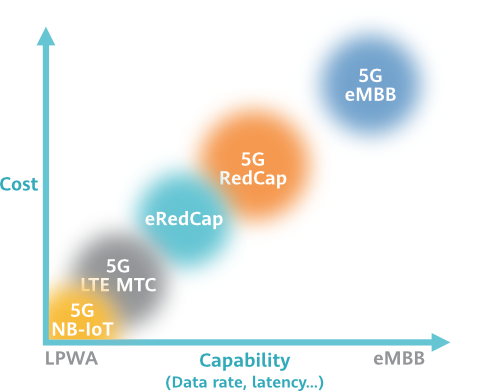
As 5G matures beyond smartphones and high-end broadband, cost-efficient IoT devices have become the next major battleground. While 5G RedCap (Reduced Capability devices) introduced in 3GPP Release 17 significantly lowered complexity compared to full eMBB devices, it still remained too expensive and power-hungry for many mid-tier IoT use cases.
This gap led to the introduction of eRedCap (enhanced RedCap) in 3GPP Release 18—a new UE category designed specifically for medium-rate IoT services where cost, power consumption, and simplicity matter more than peak performance.
What Is eRedCap?
eRedCap is an evolution of RedCap that further reduces device cost and complexity by tightening constraints on:
-
Peak data rates
-
Baseband processing capability
-
Supported baseband bandwidth
The objective is clear:
👉 Enable massive adoption of 5G IoT devices without the cost overhead of classic RedCap.
Key Technical Differences Between eRedCap and RedCap
1. Peak Data Rate Reduction
| Category | Downlink Peak Rate | Uplink Peak Rate |
|---|---|---|
| RedCap (Rel-17) | >100 Mbit/s | Tens of Mbit/s |
| eRedCap (Rel-18) | ≤10 Mbit/s | ≤10 Mbit/s |
By relaxing the peak rate computation rules defined in 3GPP TS 38.306, eRedCap significantly reduces:
-
Baseband processing load
-
Memory requirements
-
RF and modem cost
2. Baseband Bandwidth Limitation
One of the most impactful changes introduced by eRedCap is baseband bandwidth reduction:
| Parameter | RedCap | eRedCap |
|---|---|---|
| Baseband BW (PDSCH/PUSCH) | 20 MHz | 5 MHz |
| RF BW (max) | 20 MHz | 20 MHz |
This single change enables:
-
Cheaper chipsets
-
Lower power consumption
-
Smaller device form factors
Other physical channels and signals may still operate at 20 MHz, ensuring network compatibility.
Two Types of eRedCap Devices (Release 18)
eRedCap introduces flexibility at the UE capability level.
eRedCap UE Capability Signaling
Using the supportOfERedCap-r18 and eRedCapNotReducedBB-BW-r18 fields in UE-NR-Capability, the network can distinguish between:
1️⃣ eRedCap with Peak Rate Limitation Only
-
Same bandwidth as RedCap
-
Reduced DL/UL peak rates
-
Ideal for moderate throughput use cases
2️⃣ eRedCap with Peak Rate + Bandwidth Limitation
-
Peak rate reduced
-
Baseband bandwidth limited to 5 MHz
-
Lowest cost and power profile
📌 Reference: 3GPP TS 38.306 – Section 4.2.22.2
Where Does eRedCap Sit in the 5G Device Landscape?
eRedCap strategically positions itself between LPWA and RedCap:
-
Above NB-IoT / LTE-M in performance
-
Below RedCap in cost and complexity
-
Far cheaper than eMBB devices
This makes eRedCap ideal for:
-
Smart wearables
-
Industrial sensors
-
Smart meters
-
Asset tracking
-
Smart city devices
Same Ecosystem, Same Use Cases
Importantly:
-
eRedCap uses the same 5G NR architecture
-
Same deployment models
-
Same application scenarios
-
Same key technologies as RedCap
From a network perspective, no radical redesign is required—making eRedCap extremely attractive for operators.
Why eRedCap Matters for Operators and Vendors
From a business standpoint, eRedCap enables:
✅ Lower BOM cost
✅ Faster time-to-market
✅ Longer battery life
✅ Broader IoT adoption
✅ Better ROI for 5G SA networks
In short: eRedCap makes 5G IoT economically scalable.
Final Thoughts
eRedCap is not just a minor enhancement—it is a strategic evolution that aligns 5G with real-world IoT economics. By intelligently balancing capability, cost, and performance, 3GPP Release 18 positions 5G as a true successor to LTE-M and NB-IoT for medium-rate use cases.
Don’t miss our 5G Redcap and eRedcap Training to learn more about these technologies.
Benefit from Massive discount on our 5G Training with 5WorldPro.com
Start your 5G journey and obtain 5G certification
contact us: contact@5GWorldPro.com