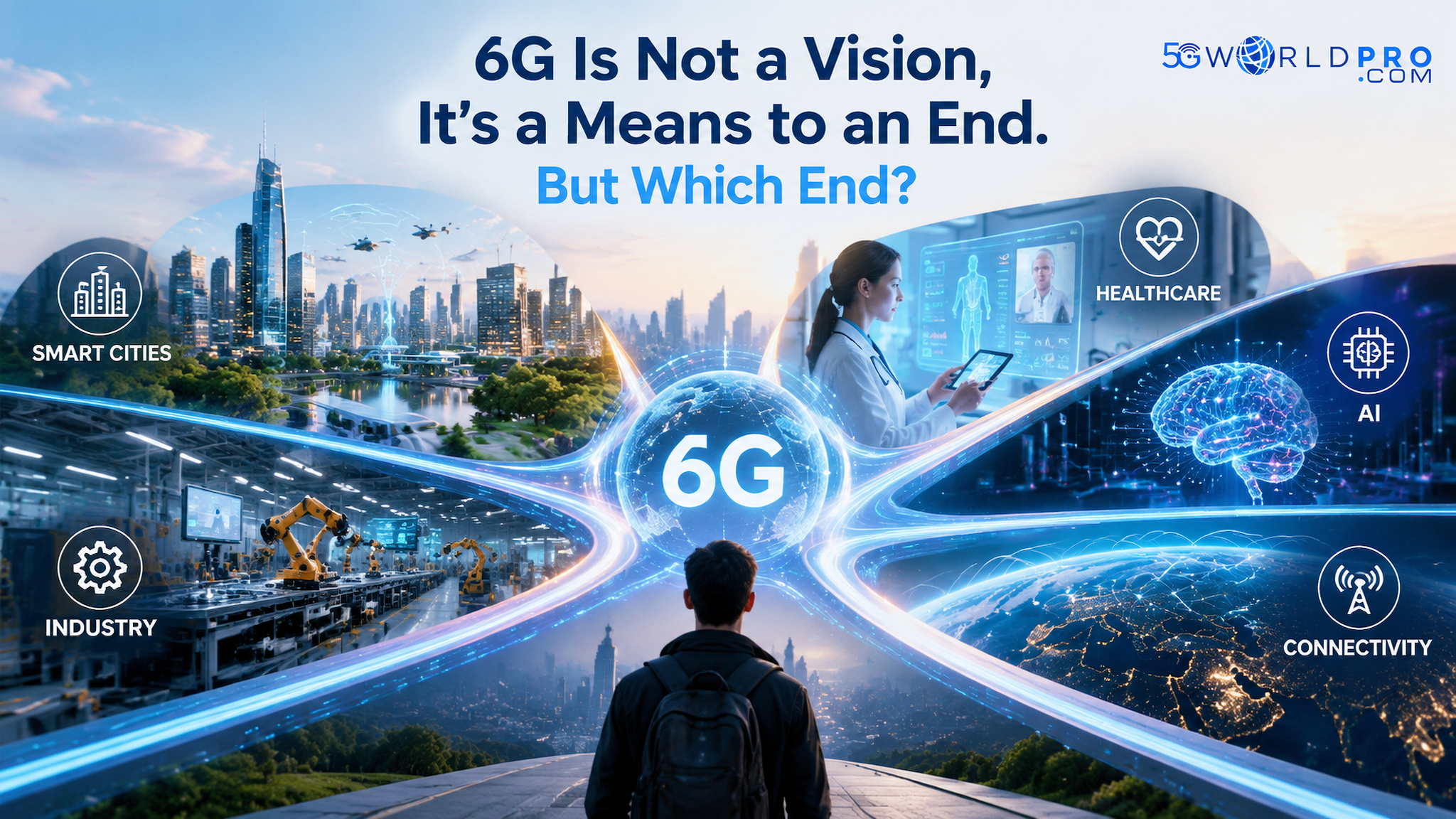
A pattern keeps showing up in vendor messaging around 6G: the technology gets positioned as telecom’s vision for the next decade. Industry analyst Sebastian Barros recently pushed back on that framing directly. The argument is worth sitting with. 6G is not a vision. It’s a technology a means to an end. Saying 6G is the future of telecom is a bit like saying Waymo’s vision is LiDAR. Or that SpaceX’s vision is its V3 satellites. Those technologies may be critical to each company’s success. However, they are not the reason either company exists.

Telecom Used to Have a Clear Answer
That distinction points to a deeper issue the industry hasn’t fully resolved. What is telecom actually trying to achieve over the next twenty years? For a long stretch, the answer was unambiguous. Nokia captured it in three words Connecting People. The industry had a purpose, and it delivered on it at global scale.
Since then, the narrative has drifted through a long sequence of technology waves. These include IoT, 5G, Edge computing, the TelcoCo/NetCo split, 6G, ISAC, GPU-as-a-Service, and now AI. Some of these will matter enormously. None of them, individually, constitutes the industry’s purpose. Instead, they are enablers. These are tools in service of a goal the industry hasn’t clearly restated since “Connecting People.”
Why the Order of Questions Matters
This isn’t just a branding critique. It connects directly to a pattern already visible in how 6G standardization is unfolding. A significant share of current 3GPP discussion centers on migration mechanics. These include spectrum sharing, core architecture reuse, and how to avoid another costly network transition. This is all happening before the industry has clearly established what 6G will do that makes deploying it worthwhile in the first place.
Barros’s argument suggests those two issues are connected. Without a clearly articulated destination a successor to “Connecting People” for the AI and 6G era it becomes much harder to judge which migration compromises are reasonable engineering trade-offs. In addition, it becomes harder to see which ones are the industry optimizing deployment speed over genuine differentiation, the same dynamic that left 5G with a mixed reputation despite being a technically successful generation.
What This Means for Operators and Vendors
Technology roadmaps benefit from a stated destination, not just a stated mechanism. 6G, AI, edge compute, and ISAC are all enablers competing for investment priority. Without a clearly articulated purpose they’re meant to serve, prioritization decisions risk defaulting to whichever technology has the most momentum in vendor marketing. This can happen rather than defaulting to the clearest line to customer value.
“6G” as a label carries real reputational risk if purpose lags capability. The 5G era demonstrated that a technically real generational upgrade can still underwhelm customers. This may happen when the marketing and the experience move at different speeds. A 6G strategy built primarily around deployment mechanics without a clear answer to what problem it solves risks the same outcome.
The purpose question is a leadership question, not an engineering one. 3GPP working groups are well-equipped to solve spectrum sharing and core evolution. Defining what the telecom industry is actually building toward over the next two decades is a strategic question. This needs to be answered before, not after, standards bodies finish the technical work.
Frequently Asked Questions
What does “6G is not a vision” mean? The argument is that 6G, like 5G, IoT, or edge computing before it, is a technology a means to an end rather than a purpose in itself. The comparison drawn is to companies like Waymo or SpaceX, where a critical technology (LiDAR, satellites) is not the reason the company exists.
What was telecom’s equivalent of a stated purpose historically? Nokia’s “Connecting People” tagline is cited as an example of a clear, industry-wide sense of purpose. Technologies like 2G, 3G, and early mobile broadband served this purpose, rather than competed to define it.
Why does this matter for 6G standardization specifically? Current 6G standards discussion focuses heavily on migration mechanics spectrum sharing and core architecture reuse. This is happening without the industry having clearly articulated what 6G uniquely enables. That sequencing risks repeating patterns that contributed to 5G’s mixed commercial reputation.
Going Deeper
Understanding where 6G standardization is headed and the strategic questions shaping it is covered throughout our 5G training catalog. This includes the standards work bridging 5G-Advanced and early 6G architecture decisions.
Source: Analysis adapted from Sebastian Barros’ newsletter, “6G Is Not a Vision” (September 7, 2026). This article is part of our ongoing coverage of 3GPP standards evolution and telecom industry strategy.
Benefit from Massive discount on our 5G Training with 5WorldPro.com
Start your 5G journey and obtain 5G certification
contact us: contact@5GWorldPro.com