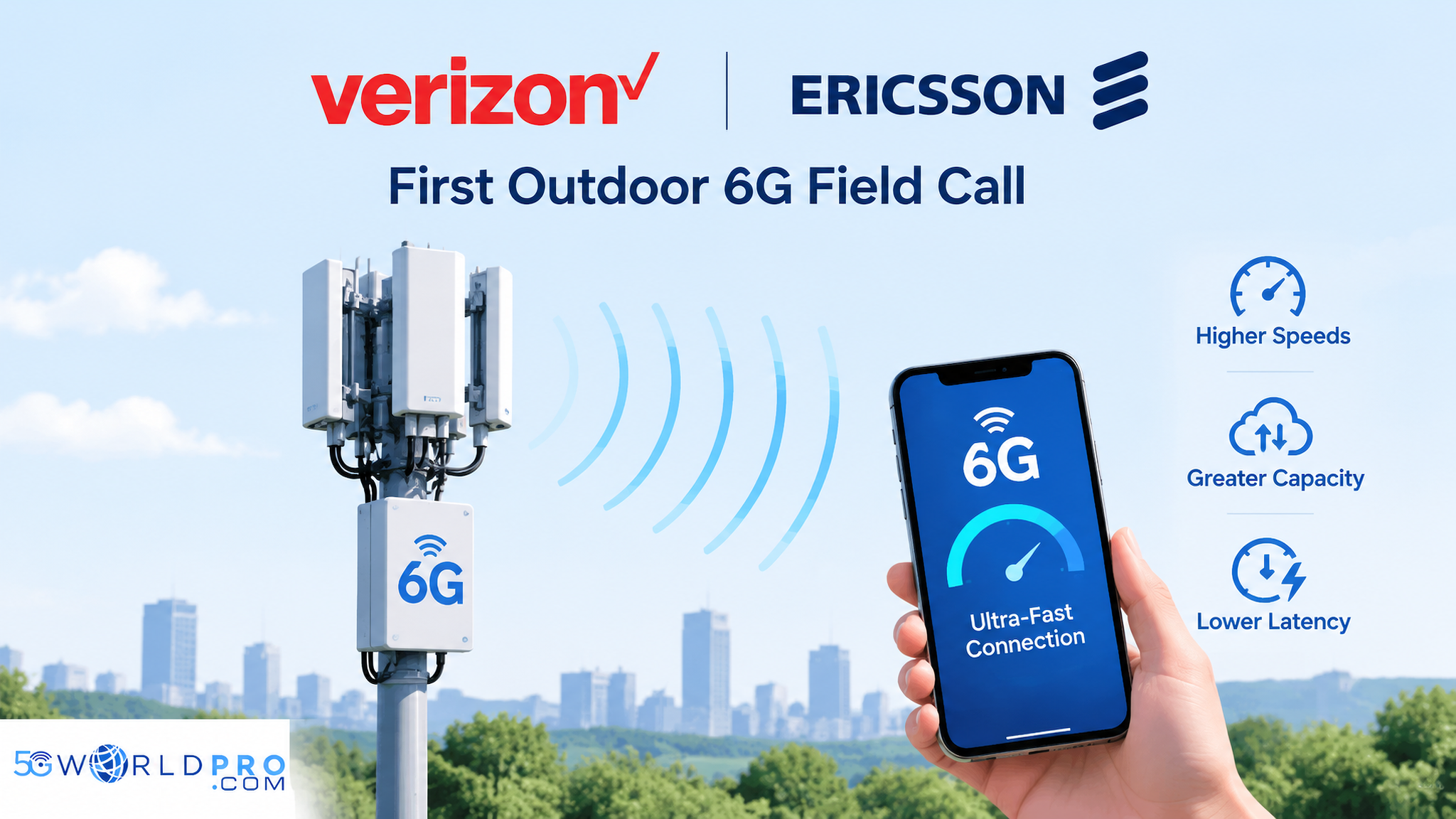
6G just took its first confirmed step out of the lab and onto a live commercial network site. On October 15, Verizon and Ericsson announced what they’re calling the world’s first outdoor, pre-standard 6G field call. This was a proof-of-concept test conducted in the 7 GHz band at a Verizon commercial network site in Concord, California. It’s a genuine milestone. However, the headline claim deserves some context: this is lab-grade 6G hardware taken outdoors for the first time, not a commercial service, and not yet a completed indoor call either.
What Actually Happened in Concord
Ericsson’s proof-of-concept base station was installed inside the site’s equipment shelter. Meanwhile, the corresponding user equipment was housed in a roughly 12-by-8-foot mobile enclosure built with different wall and window materials. This allowed engineers to compare outdoor coverage against outside-to-indoor penetration. The system ran a pre-standard protocol stack over a continuous 400 MHz carrier in the 7 GHz centimeter-wave band. The confirmed result is the outdoor call. The broader test program is still evaluating how well 7 GHz signals travel into buildings.
Yago Tenorio, Verizon’s Chief Technology Officer and SVP of Technology Development, framed the test as part of a close collaboration aimed at generating the technical insight needed to inform how 6G networks could actually be designed and deployed not as a finished answer to that question.
Why the “World First” Claim Needs a Careful Read
This test built directly on earlier groundwork. Ericsson ran an equivalent indoor session using the same band and carrier width at its own Plano, Texas headquarters back in March. Separately, SoftBank and Nokia conducted propagation trials in Tokyo’s Ginza district in January. However, they did so without a 6G protocol stack running on the equipment. That distinction is exactly why industry coverage of the Concord test has been careful to qualify the “world first” claim. It’s the first outdoor test specifically combining a pre-standard 6G stack with real-world conditions. However, it is not the first time anyone has measured 7 GHz propagation outdoors.
Why 7 GHz and Why It Matters for Deployment
The 7 GHz band sits in the upper mid-band range regulators are actively working to clear for mobile use. In the US, the FCC has been reallocating the 6.425–7.125 GHz range originally earmarked for Wi-Fi toward mobile operators including AT&T, Verizon, and T-Mobile. At the same time, regulators are also prioritizing federal system clearance in the adjacent 7.125–7.4 GHz band for high-power commercial 6G use. Europe’s Radio Spectrum Policy Group and the UK’s Ofcom have been running parallel consultations on the same general spectrum range. The 2027 World Radiocommunication Conference is expected to shape how much of the 7.125–8.4 GHz range becomes available for mobile communications globally.
That regulatory backdrop is exactly why outdoor-to-indoor penetration data from this test matters commercially. Upper mid-band spectrum offers more capacity than today’s workhorse bands. However, higher frequencies generally struggle more to penetrate modern buildings. The specific number operators are waiting on how much signal is lost through coated glass at 7 GHz compared with today’s 3.5 GHz deployments. This number will directly shape whether 7 GHz can simply reuse existing macro cell grids or requires a meaningfully denser buildout.
Verizon-Ericsson 6G Field Call Key Facts at a Glance
| Detail | Fact |
|---|---|
| Announced | October 15, 2026 |
| Location | Verizon commercial site, Concord, California |
| Spectrum band | 7 GHz |
| Carrier bandwidth | 400 MHz |
| Confirmed result | Outdoor pre-standard 6G call completed |
| Still being evaluated | Outside-to-indoor signal penetration |
| Prior related tests | Ericsson indoor test in Plano, TX (March 2026); SoftBank/Nokia Ginza propagation trials (January 2026, no 6G stack) |
| Status | Pre-standard proof-of-concept not a commercial launch |
| Broader context | Part of Verizon’s 6G Innovation Forum, which added AWS, Cisco, Intel, Nvidia, and MediaTek in September 2026 |
What This Means for the Industry
6G field validation is accelerating faster than standards work. Testing pre-standard hardware on a live commercial site rather than purely in lab conditions signals operators and vendors are racing to generate real-world propagation data well ahead of finalized 3GPP 6G specifications, data that will directly inform standards discussions rather than simply follow them.
Upper mid-band economics will hinge on indoor penetration results. Whether 7 GHz becomes a practical macro-layer addition or requires substantially denser infrastructure depends on data this test program is still generating. That answer will shape capital planning for any operator eyeing upper mid-band spectrum once it clears regulatory hurdles.
Industry alliances are consolidating around 6G testbeds. Verizon’s 6G Innovation Forum has grown to include major cloud, chipset, and infrastructure players AWS, Cisco, Intel, Nvidia, MediaTek. Founding members include Ericsson, Samsung, Nokia, Meta, and Qualcomm. This suggests 6G field validation work is becoming a coordinated, multi-vendor effort rather than isolated single-company trials.
Frequently Asked Questions
What did Verizon and Ericsson actually demonstrate? A pre-standard 6G outdoor field call in the 7 GHz band at a Verizon commercial network site in Concord, California, using Ericsson proof-of-concept hardware running a 400 MHz carrier confirmed as an outdoor call, with indoor penetration testing still ongoing.
Is this a commercial 6G launch? No. Both companies explicitly described it as a pre-standard proof-of-concept demonstration, not a commercial service.
Why does the 7 GHz band matter for 6G? It sits in the upper mid-band spectrum range. Regulators in the US, Europe, and UK are actively working to clear this range for mobile use. This offers more capacity than current bands. However, real-world data on building penetration is required before deployment plans can be finalized.
Has 7 GHz propagation been tested before this? Related testing occurred earlier in 2026 — Ericsson’s indoor session in Plano, Texas, and SoftBank/Nokia’s Ginza propagation trials — but this is described as the first outdoor test specifically combining a pre-standard 6G protocol stack with live commercial-site conditions.
Going Deeper
Understanding how spectrum allocation, field trial data, and standards timelines come together to shape real 6G deployment decisions is exactly the kind of forward-looking context covered in our 5G training catalog. This includes the standards work bridging 5G-Advanced and early 6G architecture.
Sources: Ericsson press release, PR Newswire, The Fast Mode, FinChannel, DailyCoin, 6G Futures. This article is part of our ongoing coverage of 6G field trials and spectrum developments.
Benefit from Massive discount on our 5G Training with 5WorldPro.com
Start your 5G journey and obtain 5G certification
contact us: contact@5GWorldPro.com