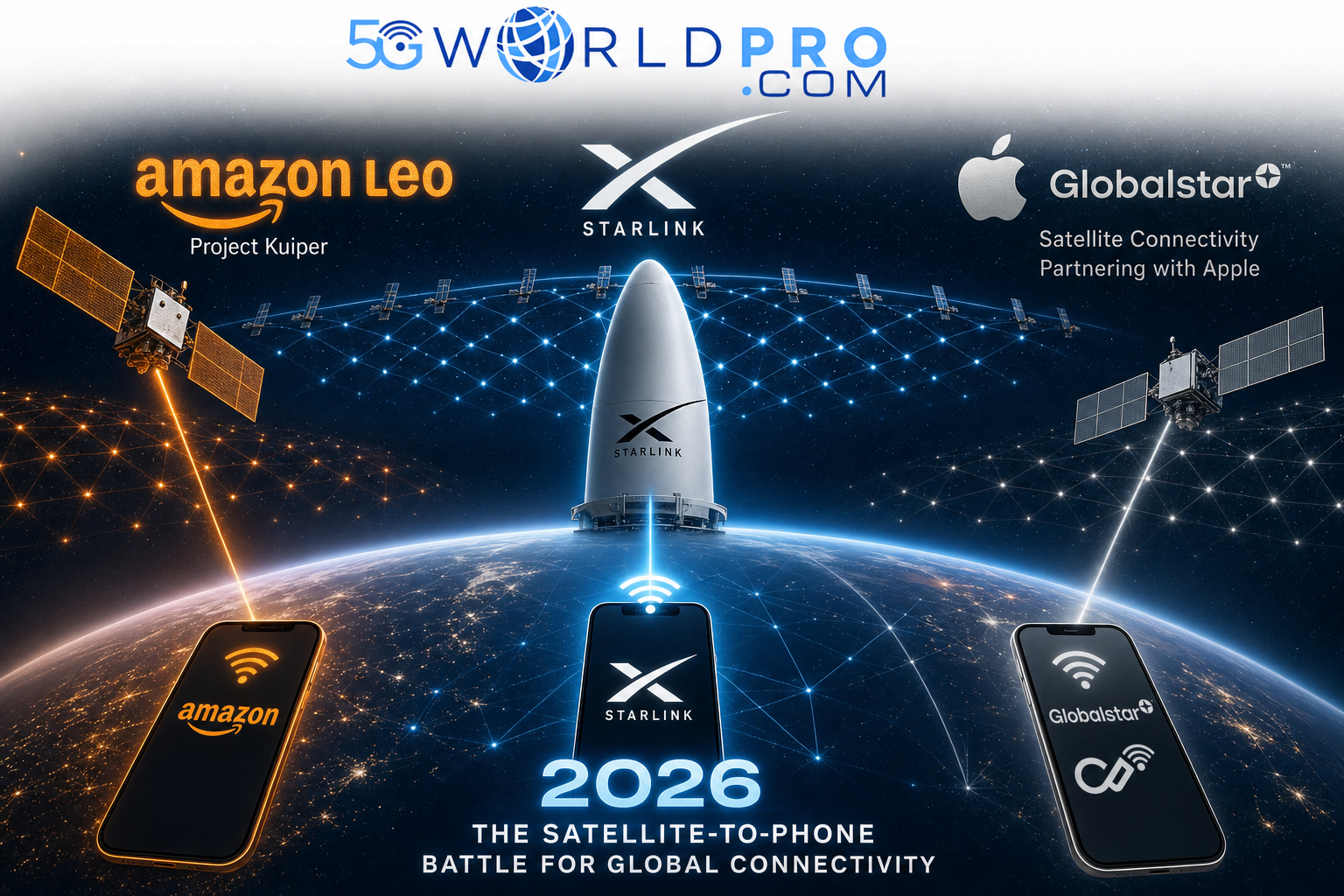
Three of the biggest names in tech are racing to put a satellite between your phone and a dead zone and most coverage treats them as if they’re all building the same thing. They’re not. Amazon, SpaceX, and Apple are pursuing three genuinely different strategies, and a fourth player AST SpaceMobile is arguably closer to the finish line than any of them on the specific question of replacing your carrier.
Here’s what each company is really building, where each one actually stands in mid-2026, and who’s positioned to win which part of the race.
The four players, at a glance
| Company | What it’s actually building | Status (mid-2026) | Direct-to-phone? |
|---|---|---|---|
| SpaceX (Starlink) | Direct-to-cell satellite network, exclusive with T-Mobile | SMS live nationwide; voice in beta; 300+ D2C satellites in orbit | Yes most advanced, live today |
| AST SpaceMobile | Direct-to-smartphone network, multi-carrier | Commercial launch targeted for 2026; partnered with AT&T, Verizon, Orange | Yes broadest carrier backing |
| Amazon (Leo, formerly Project Kuiper) | Satellite broadband, now adding D2D via Globalstar acquisition | ~241 satellites in orbit; Globalstar acquisition announced April 2026, closing 2027 | Yes, as of April 2026 future rollout, not yet live |
| Apple | Emergency satellite messaging feature, transitioning to Amazon Leo | Live since iPhone 14 via Globalstar; will run on Amazon Leo going forward | No a feature, not a network |
SpaceX: the only one with a live cellular replacement today
SpaceX’s Starlink Direct-to-Cell is the most advanced of the four by far, and it’s the only project genuinely designed to work like ordinary cell service no special hardware, no app, just a regular smartphone talking to a satellite the way it would talk to a cell tower.
The rollout has moved in careful phases. SMS beta testing with T-Mobile started in late 2024, expanded to cover most of the continental US by mid-2025 with latency typically under 10 seconds, and included emergency SOS messaging for zero-coverage areas. Voice calling entered beta in late 2025 a much harder technical problem than texting, since it needs sustained, real-time two-way data rather than simple store-and-forward messages. As of early 2026, more than 300 satellites with direct-to-cell capability are in orbit, with new ones added on nearly every Falcon 9 launch. The next and final phase is full mobile data browsing, apps, and IoT connectivity, satellite-delivered.
Amazon: from broadband bystander to D2D contender, overnight
This section needed a rewrite. Until April 14, 2026, Amazon’s satellite constellation rebranded from Project Kuiper to Amazon Leo that November was built purely to compete with Starlink’s broadband service, with no announced phone-connectivity ambitions. That changed in a single announcement.
On April 14, 2026, Amazon and Globalstar announced a definitive merger agreement: Amazon will acquire Globalstar in a deal valued at roughly $11.57 billion, offering Globalstar shareholders $90 per share in cash or stock. The deal, expected to close in 2027, hands Amazon Globalstar’s 24 operational satellites, its licensed L-band and S-band mobile satellite spectrum with global authorizations, and its established direct-to-device expertise folded directly into the Amazon Leo network. According to Amazon’s own announcement, this will let Amazon Leo add direct-to-device services voice, text, and data to future generations of its satellite network, extending coverage for mobile network operators beyond terrestrial reach.
In a concurrent, related announcement, Amazon and Apple agreed that Amazon Leo will power satellite services for supported iPhone and Apple Watch models going forward including Emergency SOS via satellite, messaging, and roadside assistance requests effectively continuing and expanding the role Globalstar already played for Apple, now under Amazon’s satellite umbrella.
As of April 2026, Amazon Leo had roughly 241 production satellites in orbit, a fraction of its planned 3,236-satellite constellation, with commercial broadband service targeted for mid-2026. The Globalstar deal is widely read as a shortcut past years of spectrum-licensing delays one analyst described the move to Forbes as setting up a “battle of the Titans” between Amazon and SpaceX. It also has a competitive side effect: by acquiring Globalstar’s spectrum outright, Amazon takes a meaningful chunk of usable D2D spectrum off the table, a dynamic analysts expect will push SpaceX and AST SpaceMobile to pursue additional spectrum of their own as the space gets more competitive.
The caveat that still matters: this is an acquisition agreement, not a live service. Direct-to-device capability arrives with “future generations” of Amazon Leo Amazon hasn’t given a specific date for when ordinary users will get D2D messaging or calls the way T-Mobile customers already can with Starlink today.
AST SpaceMobile: the multi-carrier challenger
If SpaceX is the furthest along technically, AST SpaceMobile is arguably the more direct long-term threat to how carriers think about coverage. Unlike Starlink’s T-Mobile-exclusive arrangement, AST SpaceMobile has stacked partnerships with AT&T, Verizon, and Orange, and is targeting commercial satellite-to-smartphone launch in 2026. Industry forecasts cited around the space put the potential market at 411 million users and $12 billion in revenue by 2030 numbers that explain why multiple major carriers are hedging their bets with AST rather than leaving the space entirely to SpaceX and, now, Amazon.
We covered AST SpaceMobile’s approach in detail in our dedicated breakdown.
Apple: a safety feature now inherited by Amazon
Apple’s satellite play remains the most limited of the four, by design, even as its underlying provider changes. Emergency SOS via Satellite, available since the iPhone 14, let users send short emergency messages when there’s no cellular or WiFi signal originally powered by Globalstar, and now transitioning to Amazon Leo as part of the April 2026 agreement alongside the acquisition. It’s still not a general-purpose data or voice connection, and it isn’t trying to be. It’s a safety net, not competition for your carrier just running on new satellite infrastructure going forward.
We looked at what the Amazon-Globalstar-Apple arrangement actually means for the wider satellite-telecom industry in our dedicated coverage.
It’s not just a US story: Rakuten’s approach
The satellite-to-phone shift isn’t confined to the US market. Rakuten Mobile in Japan has been pursuing its own satellite-to-smartphone connectivity path, illustrating that this is a global architectural shift in how mobile networks handle coverage gaps, not a single-market competition between four American companies. See our coverage of Rakuten’s satellite rollout for the international angle.
So who’s actually winning?
It depends which question you’re asking:
- Who has live commercial direct-to-phone service today? SpaceX and T-Mobile texting is fully live, voice is in advanced beta.
- Who has the broadest carrier backing for the long term? AST SpaceMobile’s multi-carrier strategy (AT&T, Verizon, Orange) looks structurally stronger than SpaceX’s single-partner exclusivity with T-Mobile.
- Who made the biggest strategic move in 2026? Amazon its agreement to acquire Globalstar instantly hands it D2D spectrum and technology it would otherwise have spent years acquiring, though the consumer service itself is still “future generations” away, not live yet.
- Who’s not really racing at all? Apple its satellite feature exists to keep phones useful in emergencies, not to compete with any network, even as its underlying satellite provider shifts from Globalstar to Amazon Leo.
How does direct-to-cell actually work, technically?
It sounds almost too simple: a normal phone talks to a satellite instead of a tower. Under the hood, it’s one of the harder engineering problems in wireless right now.
Two spectrum strategies exist. The first dedicates spectrum specifically for satellite-to-device use. The second the one SpaceX and AST SpaceMobile both use shares existing terrestrial mobile spectrum, essentially turning a satellite into what more than one industry writeup has called “a cell tower in space.” Sharing spectrum this way is what lets an unmodified phone connect without new hardware or a special app, but it also means satellite and ground networks have to actively avoid interfering with each other through techniques like beamforming, precise power control, and time- or geography-based division of who gets to use the band when.
The physics adds its own complications. A satellite in low Earth orbit moves fast enough that the signal experiences real Doppler shift similar to how a passing ambulance siren changes pitch except here it has to be corrected for constantly, in real time, or the connection degrades. Add in the raw distance between a phone and a satellite compared to a nearby tower, and you get a fundamentally weaker link budget than terrestrial cellular. That’s exactly why texting arrived years before voice, and voice years before full data each step up in bandwidth demand is a harder version of the same underlying physics problem.
How big is this market, really?
Independent market research puts the direct-to-device satellite connectivity market at roughly $965 million in 2026, up from $637 million the year before and projects it growing to around $15.5 billion by 2035, a compound annual growth rate above 36%. Asia Pacific currently leads as both the largest and fastest-growing regional market, with countries like India, Brazil, South Africa, and Mexico flagged as key emerging markets to watch. Mobile device connectivity services account for the largest single segment of that spending, with IoT and machine connectivity close behind as a fast-growing secondary use case.
That scale of projected growth is exactly why Amazon was willing to spend over $11 billion to buy its way into D2D capability rather than build it from scratch and why the spectrum land-grab dynamic described above is likely to keep intensifying through the rest of the decade.
The catch: this isn’t as simple as flipping a switch
Coverage from analysts and industry press through mid-2026 adds an important caveat to the excitement around direct-to-cell: actual adoption is growing, but modestly. Ookla reported direct-to-cell connections rose nearly 25% between July 2025 and March 2026 real growth, but at a pace some industry coverage has described as underwhelming relative to the initial hype. Regulatory spectrum disputes were significant enough in 2025 that industry press has directly called it a year of “spectrum battles,” as multiple satellite operators compete over the same shared-band approach and file conflicting claims with regulators like the FCC.
There’s also a competitive-dynamics angle worth understanding. Direct-to-cell technology, particularly SpaceX’s, effectively lets a satellite operator bypass the billions of dollars carriers like Verizon have spent building physical towers and terrestrial spectrum holdings. That’s part of why AST SpaceMobile’s multi-carrier strategy getting AT&T, Verizon, and Orange on its side rather than being cut out looks like the more carrier-friendly long-term bet, even as SpaceX’s exclusive T-Mobile partnership currently leads on live features. Market geography matters too: the US and Australia are considered especially fertile ground for direct-to-cell given how quickly signal drops off outside major urban centers, while Europe’s denser terrestrial coverage has historically made the case weaker there, even though operators are pursuing it anyway.
Frequently asked questions
Does Amazon compete with Starlink for phone service? As of April 2026, yes in principle Amazon’s agreement to acquire Globalstar gives Amazon Leo the spectrum and technology to add direct-to-device (D2D) voice, text, and data services. The service isn’t live yet; Amazon has described it as arriving with “future generations” of its satellite network, so for now SpaceX remains the only one with a live phone service.
Can I use Starlink satellite service on any phone? Starlink’s Direct-to-Cell works with unmodified smartphones, but as of mid-2026 it’s exclusive to T-Mobile in the US, and features are still rolling out in phases (SMS live, voice in beta, data still to come).
Does Apple’s satellite feature work like Starlink or AST SpaceMobile? No. Apple’s Emergency SOS via Satellite is limited to short emergency messages when there’s no signal it isn’t a general voice, text, or data connection like SpaceX’s or AST SpaceMobile’s services. It was originally powered by Globalstar and is transitioning to run on Amazon Leo following Amazon’s agreement to acquire Globalstar in April 2026.
Which company is closest to fully replacing cell towers with satellites? No one yet, fully. SpaceX/T-Mobile is furthest along on live features today; AST SpaceMobile has the broadest carrier partnerships; Amazon’s Globalstar acquisition gives it a strong long-term position on paper, but its D2D service isn’t live yet.
Going deeper
If you want to understand how this all fits into the broader shift toward AI-native, satellite-integrated networks not just which company is ahead this quarter our 5G training programs cover exactly where satellite and terrestrial 5G/6G architecture are heading next.
Benefit from Massive discount on our 5G Training with 5WorldPro.com
Start your 5G journey and obtain 5G certification
contact us: contact@5GWorldPro.com