The FCC said yes to the fleet. Spectrum, capacity and foreign regulators still have a say
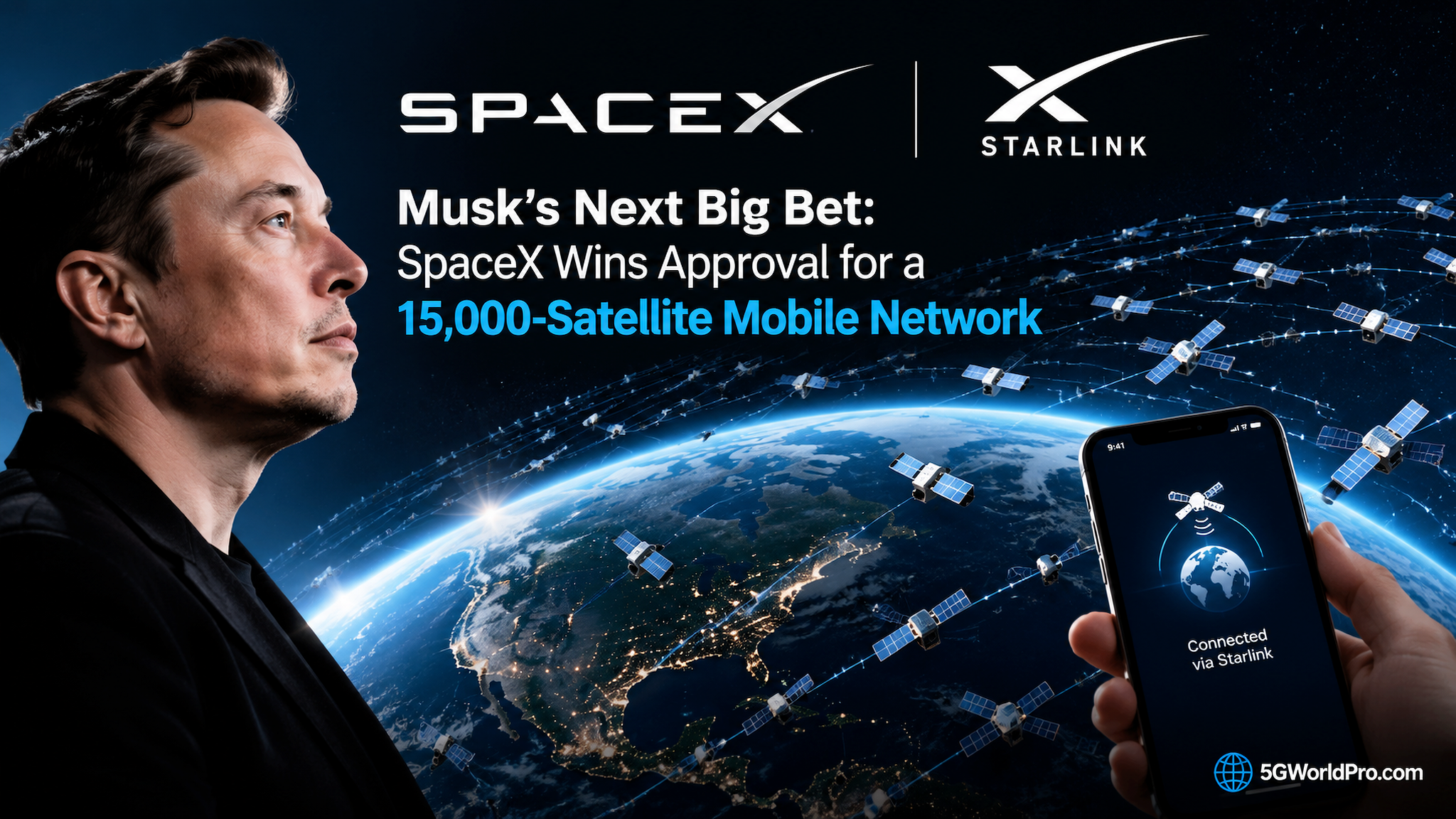
On October 6, the FCC authorized SpaceX to deploy 15,000 new direct-to-device satellites, growing its mobile fleet more than 23 times from roughly 650 today. This SpaceX satellite mobile network is separate from the roughly 10,000 Starlink broadband satellites already in orbit, and it is designed to connect to ordinary compatible smartphones without a dish.
SpaceX is targeting speeds of up to 150 Mbps. Launching the fleet is only part of the story, though. Here are the five hurdles that matter most.

Key Facts
- Approval: FCC authorization on October 6, 2026, for 15,000 mobile satellites (partial: some spectrum requests are unresolved)
- Milestones: 7,500 satellites by October 7, 2032, and 15,000 by October 7, 2035
- Orbit: nine shells at roughly 326–335 km
- Timeline: first launches targeted for 2027, next-generation service in the first half of 2028
- Speed target: up to 150 Mbps peak, versus roughly 4 Mbps-class service today
- Capacity claim: about 20 times the throughput per satellite and over 100 times the network capacity of generation one
- Spectrum today: about 65 MHz from the EchoStar portfolio
Hurdle 1: Spectrum for a SpaceX Satellite Mobile Network
A SpaceX satellite mobile network can multiply satellites, but not spectrum. With 65 MHz, and not all of it usable for downlink, the answer is spatial frequency reuse: thousands of narrow beams let the same frequencies serve different areas.
More satellites mean more beams and more total capacity, but not more bandwidth per user. For example, delivering 150 Mbps in 25 MHz of downlink would require about 6 bits per second per hertz, before overhead. SpaceX has already warned investors that its current spectrum may not be enough.
Hurdle 2: Capacity and Indoor Coverage
Satellites solve geography, not density. Dense cities need far more capacity than a satellite network can easily deliver, and building walls can weaken signals by 10–20 dB or more.
The SpaceX satellite mobile network faces a second constraint: 150 Mbps is a peak figure, shared by every user in a beam. SpaceX has not yet shown how those speeds hold when thousands of phones connect at once, and key specifications such as per-satellite throughput remain undisclosed.
Hurdle 3: The Spectrum Battle on the FCC Calendar
On October 29, the FCC will consider two proposals. One paves the way to auction 25 MHz of additional spectrum, part of it next to SpaceX’s AWS-3 holdings. The other would make 482 MHz of existing mobile spectrum eligible for satellite use, but it would stay controlled by terrestrial license holders.
That means SpaceX would negotiate with the operators it hopes to challenge, and the three big US carriers have just formalized their own satellite joint venture to strengthen their hand. A bigger bidder in spectrum deals could also push prices up for everyone.
Hurdle 4: Launch Cadence and Satellite Lifetime
At just 330 km, atmospheric drag is significant, so satellites must be replaced continuously. A rough estimate: if Starship carried 40 satellites per launch, reaching the 2032 milestone would take about 188 launches. SpaceX has not disclosed the real payload figure, so treat that as an order of magnitude, not a forecast.
Hurdle 5: Rules Outside the US
The FCC approval covers only US authority. Europe is reconsidering its 2 GHz satellite spectrum, with proposals to favor European-controlled operators. India raises questions on spectrum fees and security approvals, and the 2027 World Radiocommunication Conference could reshape global rules.
Satellites are global, but every market still decides who uses its airwaves, so the SpaceX satellite mobile network will need country-by-country approvals.
A Terrestrial Network Next?
SpaceX has said it wants a terrestrial mobile network too. Executives have floated small base stations next to rooftop Starlink dishes, and have also said partnering with carriers is possible. The FCC plans to auction 160 MHz of Upper C-band in April 2027, so spectrum purchases will be the next clue.
Our earlier analysis covers why becoming the fourth US carrier is harder than it sounds, the Starlink Mobile FCC approval and what the FCC clearance means for phone-ready satellites.
The Takeaway
The FCC approval makes the SpaceX satellite mobile network real on paper. Delivering it depends on spectrum, capacity and approvals that SpaceX does not fully control. Musk may be able to cover the planet from space, but replacing the mobile networks already on the ground is a much harder proposition.
Source: FCC authorization of October 6, 2026, as analyzed in Sebastian Barros’ newsletter of October 8, 2026. SpaceX figures are company claims; the launch estimate is a high-level calculation.
Originally published on the 5GWorldPro blog. 5GWorldPro provides specialized 5G training, including coverage of NTN and satellite technologies in our 5G training catalog. Contact us for team training.
Benefit from Massive discount on our 5G Training with 5WorldPro.com
Start your 5G journey and obtain 5G certification
contact us: contact@5GWorldPro.com